Sunday, 5 February 2023

To Dear St Brigid, Ireland's Patroness


Another offering today from the Victorian popular religious press as we continue the series of posts in honour of Saint Brigid. The following poem originated in 'The Irish Catholic', but was syndicated in the Australian press, in this case the Advocate, a weekly Catholic newspaper published in Melbourne.  Our patroness is here depicted in her role as an intercessor for Ireland and its people. Verses two and three ask that she cast her mantle over the people as a protecting shield from unspecified dangers which threaten, just as she sheltered their ancestors from 'cruel foes' in days of yore. Verse four asks that the youth of Ireland be preserved from falling away from the way 'of loyal faith and stern duty', a peculiarly Victorian way of appealing to the young.  In verse five Saint Brigid's intercession is also sought for the dying, with the hope that in the struggle to leave this life she will banish their fears. But it is the final two verses which really reflect the era of the nineteenth-century national revival in which this tribute was written. The penultimate verse, with its naive hope that 'soon' the praises of God and Saint Brigid would be sung in our own dear language, reminds us that the revival of the Irish language was a part of the national movement. In what is presumably an allusion to the shamrock, the poem ends with a soaring statement of the Irish nationalist vision in a request that Ireland will never sever the 'triple leaf' of faith, in prayer and love and duty, to God and country unto death:

To Dear St. Brigid, Ireland's Patroness.

Soft as an angel's whisper
Comes the thought of thee, sweet Saint,
Erin's bride, and gentle guardian,
Free from evil, and its taint.

Come, and with thy mantle shelter
The children of our Isle,
Dangers threaten, O protect them
From the demon's treacherous smile.

'Neath that shield no dart shall pierce them.
Oft of yore it screened from foes
Those who claimed its truthful succour,
In the midst of cruel foes.

Save the youth; the tempter's watching
To beguile them from the way
Of loyal faith and stern duty,
Oh! dear saint, we humbly pray.

Come to those who claim thy succour,
The evening of whose life draws near.
Stay, uphold them in the struggle;
Near thy heart they need not fear.

Soon our "Gaelic tongue" will echo
Thoughts of thee and all thy ways,
In our own dear Irish language
God and thee we all shall praise.

Ask that Ireland ne'er may sever
The 'Triple leaf' of Faith,
Faith in prayer, in love, in duty,
To God and country unto death.

—"Irish Catholic."

To Dear St. Brigid, Ireland’s Patroness,  Advocate, ( March 16, 1901),  p. 2.


Content Copyright © Trias Thaumaturga 2012-2023. All rights reserved.

Saturday, 4 February 2023

Told of St Brigid: Some Legends


One of the most popular types of story associated with the Irish saints are those involving their interactions with the animal creation. The vogue for 'Celtic Christianity' in recent decades has tended to give the impression that Irish saints are unique in this. Yet such stories are associated with saints of the universal church and ultimately go back to the tradition of the Desert Fathers of the east. The Irish however, did put their own stamp on stories involving saints and beasts and in his 2008 study Saints and Animals in the Middle Ages, modern scholar Dominic Alexander devoted a chapter to what he titled 'The Irish Variant'. He includes the story below, which shows how Saint Brigid is as wily as the fox she rescues, taken here from an Australian newspaper account of 1926, but whose original can be found in the seventh-century Life of Saint Brigid by Cogitosus and repeated in some other later Lives. Alexander argues that this story probably originated as a secular tale, as it doesn't quite fit the usual pattern of the animal's 'wild' nature being overcome in its interaction with the saint. As he remarks:

Now this story, it can be argued, exemplifies Christian morality: the saint shows compassion, and the king, who does not, is therefore tricked and punished as a result. Yet the story violates basic patristic parameters when it comes to animal miracles. The animal is obedient to God and the saint up to a point, but its wild nature is clearly in no way compromised by the service it renders the saint. Indeed the proverbial cunning of the fox provides the punch-line of the story. This story looks very much like a secular morality tale than one that would have emerged directly from the ecclesiastical context of hagiographic writing. 

Dominic Alexander, Saints and Animals in the Middle Ages (Boydell Press, 2008), 72.

He goes on though to suggest that due to the popularity of this tale Cogitosus may have felt obliged to include it in his Vita and it remains one of the most popular of the many stories told about Saint Brigid:

Told of St. Brigid.

SOME LEGENDS
.

Many legends testify to St. Brigid's power over the lower creation. Now it is a story of some wild animal pursued by hunters flying for protection to the convent lands, and living ever afterward in a domesticated state with Brigid's flocks and herds. Again it is a picturesque scene, such as the Saint on the brink of a pond with a flight of wild ducks fluttering round her, coming at her call, and allowing themselves to be stroked by her hand. A legend in which Reynard makes a creditable figure is one of the fairest of all.

While cutting firewood one day on the outskirts of a forest, a workman employed by St. Brigid saw a fox straying about, and thoughtlessly killed the animal, not knowing that it was a tamed creature, in whose tricks and gambols the king of the territory took great delight. On learning what had happened, he became exasperated, ordered the poor man to be put to death, and directed that his wife and children should be reduced to slavery.

Shocked at the cruelty of the sentence, the man's friends ran to the Abbess and told her of the unhappy fate awaiting her retainer and his family. Immediately she ordered her chariot to be yoked, and drove across the plain in the direction of the royal rath. 

Passing through the forest, the Saint called to her a fox which she saw running in the distance; and, instantly obeying, it jumped into the chariot and quietly lay down, nestling in the skirts of her habit. Having arrived at the king's residence, she earnestly entreated that the poor man should be liberated from his chains, while she represented that he was not really accountable for what he had done, and pointed out how disproportionate was the heaviness of the chastisement to the lightness of the offence.

The king, however, was inexorable, and declared that the prisoner should not be set free unless a fox equal in cunning and tricks to the one he had lost should be procured. Then, continues the legend, our Saint set before the king and his courtiers the fox which had accompanied her in the chariot, and which appeared to rival the former one in gambols and devices. Seeing this, the king was greatly pleased, and forthwith commanded the captive to be set at liberty.

The Abbess drove to her convent with a glad heart, leaving her late travelling companion in high society at Court, but with no injunction laid on him to give up his free life in the woods and dwell in bondage in the house of kings. So, when Reynard had finished his feats, playing and sporting for the great folks, he adroitly mingled with the outer crowd, and, in an opportune moment, scampering off to the wilds, with the hosts of Leinster behind him, both foot and horse and hound, he speedily regained his freedom and his den. But the king did not go back on his 'bargain, and St. Brigid was held in greater esteem than before.

"Told of St. Brigid." Freeman's Journal, 28 January 1926.

Content Copyright © Trias Thaumaturga 2012-2023. All rights reserved.

Friday, 3 February 2023

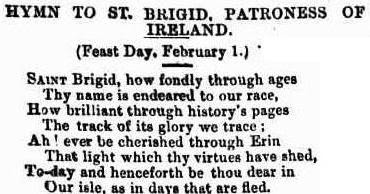
Hymn to Saint Brigid Patroness of Ireland


Continuing the octave of posts in honour of Saint Brigid with another hymn in her praise, a late nineteenth-century offering, published in The Freeman's Journal in Sydney, Australia in 1897.  It is unattributed and as these newspapers often syndicated articles from other sources, it may well have originated in the popular religious press in Ireland itself. Verse three alludes to Saint Brigid's traditional virtues of purity and charity and, appropriately for this blog, the final verse makes reference to her as one of our three patrons. There is even an air suggested to which this hymn could be sung. Initially I didn't recognize 'The valley lay smiling before me' but when I saw that it is also known as 'The pretty girl milking her cow' I realized I did know this melody and was able to try out the lyrics.


HYMN TO ST. BRIGID, PATRONESS OF IRELAND.

(Feast Day, February 1.)

Saint Brigid, how fondly through ages
Thy name is endeared to our race,
How brilliant through history's pages
The track of its glory we trace;
Ah! ever be cherished through Erin
That light which thy virtues have shed,
To-day and henceforth be thou dear in
Our isle, as in days that are fled. 
 
Saint Brigid, how deep the devotion
Long nurtured to thee, the green isle,
Till it 'swelled like the tide of the ocean.
Sunlit — 'neath thy virginal smile;
Oh ! sooner may cease the white surges
To break on her emerald shore,
Than cool the devotion that urges,
Sweet Patron, thine aid to implore. 
 
If, glorious Saint Brigid, the splendour
Of purity beams through our land,
Fair homage to thee should it render
Whose lily waves high in thy hand;
And well may the poor Irish maiden
Rejoice in thy fame and thy name,
White purity's robe thus arrayed in
While burning with charity's flame. 
 
With Columba and Patrick we've named thee
Chief Patron of old Innisfail,
And well have her Annals proclaimed thee
As true to the trust of the Gael;
Then potent protectress, may never
Thy love or thy prayer for us cease,
But our Mary of Erin be ever,
Till reach we the Kingdom of peace.

Air: — The valley lay smiling before me.


"HYMN TO ST. BRIGID, PATRONESS OF IRELAND." Freeman's Journal, 30 January 1897.

Content Copyright © Trias Thaumaturga 2012-2023. All rights reserved.
Thursday, 2 February 2023

Saint Columba's Hymn to Saint Brigid


We begin a series of posts to run until the octave of Saint Brigid's Day with a translation of the hymn Brigit bé bithmaith, one of the earliest Irish language hymns, possibly going back to the seventh century. The preface in the Irish Liber Hymnorum suggests a number of possible authors including Saints Ultan of Ardbreccan, Broccán Clóen and Columba. I have already posted two alternative translations at the blog, one by Whitley Stokes from an 1868 article on Broccán Clóen which you can read here and another here from 1908 where authorship is attributed to Saint Columba. The translation below appeared in the Boston Catholic newspaper The Pilot in 1848, it is much less literal than either of the others, but its rhyming style would have appealed to a nineteenth-century audience. The hymn is also attributed to Saint Columba here by author "J.C.M.":

ST. COLUMBA'S HYMN TO ST. BRIDGET.

FROM THE LIBER HYMNORUM*

Oh, Bridget, Virgin ever bright, 
Oh, golden torch of love and light, 
Rich lamp illumining earth's dark dome, 
Guide us to our eternal home! 
 
Defend us, Bridget, mighty Saint, 
From every evil touch and taint; 
Defend us from all wiles and woes. 
And from our fierce infernal foes. 
 
Create in us, anew, afresh, 
A spirit that shall hate the flesh: 
Oh! Blessed Virgin, Mother, give 
To all new power to love and live! 
 
Thou holiest saint of these our days, 
Worthy unutterable praise, 
Protect green Leinster from all harm 
And keep her sons from vain alarm! 
 
O! pillar of our kingdom, grandest! 
To Patrick next, that chief, thou standest! 
Thou blessed maid, thou Queen of Queens. 
On thee each soul devoutly leans! 
 
And after this vain life be past. 
Oh, let our lot with thine be cast! 
And save us in that last dread day 
When Heaven and Earth shall flee away!

J.C.M.

* “A work more than a thousand years old, if the copy in Colgan’s possession, now in St. Isidore’s, Rome, be the same as that in Trinity College library.

Boston Pilot, Volume XI, Number 40, 30 September 1848


Content Copyright © Trias Thaumaturga 2012-2023. All rights reserved.

Wednesday, 1 February 2023

'The Queen Mother of the Irish Church': A Sermon for Saint Brigid's Day


Marking Saint Brigid's Day 2023 with a sermon delivered in 1915 at Saint Brigid's Church in the Northbridge district of Perth, Western Australia. If nothing else, these stirring, vintage sermons make us aware of how much has changed over the course of the last century. The Venerable Archdeacon Smyth paints a picture of Ireland as a nation faithful like no other, whose people withstand the wiles of proselytisers and whose women are renowned for their virtue.  Saint Brigid he describes as 'the glory of the Irish race' and 'the Queen Mother of the Irish church' and he concludes by urging his expatriate audience to 'invoke her aid with the prayer "St. Brigid, patroness of Ireland, pray for us."' Amen to that and the blessings of the feast to all!

ST. BRIGID— The Mary of Ireland

A Special Day at St. Brigid's, West Perth

Sermon by Archdeacon Smyth

Monday last being the feast of St. Brigid, patroness of West Perth parish, a Missa Cantata was sung at St. Brigid's Church on Sunday last. Last year was celebrated, by a general Communion of the children, the silver jubilee of St. Brigid's schools. Twenty-six years ago the first Catholic school was opened in the parish. It had a small beginning, but in the brief span: between then and now the parish has made rapid strides, and to-day St. Brigid's owns one of the finest blocks of Church buildings that can be found in any Catholic diocese. The parishioners have good reason to be proud of them, and the genial and zealous rector of the parish should draw consolation, in the midst of many worries and exacting duties, from the fact that a fine spirit of faith is to be found in the parish. The feast day of its patroness was observed as a special day, and the Masses were largely attended. The choir, under  the baton of Father Kearin, at the Missa Cantata, which was sung by Father D. B. Verlin, rendered Ravenello's Mass, which was composed in honour of St. Joseph Callasanctius, a saint who had a special devotion for the Mother of God and which was not inappropriate to the feast day of St. Brigid, the Mary of Ireland. The music and the singing gave additional solemnity and devotion to the ceremony.

In the evening the church, was thronged with an expectant congregation, who came to hear a panegyric on the saint by the Venerable Archdeacon Smyth, of Bunbury. It was an eloquent and forceful review of the life-work of the saint, and a fine tribute to the fidelity of the Irish people to the ancient faith.

The Sermon

Taking for his text, "Be just and you shall have everlasting remembrance," the Archdeacon said: The words of the Royal Prophet were as trite as they were true. No man, unless he be just and acceptable to  God, would live in everlasting memory. Our instinct alone told us that fact. And so it was that in the affairs of time we give honour to the just, and we love to cherish the memory of the righteous. Hence the Catholic Church clings to and holds in benediction the memory of those righteous ones who by the sanctity of their lives and their charity have shed a lustre upon the world. Nations and governments are grateful to those who have served them, perhaps not wisely, but too well, and we find them raising costly monuments to their memory — statues of bronze and marble — carved columns and brass tablets, and in other ways with all the magnificence that wealth and human art could employ giving expression to their gratitude and seeking to perpetuate their memories. But how often were such efforts  vain and futile. The years roll, away and time showed that nothing remained of those great ones but the  shadow of a name. Only in the spiritual world, when the Church of  God takes possession of a memory  inspired and sweetened by virtue, only, then did that memory remain and become a permanent legacy to
the world. Where were the memories of the great ones of the Greek and Roman Empires? — where the memories, of Alexander, Cyrus, and Napoleon, meteors who flamed for a moment of time , and passed away—where are they? Who cared! Yet the names of the Patricks and Brigids and the saintly ones of the Church whose lives were devoted to religion and to the inculcation of charity and virtuous living remain. Time passes and centuries roll away, their names live. How true of the Apostles who spread the light of the Gospel and the seed of God; they saw their work of sacrifice and love blossom into fruitfulness that gave new pages to history and glory to the nations. And so it was that out of the centuries that evening came to them the name of St. Brigid, the patroness of their parish, one of the elect of God called by Him to be the glory of the Irish race. They had dedicated everything to her.

Their past and their present enshrined the memory of her whom the Church remembers as the Queen  Mother of the Irish Church — the Mary  of Ireland, and whose feast they would celebrate on the morrow. There was no need to review the story of her life. They all knew her zeal, her righteousness and her love of virtue. Of Royal stock, her supernatural life gave promise of great sanctity. God opened to her mind the future of the great Church she and Patrick founded and nursed and cared for. She saw its failures, its long night of persecution, and its ultimate triumph. Favoured with great personal beauty, she had all the needs that wealth could give her, and she had all the graces of excellent teaching — but above all it was in her beauty of soul she excelled. Her humility, her wisdom and her virtue raised her above all her contemporaries. Her beauty she kept for God; no royal gifts could win her in marriage; she flew to the cloister and consecrated her life to Him. In eloquent words the preacher told how she established her first convent— the Cell of the Oak, and how through many labours and vicissitudes she  worked to bring the little children of Ireland to the feet, of Christ, and through her zeal and her wisdom became the patroness of art and learning. How throughout the land she went at the invitation of Bishops to spread the name of Jesus and to sow the seed of the Christian virtues so that the women of Ireland might be known the world over for their love of chastity. Her name, continued the preacher, is perpetuated in the names of Irish places and her memory, lives in the people's hearts. The ignoramuses of the time may rail at the name of Brigid, but with the Irish race it will always be a holy name. Her long and fruitful life,  from the moment she commenced her missionary work unto the day when at the age of 75 at Kildare she gave it back to her Creator, was one filled with labour, sacrifice and charity. Having, seen in vision by the favour of Almighty God the fruitfulness of her work, how she must, have revelled at the splendor of her labors for the Irish Church and the richness of the harvest of virtue that was to be reaped from the seed of her teaching. So it is that the womanhood of Ireland, treasuring the virtue taught to them by the glorious life of Brigid, had become the mothers of a host of Irish saints. Since her death fifteen centuries had rolled away, and many changes had come over Ireland— her language had been near to being forgotten— customs had vanished, even the physical features of the country, had changed— all things had changed only the Faith that St. Brigid had helped to plant.

Everything perishes but the work of God. Many a nation had been given a privilege as great as the Irish  people, but none have remained so faithful. The day of wrath and persecution came and they grew ashamed of the old faith. But the Irish Church remained in the face of every danger faithful to the teachings of Brigid and Patrick; its women have been the most faithful, and virtuous throughout the ages.

Ireland is a beacon light which beckons to the world with the admonition, "Come here and admire God's work." Her children faced the rack, the scaffold, and the dungeon for their faith. The curse of the reforming invaders tore up her sacred books, broke down her altars, burnt her manuscripts, destroyed her art treasures, and made desolate the land; yet, hunted, proscribed though the Irish were, they kept the Faith. The green sward of Ireland is fertilised by human blood shed for the faith of Jesus Christ planted by Brigid and Patrick. In swift and telling words the preacher sketched the horrors of the famine years and the wiles of the souper to win the starving Irish from their allegiance to the, ancient faith, and recited a touching instance of the fidelity of a little boy, who with his mother was dying of hunger within reach of the souper's kitchens. The mother, tempting him to save himself by accepting the soup of the proselytiser, he, cried, "Mammie, let us go to God — let us die together." Such was the marvellous fidelity which characterised the Irish exiles in founding the Church in the Great Republic of  America, and here in Australia.

Keep the faith, said the preacher in conclusion, love the faith of Patrick and Brigid; show your loyalty to it; it must never be sullied or tarnished or mixed with sin. Love St. Brigid for her purity. Invoke her aid with the prayer "St. Brigid, patroness of Ireland, pray for us." Transmit the faith to your children, and so, being loyal to her, St. Brigid will be with  you in life and in death.

"ST. BRIGID--The Mary of Ireland" The W.A. Record, 6 February 1915.

Content Copyright © Trias Thaumaturga 2012-2023. All rights reserved.

Sunday, 25 December 2022

Saint Patrick's Flowers


It seems strange perhaps to be writing about Saint Patrick at Christmas, but the shamrock is not the only plant to which our national apostle has a link. Below is a poem by Irish-American poet Patrick Joseph Coleman, a frequent contributor to the popular religious press. In this offering from the December 1908 edition of The Rosary Magazine he recounts a legend of Saint Patrick, travelling in France at Christmas time on a visit to Saint Martin of Tours, where he is offered shelter by a thornbush which miraculously burst into flower. Father William Bullen Morris, author of a substantial Life of Saint Patrick, gave a short summary of this story: 

The inhabitants of St. Patrice record an ancient tradition, which in its simplicity is full of freshness and poetry. St. Patrick, it is said, being on his way from Ireland to join St. Martin in Gaul, attracted by the fame of that Saint's sanctity and miracles, and having arrived at the bank of the Loire, near the spot where the church now bearing his name has been built, rested under a shrub. It was Christmas time, when the cold was intense. In honour of the Saint, the shrub expanded its branches, and shaking off the snow which rested on them, by an unheard-of prodigy arrayed itself in flowers white as the snow itself. St. Patrick crossed the Loire on his cloak, and on reaching the opposite bank, another blackthorn under which he rested at once burst out into flowers. Since that time, says the chronicle, the two shrubs have never ceased to blossom at Christmas, in honour of St. Patrick.

When the present writer visited St. Patrice in August, 1881, he was struck by the extraordinary beauty and luxuriance of the foliage on the tree: it was so dense from the ground upwards that it was impossible to distinguish the stem, and he could under- stand how, when it flowers at Christmas, it supplies the country round with trophies of St. Patrick. It also appears that they are objects of religious veneration, as we learn that M. Dupont always kept a branch of the Fleurs de St. Patrice, hung up in his room...

Rev W.B. Morris, Life of Saint Patrick, with a Preliminary Account of the Sources of the Saint's History (4th ed., London, Dublin and New York, 1890), 271. 

Coleman's poetic rendering of the legend sticks very closely to the story recounted by Father Morris but adds a postscript telling us that the thorn bush flowers every Christmas night. Nollaig Shona daoibh go léir!


St. Patrick's Flowers 

By P. J. Coleman 

Beneath the freezing winter gale 
Poured Loire its waves in sullen flow; 
’Twas Christmas Eve, and hill and dale 
Lay mantled deep in snow. 
 
’Twas Christmas, and of Christ, our Lord, 
To hut and hall the church bells told, 
When to the river’s bank there trod 
A pilgrim, faint and old. 
 
A pilgrim, worn with many a mile 
Of weary journey since the dawn — 
’Twas Patrick, Saint of Erin’s isle, 
To Tours of Martin drawn. 
 
At Tours lived Martin, Patrick’s friend. 
Upon the river’s southern shore. 
How shall he gain his journey’s end. 
Or win him passage o’er? 
 
There was no sound of boat or bark, 
Nor fisher’s keel, nor ferry frail; 
Deserted flowed the river dark, 
With not a single sail. 
 
Deserted lay the lonely shore 
Beneath the cruel winter storm; 
No cheering light, no ruddy door 
To give him welcome warm. 
 
Then, while he paused upon the bank, 
Footsore with many a weary league. 
Beneath a leafless bush he sank. 
All spent with sore fatigue. 
 
Now shall he perish in the storm, 
The pilgrim, wearisome and faint; But no! 
A breath of summer warm 
Blows round the sleeping saint. 
 
A breath of fragrance, as if June 
Had culled a rosy coronal, 
And on the gentle saint aswoon 
Had let the blossoms fall ! 
 
And lo! as if the snow-drifts blanch 
Its boughs, — oh, miracle divine! — 
The bush in every bole and branch 
With blossoms ’gins to shine. 
 
And spreads above Saint Patrick’s head 
Its fragrant canopy of bloom; 
Bestrews for him a petalled bed, 
And pillows of perfume. 
 
And draws around, of leaf and flower, 
To shield the sleeper from the storm. 
The woven branches of its bower, 
Its shelter sweet and warm. 
 
So, sheltered by the blessed thorn, 
Slept holy Patrick all the while. 
Until at last the glorious morn 
Across the land did smile. 
 
N. B. — This event occurred at the village of St. Patrice on the northern bank of the Loire. The white-thorn blossoms every Christmas night.

The Rosary Magazine Volume XXXIII, December 1908, 642-643.


Content Copyright © Trias Thaumaturga 2012-2016. All rights reserved.

Tuesday, 4 October 2022

'Twin Souls-Kindred Spirits': Brigid of Kildare and the 'Poverello' of Umbria.


October 4 is the Feast of Saint Francis of Assisi and below is an article syndicated from The Irish Catholic and published in 1930 in an Australian newspaper, which seeks to draw parallels between Italy's 'Poverello' of Umbria and Ireland's 'Mary of the Gael'. The anonymous writer draws on the rich hagiographical traditions surrounding Saint Brigid which s/he describes as 'still more idyllic and wonderful than the “Fioretti” of St. Francis'. Both were 'essentially Saints of the people' and both had poetic souls deeply moved by the wonders of nature. Saint Francis rather fades from the scene though and the author finishes with the story of Sister Dara, a blind member of Brigid's community who is unable to fully appreciate the beauty of creation, but who rejects Saint Brigid's offer to restore her vision. This article is a reminder of the reality that for the past fifteen hundred years the Irish people have honoured Saint Brigid not as a thinly-disguised pagan godess or as an icon of feminism or the environmental movement but as Muire na nGael, the Mary of the Irish. It is also worth noting that the order of friars established by Saint Francis put down deep roots in this country and at the time of the Reformation they kept the memories of the Irish saints alive and themselves contributed many names to the roll of Irish martyrs:

 
THE 'MARY OF THE GAEL.'

Brigid of Kildare and the 'Poverello' of Umbria.

'Beauty of person, beauty of voice, the gift of music, knowledge of embroidery, knowledge of needlework, and the gift of wisdom and virtuous chastity.” — The Six Maidenly Gifts of Emer.

Because of that which ancient Ireland loved best in womanhood, it reverenced and idealised her who is 'our life, our sweetness, and our hope' — the pure and spotless Mother of God — and took her to its heart, since first Patrick spoke of her in the furze-sweet-air of an Irish meadow at Eastertide.

And because Brigid, the Abbess of Kildare, while she yet walked on earth reminded people of 'our tainted nature's solitary boast,' they called her “The Mary of the Gael.”

“She was a consecrated casket,' says the Book of Lismore, 'for holding Christ's Body and Blood. She was a temple of God. She was simple towards God; compassionate towards the wretched; she was splendid in miracles and marvels; wherefore her name among created things is like unto a dove among the birds, a vine among trees, the sun among stars.

“She is the prophetess of Christ: She is the Queen of the South. She is the Mary of the Gael.” 
 
Great Sympathy.

In truth it is a far cry from the fifth to the twelfth, and more than a bird's flight from the misty, lavender hills and valleys of Umbria to the rich, grassy plains of Kildare, but one ventures to say that, separated by centuries, Brigid of Kildare and the Poverello of Umbria were twin souls — kindred spirits: as much alike as the drops of dew trembling in the calyxes of two flowers of different hue, each tinted by its environment.

The keynote of both lives was an intense humanity— an energetic sympathy with all things living and suffering. St. Francis ministered to lepers and kissed their sores as he would have those of Christ. St. Brigid,- “the milk-maid of the snow-white palm,” who, in her father's house, cared for the milk of twelve cows, always made the butter into twelve equal parts, and one large part, in memory of Christ and His disciples. And the large portion went to the poor. Clothes, food— even her father's sword was not spared— for the needy who came to her in crowds.

Of course, she was reprimanded again and again for her prodigality. But the keys of her charity 'hung at the cincture of God, and He did not fail her,' if we may believe all the old Brigidine legends which have come down to us, and which are still more idyllic and wonderful than the “Fioretti” of St. Francis.

Again, the “Little Poor Man of Assisi” did not retire into a desert after his conversion and his Espousals with his Lady Poverty; neither had Ireland's secondary Patroness hidden herself behind the grille of a contemplated life after she heard the “Sequere Me” of the Gospel.

Real and Ideal.

Both were essentially Saints of the people. “In the heart of Francis,” says an old chronicler, “the whole world found refuge.”

Both worshipped at the shrine of the same great ideal, never forgetting “the actual and the real, which the ideal must grow in.”

St. Francis of the “Joculatores Domini” would “lift the hearts of men and move them to spiritual gladness. But 'not from monastic stalls nor with the careful irresponsibility of the enclosed student' did the Saint and his company address the people. They dwelt amongst them and grappled with the evils under which the people groaned.”

So, too, Brigid, ruling in her famed Abbey of Cill-Dara, kept ever in touch with the spirit of the age. The poor, the rich, the unlettered, the book-learned — layman and cleric— had free access to her, and certainly never left without spiritual profit.

Yet another point of resemblance between the 'Mary of the Gael' and the Troubadour of God was their intense love of Nature.

St. Francis, setting out over the hills which lay beyond, Monte Subicio, with the rose-tinted houses  of Assisi smiling in the Spring sunshine, used to sing in sheer joy of spirit. “He recognised the comradeship of the mountain heights and the deep ravines and the shadowy woods, and of the bare, rugged slopes, so strong and bracing, and yet revealing a tenderness where the wild flowers nestle in the rocky soil.”

Was a Poet.

The sight exhilarated and caused some thing akin to rapture in his soul. For he was a poet, born, like the rest of them, “under a dancing star.” He would conquer the world by love and poetry, believing in the light of his glowing idealism, that 'if men could but be brought to gaze upon the beauty of God and His works, they would be impelled to love and serve Him.”

St. Brigid also had the poet-heart. A slender quiver of sun-gold, the young wrinkled leaves bursting from the bronze grey trunks of the Abbey oaks, a bird's call, were so many levers raising her white thoughts to Him Who is Infinite Beauty.

She pitied poor, blind Sister Dara, who could not behold the sights she saw.

One evening, she came upon the latter seated in the cool garden, telling her beads with eyes closed, a sweet, resigned expression on her face.

The garden was a riot of sweet-smelling flowers and herbs, such as monks and nuns used to cultivate in the olden days. There was not a sound save the lowing of kine in the broad, daisy-starred meadows, the occasional bark of a dog, the rustle of a little breeze that had just sprung up among the tall grasses.

It was the sunset hour. The sky, blue as a robin's egg overhead, flushed faintly rose where the sun was sinking. The familiar hills looked far-off — ethereal.

St. Brigid watched it all in silence, with clasped hands. Then she sat down beside the blind nun and forthwith the pair began to discourse of God. . . . Of God and Mary and the angels and saints, and of the beauty of Heaven, which should never pass away. ... In such holy conversation, time flew. The rose faded from the sky and the stars crept out powdering the velvet vault with bits of broken silver.

Touched Sightless Eyes.

But the nuns did not stir. Like the disciples at Emmaus, “their hearts were burning within them” while they spoke together, and neither knew that so many hours had passed.

And now Dawn stole - with grey feet across the sleeping skies' and the sun came up from behind the mountains. Everything was bathed in light. It was an “heure exouise,” throbbing with the splendors of the new-born day.

St. Brigid felt a wave of pity overcome  her as she looked at her blind companion, knowing all this loveliness was shrouded from her.

Then praying, she touched the sightless eyes with her hand and Dara saw.

For a little while Dara looked, entranced with the sun and the blue Wicklow mountains and the trees and the flowers.

Then she turned to her holy Abbess. “Close my eyes again, dear mother,” she said, “for when the world is so visible to the eyes God is seen less clearly in the soul.”

So Brigid prayed again and Dara's eyes grew dark once more:

“Lest His presence in me
Groweth less plain.
Stars, and dawn and sunset
Keep till Paradise,
Here His Face sufficeth
For my sightless eyes.”

— AMO NESCIRI in 'Irish Catholic.'


THE "MARY OF THE GAEL."  Freeman's Journal , August 28 (1930), p. 43. 

Content Copyright © Trias Thaumaturga 2012-2022. All rights reserved.