Showing posts with label Folk Tradition. Show all posts

Wednesday, 31 January 2024

Saint Brigid's Eve


As we approach the feast of Saint Brigid, below is a 1927 account of the celebrations held on its eve in rural Ireland. What is striking about the ritual associated with the Cross, Shield and Veil of Saint Brigid is its entirely Christian character. I have previously posted a 1914 account of the same ritual as carried out in the Omeath area of County Louth here. It would be interesting to know if it still survives anywhere in Ireland today or when it finally died out. Two things struck me, first the central character is a young girl who instructs the male head of the household, an echo of how the female saint addressed rulers and bishops. Secondly, there is an emphasis on the purity of Saint Brigid. In this I see an affirmation of the 1500 year tradition of Saint Brigid as Muire na nGael, type of the Virgin Mary, which is how the Irish people actually related to their patroness.  It's thus a reminder that 'folk tradition' isn't necessarily synonymous with thinly-disguised pagan goddesses, despite the claims to the contrary which surround us at this time of the year.


ST. BRIGID'S EVE.

The Mary of Ireland.
 
QUAINT and beautiful old customs of the early ages of Faith are handed down in the traditions and legendlore of our race. In remote parts many of these survive in actual practice. Some are relics of a pagan past, retained by the first missionaries, when the pagan feast was replaced by the Christmas festival.
 
It would be interesting to trace back the sources of the amusements of Shrove Tuesday, St. John's Eve, and Hallow E'en. These are common to many countries, not to Ireland alone. Some customs peculiar to our own land are still with us, such as the hunting of the wren on St. Stephen's Day, the 'Wake,' the wearing of Shamrock and St. Patrick's Cross on the feast of the Saint. Others have been allowed to die out. The making of the rug of St. Brigid's square cross, the hanging of a ribbon on a handkerchief from the windows on St. Brigid's Eve, and many others have almost disappeared.

The celebrations on the Eve of Ireland's patroness show in what veneration the Saint was held. Her feast was kept as a Holiday of Obligation in the parishes and villages dedicated to the holy virgin. She is called the 'Mary' of Ireland' and is the patroness more especially of the young maidens of the land.
 
As a girl of sixteen, she took the white cloak and veil of religious life, and with her entered eight other girls of similar age. Their convent was founded at a spot called Brigid's town in the Co. Meath.

Brigid was summoned from place to place by Bishops and Abbots. Wherever she went convents — the first to be founded in Ireland — were quickly peopled by young souls desirous of the life of perfection. Fearful that she might leave them for ever, her own people of Leinster demanded her return, and it was there she founded the famous Monastery of Kildare, the Church of the Oak. The fame of her sanctity and miracles drew pilgrims and strangers thither, and one of the largest cities arose on the once solitary plain.
 
Keeping Her Feast. 

The Eve of her Feast was kept in a very impressive way. The preparations were more penitential and austere than festive. Perhaps, for that reason, they do not appeal to our pleasure loving age. But for centuries after the time of St. Brigid they were carried out with great fidelity.

In the country villages and townlands, the people spent their time on the Eve in plaiting the Cross, veil and shield of St. Brigid. The strong grass of the bogs and marshes, or oaten straw was used. Great emulation arose between the different villages, and the most wonderful skill and ingenuity were displayed in the production of these emblems.
 
At dusk, when each family had finished preparations, the people assembled, as was their custom, at some appointed spot.

Now came the most important ceremony of the day. No partiality, no family interest of any kind was allowed to decide the election! The 'Queen' of a 'fair' or a 'pattern' might be chosen for some worldly motive or some human satisfaction, but nothing of that kind entered into this semi-religious ceremony.

This was the choosing of the 'Brigid Oge,' 'the Little Brigid,' who was to preside over the celebrations of the evening. 

Whether the daughter of the chief, or peasant mattered not, she was chosen,  whose life was known to be the most pure and spotless. If she happened to bear the name of Brigid, it was a blessed coincidence. 

When the 'Brigid Oge' was chosen a procession was formed at the head of which she took her place. Prayers were then offered up for the preservation of all present from evil of soul and body until the next Eve of the Saint. Each home was visited. The closed door was incidentally thrown open at the knock of the 'Brigid Oge,' and she was invited to enter.
 
Holding the Cross in her hand she addressed the head of the family and reminded him that the Cross was the emblem of salvation, and that it was by devotion to Christ's Cross and Passion that the Holy maiden Brigid had obtained eternal life. Then, pausing, she asked solemnly, if all in that house would promise to imitate the virtues of St Brigid. When the promise had been given, the 'Brigid Oge' presented the Cross to the head of the family, and at once it was placed over the doorway that it might be a reminder to all.
 
Presentation of Veil. 

Next came the presentation of the veil.

Again the members of the household were admonished to practice the purity the Saint, of which the veil was the emblem, that like her, they might attain their eternal reward. They were asked once more if they would imitate the piety and the purity of Brigid, and on promising to do so the veil was given.

The 'Brigid Oge' then held up the Shield, which she said was the shield of  the true faith bequeathed by St. Patrick and St. Brigid to those beloved children of Eire: It would help them to overcome their spiritual and temporal enemies. All present then bound themselves with the help of God to preserve holy Faith pure and strong until the next Eve of St. Brigid. Then, falling on their knees, they asked for grace and strength to be faithful to their promises.
 
Each house in succession was reached in this way and the same custom repeated. This pious and simple custom was very efficacious in preserving the faith pure and strong during the ages of persecution, when Ireland suffered so nobly for her religion. St. Brigid proved herself to be then — as she will always be—a true friend to her people, ' and a guardian of their spiritual interests.
 
Una Constance, in 'Catholic Pictorial.'

ST. BRIGID'S EVE. (1927, November 10). Freeman's Journal Sydney, p. 35 


Content Copyright © Trias Thaumaturga 2012-2024. All rights reserved.

Saturday, 5 February 2022

A Legend of Donegal


Today we are staying at Saint Brigid's holy well in Donegal to explore another piece of its associated folklore. Whilst rural Catholics cherished holy wells and the rituals which took place at them, the sites themselves were often in the ownership of Protestant landlords who could be hostile to their tenantry's traditions. Such a story is told of the landowner of the site of Saint Brigid's well and it is typical of the type of accounts uncovered by folklore collectors in the nineteenth century. This tale of how the Protestant landlord tries to impede access to the well, only to have a vision of a beautiful maiden hover protectively over it, was published in the American periodical The Sacred Heart Review in 1889. The illustration above is a postcard from my own collection showing Saint Brigid hovering ethereally above the stream at her reputed birthplace of Faughart, in County Louth:

A LEGEND OF DONEGAL.

Not far from the picturesque little village of Stranorlar, renowned as the last resting-place of Butt, the founder of the Home Rule movement, lies a calm, placid sheet of water, known to the peasantry as Loch Lawne. In its southern side, about three feet from the pebbly shore, is the famous well of St. Brigid, surrounded by a mound of small white stones brought from almost every part of Ulster, and surmounted by pieces of linen, sticks, and crutches, left by those who had the happiness of being cured by its healing waters. It has long been considered a pious custom for the pilgrim, on his first visit, to place three white stones on the ever-increasing mound. 

In the year 18 —, the concourse of pilgrims being larger than usual, the owner of the estate on which the lake is situated, under pretence that his crops were in danger of being destroyed, closed all ingress to the holy well. The peasantry became excited; threats were indulged in by some; petitions were made by others, but in vain. He was a man of gentle, but by times (as in the present instance), of stubborn manner. He knew no fear, and threats as well as petitions were entirely disregarded. For three months his hateful mandate was in force. One morning the inhabitants of Stranorlar awoke to find the following placard on the trunk of a large beech-tree, long used for public notices. It was signed by the owner of the estate: 

"FREE ACCESS TO ST. BRIGID'S WELL." 

Many were the suppositions of the pious villagers as to the cause of his relenting; some said that his cattle were all dying; others, that good St. Brigid had sent him a warning from heaven. Be this as it may, a great change had come over him; his toleration was the wonder of all. Pilgrims might trample his oats, break his fences; he would only remark, "I will be nothing the poorer." 

Sitting one evening by his blazing peat-fire, many years after, he said to me: "I will tell you an incident that happened long years ago. You were then a mere boy. One morning I found my fences thrown into the lake. I became angry, and falsely suspecting the pilgrims, I poured forth threats and curses against them, and closed all ingress to the well; I even determined to drain it by means of a channel connecting it with the lake. To accomplish this spiteful work, I chose a clear, moonlight night. Taking a gun and spade, I set out by the shortest route to the well. Judge of my surprise on finding it illuminated as if by hundreds of candles! Trembling, I aimed my gun and fired. Not a light was extinguished; on the contrary, I seemed only to have increased the brilliancy of the scene. As I was pausing, not knowing whether to proceed to the well or return home, I saw a beautiful maiden rising, as it were, from the lake, attired in a long-flowing white robe, girded by a blue sash. On her breast sparkled gems more dazzling than the sun. She glided as I have seen swallows, without touching the earth, and hovered over the well. No doubt it was St. Brigid. . . . I often think of calling on Father C , and joining the Catholic Church." 

He is dead now, but his son, who inherits his liberal spirit, has made an excellent road to St. Brigid's well. And the peasants thereabout tell the strangers that linger on that romantic way the story I have told you.— S.D. in the Ave Maria.

 The Sacred Heart Review, Volume 1, Number 24, 11 May 1889, p6.

Content Copyright © Trias Thaumaturga 2012-2022. All rights reserved.

Friday, 4 February 2022

St Brigid's Well in Donegal


Saint Brigid, like many Irish saints, has holy wells dedicated to her throughout the country. These sites were an important part of popular Irish devotion to the saints, and often involved the performance of set rituals on the saint's feast day plus the use of the well water for therapeutic purposes.  These activities could be rather shocking though to observers from outside the rural Catholic communities which practised them. Nineteenth-century writer Mary Frances Cusack (1829–1899), defended holy wells against the charge that their use and the rituals surrounding them were no more than pagan superstition:

...in Ireland, the people happen to believe that God hears the prayers of saints more readily than their own; and acting on the principle which induced persons, in apostolic times, to use "handkerchiefs and aprons" which had touched the person of St. Paul as mediums of cure, because of his virgin sanctity, in preference to "handkerchiefs and aprons" of their own, they apply to the saints and obtain cures. But they do not believe the saints can give what God refuses, or that the saints are more merciful than God. They know that the saints are His special friends, and we give to a friend what we might refuse to one less dear. Lege totum si vis scire totum, is a motto which writers on national customs should not forget

 M.F. Cusack, An Illustrated History of Ireland (London, 1868), p.105.

The article below is from a 1936 Australian newspaper which describes a Donegal holy well dedicated to Saint Brigid. Interestingly, the emphasis here is less on Ireland's patroness and more on Ireland's experience of religious persecution in the centuries following the Reformation. For this well has an inscribed stone recording that "Father James Gallagher said his last Mass in Penal Days at Tobar Brighde." Although the 'Mass Rock' is the most iconic outdoor setting for Mass in the Penal times, holy wells also served this function and form part of its folklore. There are stories, for example, of strange mists descending at wells which hid the celebrants from the prying eyes of the 'priest hunter'. The account below suggests that in 1936 the popularity of Saint Brigid's well was undimmed, with Sunday the most popular day for visiting:


LINK WITH PENAL DAYS

ST. BRIGID'S WELL IN DONEGAL

In the heart of the Finn Valley, in Donegal, is the Well of St. Brigid. Eager workers from in and around Clady, the nearby little village across the Tyrone border, have now fashioned a grotto near the Well, and placed there a statue of the saint. Below the grotto, in black letters on a white slab, is the simple inscription: "Father James Gallagher said his last Mass in Penal Days at Tobar Brighde."

This Well links the people of the Valley of the Finn with the not too distant days when the heads of priests were bought for a few pounds and the more distant times when the work of saints like Brigid made possible the triumphant bridge that has been built ever the Penal Days. On Sundays there is a constant stream of visitors, and last Sunday made a record. Motor cars, cycles, and horse-drawn vehicles were parked along the road sides.

A circular wall has been built around the well five feet high, with coping stones on top, set in cement. Over the grotto covering there is a construction of rough stones, and on top a Celtic cross. At one side of the well is the raised grotto containing the Saint's statue, and again on the right is another with a statue of Our Lady. 

LINK WITH PENAL DAYS (1936, December 10). Examiner (Launceston, Tas. : 1900 - 1954), p. 9.

Content Copyright © Trias Thaumaturga 2012-2022. All rights reserved.

Sunday, 31 January 2021

Saint Bridget in Ireland


Tomorrow will be the feast of Saint Brigid and the article below describes for an expatriate audience many of the folk customs associated with the feast in the old country, some of which take place on the previous evening. It has been taken from an Australian newspaper of 1919 where it appears to have been syndicated from an American Catholic publication, the Ave Maria. In common with many other pieces on this theme at this time, the writer laments the passing of these traditions, in particular the falling popularity of the name Brigid and notes the adaptation of the homely diminutive 'Biddy' into the rather more polished-sounding 'Bidelia' by the younger generation.  In the nineteenth century 'Biddy' represented the stereotypical Irish peasant girl on music-hall stages and in popular culture so perhaps by 1919 she had had her day. I have never seen the name Bidelia before nor have I come across the other diminutive 'Jetty'. I have though encountered a surprising number of writings on this theme and wonder if it points to an underlying anxiety about the cultural influences of the host nation to which Irish immigrants were naturally subject. This writer ends by linking the folk customs of Saint Brigid's day with those of the eve of the feast of All Hallows and concludes that they are ultimately harmless:
 
St Bridget in Ireland
 
Of all the saints whom the Irish honour, St. Patrick is first and foremost in their affections, but there is another that is held in fond esteem and veneration: Saint Bridget, whose death occurred in the year 528. She is called the Patroness of Ireland. 
 
Old customs are rapidly vanishing in Ireland. Yet still the colleen, on the 1st. February, rises very early in the morning, and churns before the sun climbs in glory over the eastern hill; and if she has finished her work by that time, and hears the lark sing, then folk say that she will have success in all her doings for the year. For the lark is the bird of St. Bridget, ever since it was wont to awaken her in good time for Matins. To all who on the morning of her festival, hear its strains, it is a good omen for the year, also a sign of fine weather. 
 
Most of the oldtime customs associated with "Biddy's Day" — for so the Irish, with that apparently over-familiar, yet deeply reverent and reticent, trait of theirs, term the festival— are fast dying; but in remote places little girls still carry round a "bredogue" — a large doll resembling the "Morena" of the  Hungarian children,  and supposed to represent St. Bridget or Bride. 
 
In far-lying countrysides the folk usually place before their doors a mat made out of peeled rushes, in order that the Saint may come and kneel there to pray for the family. This they also do if there is illness in the dwelling. Irish girls born in February were formerly almost invariably named after the Saint. But to-day the name is no longer in such great favour, and some young women on whom the name has been bestowed have changed it into Bidelia. In the North of Ireland, as in Scotland, Bride is a popular form of the name; and the homely contraction of "Jetty" takes the place of the "Biddy" or "Bridgie" of the other parts of the island. 
 
On the eve of St. Bridget a silken riband is still occasionally placed on the windowsill in honour of the Saint; and is left out all night, during which time it is popularly supposed to grow longer. It is afterwards kept as a panacea for headaches, the cure being worked thus: the riband is drawn thrice round the patient's head, the following words being repeated at each round, "In the name of the Father and of the Son and of the Holy Ghost. Amen!" and then the silk is knotted round the patient's head. 
 
These are a few of the customs in honour of St. Bride, of Bridget, that still linger in the Green Isle, where many kindly folk still put out a plateful of victuals on All Hallow Eve, for the wandering spirits of the dead and all the strange hosts of beings so real to the Irish peasant. If the griddle-cake and bowlful of milk, and the bit of bread and cheese, have vanished by the morning into the maw of some hungry beggar or even cat or dog, the donors are the better of it, and no one is the worse. — "Ave Maria."


 W.A. Record (Perth, WA : 1888 - 1922), Saturday 22 March 1919, page 8


Content Copyright © Trias Thaumaturga 2012-2021. All rights reserved.

Sunday, 24 December 2017

St. Bridhe of the Mantle - A Legend of Saint Brigid at Christmas


St. Bridhe of the Mantle.

LEGEND OF THE MARY OF IRELAND.

The following legend is told of St. Brigid, whose feast is celebrated on February 1:

In Ireland this saint is sometimes called 'St. Bridhe of the Mantle' because of the way she came to be at Bethlehem when Our Lord was born.

When she was a tiny child she came to the Island of Iona with her father, Donell Donn, a prince of Ireland, who was banished from the country. He took the child and left at night in a small boat. They were washed up by the storm on the coast of Iona, where they settled and made their home.

When Brigid was 21 years old, one day, as she climbed the hillside, a white bird called her from the thicket and she followed him over the crest of the hill to find herself in a strange country. Here no green fields and pastures met the eye; it was a country of sand and hot sun close to Bethlehem. Her father was with her, and as they came to the village he said: 'Bridhe, the drought has been upon the country for many months. The wells are empty, the wine is failing, and our cattle are dying. I shall leave you in charge of the inn to-night and go to a place near the Mount of Olives where they say the
well is never dry.'

"And what shall I do while you are away?" asked Brigid.

"Stay in the inn," he said, "and don't open the door to a soul."

"But what if they ask for food?" she said.

"There is only enough for yourself," he told her. 'And be sure to keep the promise and not shelter anyone until I return."

He then drove off with his camels, and for two days nobody called at the inn. But on the third night, as Brigid was getting ready for bed, there came a knock at the door.

"Who is it, and what do you want?" she asked without opening the door.

A man's voice replied: "I am Joseph, a carpenter of Nazareth, and I have Mary with me, who needs shelter."

"That I cannot give as I have promised not to. Were it not for that I would gladly give you welcome."

Then the woman's voice called from the darkness and Brigid could not resist the sweet pleading of her voice.

She opened the door wide and bade them enter, laying before them all the food she had left. But she could not break the whole of the promise she had made to her father, and so led them to the stable in the courtyard, where they sought shelter for the night.

As she hurried back to the inn she found that her father had arrived, and sorrowfully she told him what she had done. But when they looked at the dishes that were empty, behold they were as if they had not been touched, and at once they realised that a miracle had happened.

Outside came the sound of falling rain.

''The drought is broken!" said Donell Donn. Then they remembered the prophecy:

'The King of  Love, Ruler of the World and All Time, shall be born on the first night of rain following the great drought, and He shall be born in a byre outside an inn.'

They hurried out to see, and there on the hay lay the newly-born Child. Brigid took Him lovingly and wrapped Him in her white mantle, and all, through the night she cradled Him in her arms. At daybreak, the white bird called again, and when she looked about her she found herself on the crest of the holy hill once more, with the green fields and pastures full of sheep and the blue bay of Iona at her feet.

"'Tis all a dream," she said. But she looked at her mantle and saw that it was woven with gold threads into marvellous pictures of birds and beasts and angels. Slowly she went down the hill, and when she came to her father's hut she found that she had been gone for a year and six months.


St. Bridhe of the Mantle. (1935, December 26). The Catholic Press (Sydney, NSW : 1895 - 1942), p. 6. Retrieved December 19, 2017, from http://nla.gov.au/nla.news-article104498977

Content Copyright © Trias Thaumaturga 2012-2017. All rights reserved.

Wednesday, 15 June 2016

Saint Colum Cille and the Mulroy Fishermen


One thing that I have learnt since I started researching the holy men of Ireland is that it really does not do to cross the saints or fail to be anything other than completely open with them. In the story below, taken from Henry P. Swan's Romantic Stories and Legends of Donegal, we see what happens to the fishermen of Mulroy bay when they begrudge Saint Colum Cille a share of their catch:

A Legend of Mulroy Bay

While fish abound in the waters of Lough Swilly on the right hand and Sheephaven on the left, they are exceedingly scarce in Mulroy Bay. This is the story explaining it.

It happened on his travels through Donegal that Saint Columcille came to Mulroy. Now the fishermen saw him coming and as they had only caught two salmon they grudged a gift to the saint. So one of them said "Hide the fish. We have none to spare if he does be asking us."

When Columcille came to them, he blessed them and their work and asked, "Did you catch any?" The replied that they hadn't but the saint knew that it was a lie, so he said to them, "if you didn't catch anything may you catch now; and if you did catch, may you never catch again."

From that day to this, scarcely a trout or salmon has been caught in the waters of Mulroy Bay.

H. P. Swan, Romantic Stories and Legends of Donegal, (Belfast, 1965), 157-158.

Today, however, Mulroy Bay is a centre for aquaculture, particularly salmon farming!

Content Copyright © Trias Thaumaturga 2012-2016. All rights reserved.

Tuesday, 14 June 2016

Colm Cille agus Na Mic Ó gCorra

Another story of Saint Colum Cille with a Tory connection - the curious tale of the Mic Ó gCorra. Here we see the saint turning those who opposed him to stone. There are some photographs of the rocks, which seem to be known a whole lot less colourfully in English as the Stag Rocks, here.  Linking natural physical features in the landscape with tales of the saints is found all over Ireland. This particular story was collected as part of a project on the devil in Donegal tradition and published in Béaloideas, the Journal of the Folklore of Ireland Society, at the end of the 1980s. A summary in English was included by the authors. It looks like the Mic Ó gCorra live on for another generation in the children's book by Donegal author Proinsias Mac a'Bhaird (see cover on the left):


20. Na Mic Ó gCorra

Bhí triúr deartháireacha orthu seo a dhíbir Colm Cille san am sin a dtugadh siad na Mic Ó gCorra orthu agus rinn sé trí chreag daofasan agus tá siad le feiceáil ansin ina seasmah go dtí an lá inniu. Deirtear go rabh oiread feirge orthusan le Colm Cille agus go dtógann siad a gcuid seoltaí uair achan bhliain le pilleadh ar Thoraigh le muintir Cholm Cille a bhruith agus a dhódh ach comh luath agus a títhear iad, caithfidh siad a gcuid seoltaí a ísliú arís agus tá siad ansin ó am  Cholm Cille. Tá muid uilig ag dréim nach bhfaghann siad bogadh choíche nó dá mbaineadh siad Toraigh amach bhéarfadh siad drochbhail air agus ar a bhfuil fágtha ann.

20. The Mic Ó gCorra
Colmcille turns three brothers called the Mic Ó gCorra into three rocks. They are said to hoist sails once a year to return to Tory and kill all its inhabitants, but as soon as they are seen they must lower them again and turn to stone once more.

S. Ó hEochaidh agus L. Ó Laoire,  'An Diabhal i Seanchas Thír Chonaill',  Béaloideas Iml. 57 (1989), 37, 86.


Content Copyright © Trias Thaumaturga 2012-2016. All rights reserved.

Monday, 13 June 2016

Colum Cille Banishes Rats from Tory


Yesterday we were told in the account of Saint Colum Cille's winning of Tory Island that he decreed that no dog should be brought there. Dogs are not the only animals he banished and below is an an account of the reputation the island developed as being free from rats. It doesn't seem to have had a monopoly though, as the island of Inishmurray claimed the same status:

Rats banished from Tory

When Columcille arrived on Tory, he met with some opposition in his efforts to convert the people. The first man to stand by him was a dark man, and to him he gave the name of Dugan.

Then the saint banished all the rats from Tory and conferred the same miraculous power on Dugan. To this day, in spite of the many ships that have been wrecked on the island through the centuries, there are no rats on Tory.

It is said that a sceptical atheist from Derry once brought a box of rats to the island, but they all dropped dead a few minutes after landing. Inishmurray was also freed of rats by the saint, according to an old story.

People often journeyed many miles from different parts of the mainland to these two islands to obtain some clay. This they used to get rid of rats when they were bothered with them in their own home.

H. P Swan, Romantic Stories and Legends of Donegal (Belfast, 1965), 155.

Content Copyright © Trias Thaumaturga 2012-2016. All rights reserved.

Sunday, 12 June 2016

Saint Colum Cille Wins Tory Island

Yesterday we looked at an account derived from oral tradition preserved in the archives of the Irish Folklore Commission on how Saint Colum Cille came to bring Christianity to Tory Island. Below is another account derived from the Life of the saint written in the sixteenth century by Donegal chieftain Manus O'Donnell. The essentials of the story remain the same in that Saint Colum Cille wins the territory by imitating the miracle of saint Brigid's cloak, but here he has some opposition from other holy men:

E.Getty, U.J.A. Vol. 1 (1853)


It is generally understood that Saint Columba, influenced, most probably, by a desire of securing a safe and calm retreat in his own part of Ireland, first introduced Christianity into this remote island of the ocean.  Colgan, in the Trias Thaumaturga, introduces what he denominates " the fifth life of the holy Columba, briefly extracted from the one that Magnus O'Donnell, chief of Tirconnell, wrote out from the original volume in Irish : — translated into Latin and divided into three books."  From this work it may be interesting to extract the account of the dedication of this island. "This servant of Christ," says the legend,  departed thence, [Gartan,] into the part of the country commonly designated Tuatha, (the territories,) in the northern plain on the sea coast of Tirconnell. Being there admonished by an angel of the Lord to cross into Tory, an island in the open sea of those parts, stretching northward from the mainland; and, having consecrated it, to erect a magnificient church; he proceeded towards it accompanied by several other holy men. On reaching, however, Belach-an-adhraidh, "the way of adoration, — a high precipitous hill that lay in his course, whence Tory is ob- scurely visible in the distance,— there arose dissension amongst these holy men, with respect to the individual who. should consecrate the island, and thereby acquire a right to it for the future: — each renouncing, from humility and a love of poverty, the office of consecrator and right of territory. After discussing the question in its several bearings, they all assented to the opinion of Columba, that such a difference was best settled by lot; and they determined on his recommendation to throw their staves in the direction of the island, with the understanding that he, whose staff reached it nearest, should perform the office of consecration, and acquire authority over Tory. Each throw his staff, but that of Columbkille, at the moment of issuing from his hand, assumed the form of a dart or missile, and was born to the island by supernatural agency. The saint immediately called before him Alidus, the son of Baedain, toparch of the island, who refused to permit its consecration, or the erection of any building. He then requested him, at least, to grant as much land as his outspread cloak would cover. Alidus readily assented, conceiving the loss very trivial; hut he had soon reason to change his opinion, for the saint's cloak, when spread upon the ground, dilated and stretched so mueh; by its divine energy, as to include, within its border, the entire island. Alidus was roused to frenzy by this circumstance, and incited or hunted upon the holy man a savage, ferocious dog, unchained for the purpose, which the latter immediately destroyed by making the sign of the cross. The religious feelings of Alidus were awakened by this second miracle, — he threw himself at the saint's feet  asked pardon, and resigned to him the entire island. No further opposition being made, the blessed father consecrated Tory, and built a magnificent church, which he placed under the control of Ernanus, one of his disciples, surnamed, from this circumstance, Torracensis. Amongst other things, the saint commanded that no dog should ever again be introduced into the island.

E. Getty, The Island of Tory; Its History and Antiquities, Part III. Ecclesiastical Period, Ulster Journal of Archaeology, Volume I (1853), 149-150. 

Content Copyright © Trias Thaumaturga 2012-2016. All rights reserved.

Saturday, 11 June 2016

How Colum Cille Converted Tory Island

Ulster Journal of Archaeology (1853)


Saint Colum Cille is still vividly remembered in Gaelic speaking parts of both Ireland and Scotland, a connection which has been explored in recent years by organisations such as Slí Cholmcille.  He features prominently in the folk tradition of his home county, Donegal, and below is a story of how he converted the people of Tory Island/Oileán Thoraí off the Donegal coast. It comes from the archives of the National Folklore Collection of Ireland and was a collected in the 1930s from a 76 year old man living in County Mayo. It is interesting to see here echoes of the well-known story about Saint Brigid's cloak which similarly expanded miraculously to encompass enough land for the saint's needs when she was looking for a site on which to build her monastery at Kildare:
Columcille often tried to convert Tory island but the chief of the island would not let him. Then Columcille thought of a good plan and asked the chief to let him convert as much as his handkerchief could cover. The chief thought that wasn't much ground so he granted the request. Columcille put his handkerchief under his feet and it began to spread until it covered the whole island. The chief had to keep his word so in that way Columcille converted Tory island.
We will explore some more of the Colum Cille traditions of Tory Island as we continue with the series of posts to celebrate the octave of the feast.


Content Copyright © Trias Thaumaturga 2012-2016. All rights reserved.

Wednesday, 3 February 2016

Teagasc Bhríde - Brigid's Instruction

Gaelic Journal, Vol. 4, No. 46 (1893)
We continue the octave of posts in honour of Saint Brigid with a look at one of the lesser-known poems preserved in the oral tradition - Teagasc Bhríde - Brigid's Instruction or Teaching. Daphne Pochin Mould on page 67 of her 1964 study of Saint Brigid introduces it thus:
A fairly long poem called Brigid's Instruction, Teagasc Bhríde, was known throughout Ireland from at least the beginning of the 18th century. Fragments have been collected from Irish speakers at the beginning of the present century. Brigid appears to the author of the poem and explains that she has been allowed back to earth to give him the instruction that will bring him to the City of Glory, where Jesus Christ sits with his mother beside him.
Ireland's first President, Dr Douglas Hyde (1860-1949), took down a version of the poem from a monoglot Irish speaker, Martin Rua O Gillarná from Lisanishka near Monivea, County Galway, and included it in the first volume of his Religious Songs of Connacht. I have reproduced only the English translation as I don't have time to transcribe the Irish original from the old script. The volume is available online if you wish to see both versions on facing pages. The illustration on the left is from another version referred to by Hyde in one of his footnotes. Somehow I doubt that Brigid's Instruction will have much appeal to either the neo-pagan followers of the goddess Brigid or to the contemporary followers of 'Celtic Christianity'. What we have here is an expression of an older strain of popular Irish Catholicism altogether:

BRIDGET'S COUNSEL.

The teaching of Breed for his good to the sinner,  
To take his father's advice and blessing, 
To plead for ever with Mary Mother, 
A guiding-star to our foolish women.

The Son of the Woman who earned no scandal, 
 The Son who never forgot the Father, 
 It was He himself who made our purchase, 
 And through His side that the lance's thrust went. 

 The poem goes on to say of those who have no pleasure in alms or in mercy : 

 The darkest night in this world at present 
 Dark without mist or stars or moonlight, 
 Is brighter than their day when brightest. 

 Could you come with me but once, and see it, 
 You would sooner be hacked in little pieces, 
 Be boiled, be burned, and be roasted,
Be put in an oven till you had perished, 
 Be ground in a quern with hundreds grinding, 
- Sooner than live in a sin that is mortal. 

 Go to Mass when you rise at morning, 
 As you should do, regard the altar. 
 See, Christ Jesus is thereby standing, 
 In the priest's hand is His sacred body. 

 Go home again when that is finished, 
 Give wanderers lodging until the morning, 
 Food and drink to him who is empty. 

 Is your friend ill, or on sick-bed lying, 
 Bring him whatever will give him comfort, 
- Never earn the curse of widow. 

 When to your bed you get at night-time 
 Go on your knees your prayers repeating, 
 Do the same when you rise next morning.

 What the poem chiefly teaches is to do good deeds : 

Do good deeds without lie or falsehood, 
 Do without lie good deeds on earth here, 
 That is the one straight way to follow, 
 That is the road, and go not off it.

D. Hyde, ed. and trans., Abhráin Diadha Chúige Connacht or The Religious Songs of Connacht, Cuid I (London and Dublin, 1906), 96-101. 


Content Copyright © Trias Thaumaturga 2012-2016. All rights reserved.

Saturday, 7 February 2015

Saint Brigid's Feathered Servant

The dandelion was called Bearnain Bhrighide - "the serrated flower of Brigid" (it begins to flower on her day). The linnet is big-ean Bhrighide - "the little bird of Brigid" (it begins to sing on her day), and the oyster catcher is called giolla Bhrighide, "the servant of Brigid".

An Claidheamh Soluis, Jan. 25, 1908, quoted in 'St. Brigid in Tradition and Art', The Furrow Vol. 3, No. 2 (Feb., 1952), p. 4.

Content Copyright © Trias Thaumaturga 2012-2015. All rights reserved.

Monday, 2 February 2015

Brighid na gCoinneall - Brigid of the Candles


St Brigid is called the Mary of Ireland. Numbers of most beautiful legends cluster around her fame. She was the attendant woman of the Virgin and the foster-mother of Christ. She carried two candles before the Virgin at the Purification, hence she is called Brighid na gCoinneall - Brigid of the Candles - and her feast was Candlemas. Her crosses, indeed, are sometimes called Candlemas Crosses.

...On her day Winter is chased away, and life is breathed into the earth. At Candlemas a candle less is required, the days are so much longer.

An Claidheamh Soluis, Jan. 25, 1908, quoted in 'St. Brigid in Tradition and Art', The Furrow Vol. 3, No. 2 (Feb., 1952), p. 4.

Content Copyright © Trias Thaumaturga 2012-2015. All rights reserved.

Friday, 21 March 2014

Saint Patrick and the Miraculous Yield of Milk

Alongside the scholarly works about Saint Patrick and the devotional items published in the Victorian religious press, our national apostle also flourished in popular tradition. I'm currently reading an anthology of folklore, translated from a collection first published in Irish in 1952. The tales have a distinctly religious flavour and so the three patron saints of Ireland are well represented. I was interested by the following episode featuring Saint Patrick, as miracles involving milk are more usually Saint Brigid's domain. This one was collected in County Mayo and as the notes remind us, 'A common theme in folktales is an abundance of food being given to a poor household after a visit from a saintly person'. Particularly enjoyable is the obvious anachronism of the men sowing potatoes, centuries before this crop was introduced to Europe:

70. The Miraculous Yield of Milk

At the time Saint Patrick was going around working miracles, he came in to an old woman on a fine spring day. The old woman was very good-hearted. He asked her for something to drink and she said she had very little, that the cow was nearly dry but whatever drop she had she'd give him, and welcome. She told the servant-girl to go out and milk the cow for whatever drop she might have; and she was taking a small vessel with her.

'Bring a fine big vessel with you', said Saint Patrick.

She was very surprised at that, but she brought a can with her and the girl didn't leave the cowshed until she had filled the can from the cow. There were three or four men working there, sowing potatoes, and she called them in so that they could drink their fill of milk, more than they ever drank from a single cow in their lives before. And they were very pleased with the amount they got to drink.

Before that time, cows never gave more than the full of their horns of milk.

Seán Ó Súilleabháin, editor, Miraculous Plenty- Irish Religious Folktales and Legends, (Dublin, 2012), 166-167.

Content Copyright © Trias Thaumaturga 2012-2015. All rights reserved.

Monday, 24 December 2012

Patrons in Poetry: Saint Brigid's Lullabies

Below is a poem by Ethel Rolt-Wheeler (1869-1958) which draws on the legend that Saint Brigid assisted at the birth of Christ, an event made possible by her miraculous transport to Bethlehem. The author also wrote about Ireland's patroness in her 1913 work, Women of the Cell and Cloister, which is available to read through the Internet Archive here. There she examines Saint Brigid in relation to two themes - milk and fire. Rolt-Wheeler's work is representative of the various influences which went into the 'Celtic Revival' and she embraces the idea of Brigid goddess and saint, a concept which modern scholarship is starting to question.


ST BRIGID’S LULLABIES

(The Legend tells that Brigid was the Foster-Nurse of Jesus.)

I.

FIRST I kiss the eyelids sweet
Little eyes that soon shall know
All the dark of human woe
Peace that comes when sorrows seize us
Fill the dreams of Baby Jesus.

Then I kiss the little feet
Hard your way, and sharp and fierce
Little feet the nails shall pierce.
Hope that lifts and Faith that frees us
Guide the feet of Baby Jesus.

Then the kisses I repeat
On the hands in slumber curled
Little hands that hold the world.
Love whose circling arms appease us,
Cradle softly Baby Jesus.

II.

The burning blight of the midday might on meadow and city falls,
And shadow fails, and a Terror pales the dazzle of eyeless walls,
Fierce stifling gusts of the desert-dusts up lanes and up alleys beat
And all things gasp in the fever grasp of the merciless hands of Heat.

I chant the tune of a mountain rune to screen my Babe from the glare.
And spells I weave of the dews of eve and of Ireland's radiant air,
I loop a twist of her rainbow mist, and a film of her twilit skies,
And silver strains of her rills and rains through the liit of my lullabies.

As low I croon of the pale green noon and the long Atlantic roll,
It sometimes seems as if Ireland's dreams may slide into Baby's soul.
That in the prime of a future time, on my hills and my isles remote
His words of speech all hearts shall reach with a sweet familiar note.

ETHEL ROLT-WHEELER.

The Dublin Review, Volume CLV, Quarterly No.310, 311; July-October 1914, 60-61.

Content Copyright © Trias Thaumaturga 2012-2015. All rights reserved.

Thursday, 13 December 2012

Saint Brigid and Saint Lucy


December 13 is the feast of Saint Lucy of Syracuse, an early virgin martyr whose feastday is still celebrated in Lutheran Sweden. There is a good illustrated summary of the Swedish celebration of Saint Lucy here. According to a modern scholar of Irish folklore, the cult of Saint Lucy may have directly influenced the cult of our own Saint Brigid, both in the use of the hagiographical motif of the plucking out of the eyes and in some of the ways in which Saint Brigid's day was celebrated in popular culture. Dr Dáithí Ó hÓgain writes:

Narratives of Brighid were developed through medieval times by further additions from Continental hagiography. A ninth-century text describes how a man comes to woo the young, and as yet unprofessed, Brighid. Her stepbrothers try to compel her to accept the marriage, but she knocks out one of her eyes so as not to be attractive to the suitor. When the family allow her to remain a virgin she miraculously restores sight to herself. The story is repeated in later sources, and it survived in the recent folklore of north Leinster and south Ulster. The name of the suitor, Dubhthach mac Lughair, is borrowed from the early Patrician texts, and it is obvious that the story cannot be older than the eighth century. It was, in fact, taken from the lore of the continental saint Lucy and was suggested by the symbolism of light associated with both of these holy virgins. It is apparent that the cult of Lucy influenced that of Brighid in other ways also in medieval times. Lucy's feastday, December 13, coincided with the winter solstice in the old calendar and was thus seen to usher in the lengthening of daylight. In Irish the saying which refers to Brighid's feastday, February 1, is that 'from Brighid's feastday onwards the day gets longer and the night shorter', although in fact that change occurs from the winter solstice, and the presumption must be that this saying was in origin a rather inaccurate borrowing from the Lucy lore. It could well be, also, that some of the paraphernalia associated with the feast of Brighid in Irish folk life - such as processions of young girls with the leader dressed up as the saint - shows the influence of the Lucy cult, which was very popular in western European countries in the Middle Ages.

Dáithí Ó hÓgain, Myth, Legend and Romance: An Encyclopaedia of the Irish Folk Tradition (Ryan, 1990), 62-63.


Something else which struck me as I looked at the picture above of a celebration of Saint Lucy's Day in Sweden in 1943, was that the round headdress of candles worn by the young girl representing the saint has echoes of another tradition associated with Saint Brigid - her connection with the feast of Candlemas:

Ireland: Folklore

108. A Legend of St. Brigid

In further reference to the spring feature of Saint Brigid I am indebted to Miss Delap for a curious legend from Valentia Island which, with fine disregard of chronology, makes Saint Brigid a friend of the Virgin Mary. It is said that when the Virgin was shy about facing the congregation in the Temple, Saint Brigid procured a harrow, took out the spikes and putting a candle in every hole, placed it on her head, walked up before the Virgin and escorted her down again. According to another version, which it is believed came from the north of Ireland, it was a hoop with lighted candles which the Saint wore as she danced up the aisle before the Virgin and down again. For this service Saint Brigid’s Day is the eve of Candlemas or the Purification of the Virgin.

Elizabeth Andrews, Man, Vol. 22 (December 1922), 187.

I don't know if the 'hoop with lighted candles' is also borrowed from the Saint Lucy tradition, but in view of what Dr Ó hÓgain has said, it seems to me an interesting coincidence.

Content Copyright © Trias Thaumaturga 2012-2015. All rights reserved.

Sunday, 5 August 2012

Saint Patrick and Crom Dubh

Alongside the work of religious writers like Canon O'Hanlon and his work on the saints, there were also secular writers working on the preservation of native Irish folklore. The nineteenth-century saw the move away from the countryside to cities, from the farm to the factory and from the use of the Irish language to English. The mainly middle-class people who were involved in the national revival movement set themselves the task of trying to record and preserve aspects of the vanishing Gaelic, rural culture before it was too late. One of the staunchest labourers in this field was the man who went on to become the first President of Ireland, Douglas Hyde (1860-1949). Hyde was the son of an Anglican rector in County Sligo and became fascinated by hearing local people speak the Irish language. He mastered the language himself and under the pen name 'An Craoibhín Aoibhinn' ("the dear little branch") became a prolific contributor of poetry and articles to the journals of various Irish language preservation societies before becoming one of the founders in 1893 of Conradh na Gaeilge, the Gaelic League. Hyde published a number of collections of poems, prayers and stories collected from the Connemara Gaeltacht, and below is his account of the legend of Saint Patrick and Crom Dubh, complete with his own introduction to the tale:

ST. PATRICK AND CROM DUBH.

PREFACE.

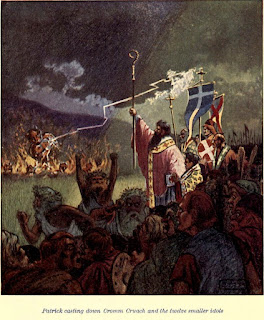
This legend, told by Michael Mac Ruaidhri of Ballycastle, Co. Mayo, is evidently a confused reminiscence of Crom Cruach, the great pagan idol which was overthrown by St. Patrick. [1] Though Crom appears as a man in this story, yet the remark that the people thought he was the lord of light and darkness and of the seasons is evidently due to his once supposed Godhead. The fire, too, which he is said to have kept burning may be the reminiscence of a sacrificial fire.

From a letter written to Sir Samuel Ferguson [2] by the late Brian O'Looney, concerning Mount Callan in the Co. Clare, we see that this legend of Crom was widely circulated.

" Domnach Lunasa or Lammas Sunday," says O'Looney,"the first Sunday of the month of August was the first fruits' day, and a great day on Buaile-na-greine. On Lammas Sunday, called Domnach Crom Dubh, and anglicised Garland Sunday, every householder was supposed to feast his family and household on the first fruits, and the farmer who failed to provide his people with new potatoes, new bacon and white cabbage on that day was called a felemuir gaoithe, or wind farmer; and if a man dug new potatoes before Crom Dubh's day he was considered a needy man..... The assemblage of this day was called comthineol Chruim Dhuibh, or the congregation or gathering of Crom Dubh, and the day is called from him Domnach Chrom Dubh, or Crom Dubh's Sunday, now called Garland Sunday by the English-speaking portion of the people of the surrounding districts. This name is supposed to have been derived from the practise of strewing garlands of flowers on the festive mound [on Mount Callan] on this day, as homage to Crom Dubh hence the name Garland Sunday. Assuredly I saw blossoms and flowers deposited upon it on the first Sunday of August, 1844, and put some upon it myself, as I saw done by those who were with me…

If you ask me who Crom Dubh was, I can only tell you I asked the question myself on the spot. I was told that Crom was a god and that Dubh or Dua meant a sacrifice, which in combination made Crom Dubh, or Crom Dua, that is, Crom's Sacrifice; and this Sunday was set apart for the feast and commemoration of this Crom Dubh, whoever he may have been."

It is interesting to find O'Looney's old-time experiences in Co. Clare so far borne out by this legend from North Mayo.

The name Teideach given to Crom's son, is, as Mr. Lloyd acutely points out, founded upon a misunderstanding of the name of the hole which must have been "poll an t séidte," the puffing or blowing hole. Downpatrick, where these events are supposed to have taken place, is at the extreme northern extremity of Tyrawley, Co. Mayo, and all the other places are in its neighbourhood.

For the leannún sidhe, or fairy sweetheart (often supposed to be the muse of the poets), see O' Kearney's "Feis tighe Chonáin." Oss. Soc. Publ. vol. II., pp. 80-103. For the Irish of this story, see "Lúb na Caillighe," p. 33.

1. See my "Literary History of Ireland," pp. 84-88. Also Stokes’ edition of the "Tripartite Life," p. 92.
2. See the paper read by Sir Samuel before the Royal Irish Academy, April 28, 1873.

THE STORY

Before St. Patrick came to Ireland there lived a chieftain in the Lower Country [1] in Co. Mayo, and his name was Crom Dubh. Crom Dubh lived beside the sea in a place which they now call Dun Patrick, or Downpatrick, and the name which the site of his house is called by is Dún Briste, or Broken fort. My story will tell why it was called Dun Briste. It was well and it was not ill, brother of my heart! Crom Dubh was one of the worst men that could be found, but as he was a chieftain over the people of that country he had everything his own way; and that was the bad way, for he was an evil intentioned, virulent, cynical [2], obstinate man, with desire to be avenged on every one who did not please him. He had two sons, Téideach and Clonnach, and there is a big hollow going in under the road at Gleann Lasaire, and the name of this hollow is Poll a' Teidigh or Téideach's hole, for it got its name from Crom Dubh's son, and the name of this hole is on the mouth of [i.e., used by] English-speaking people, though they do not know the meaning of it. Nobody knows how far this hole is going back under the glen, but it is said by the old Irish speakers that Teideach used to go every day in his little floating curragh into this hole under the glen, and that this is the reason it was called Teideach's Hole. It was well, my dear. To continue the story, Crom Dubh's two sons were worse than himself, and that the leaves them bad enough! Crom Dubh had two hounds of dogs and their names were Coinn Iothair [3] and Saidhthe Suaraighe [4], and if ever there were [wicked] mastiffs these two dogs were they. He had them tied to the two jaws of the door, in order to loose them and set them to attack people according as they might come that way; and, to go further, he had a big fire kindled on the brink of the cliff so that any one who might escape from the hounds he might throw into the fire; and to make a long story short, the fame of Crom Dubh and his two sons, and his two mastiffs, went far and wide, for their evil-doing; and the people were so terrified at his name, not to speak of himself, that they used to hide their faces in their bosoms when they used to hear it mentioned in their ears, and the people were so much afraid of him that if they heard the bark of a dog they would go hiding in the dwellings that they had underground, to take refuge in, to defend themselves from Crom Dubh and his mastiffs. It is said that there was a linnaun shee or a fairy sweetheart [5] walking with Crom Dubh, and giving him knowledge according as he used to require it. In place of his inclining to what was good as he was growing in age, the way he went on was to be growing in badness every day, and the wind was not quicker then he, for he was a nimble as a March hare. When he used to go out about the country he used to send his two sons and his two mastiffs before him, and they announcing to the people according as they proceeded, that Crom Dubh was coming to collect his standing rent, and bidding them to have it ready for him. Crom Dubh used to come after them, and his trickster (?) along with him, and he drawing after him a sort of yoke like a wheelless sliding car, and according as he used to get his standing-rent it used to be thrown into the car, and every one had to pay according to his ability. Anyone who would refuse, he used to be brought next day before Crom Dubh, as he sat beside the fire, and Crom used to pass judgement upon him, and after the judgement the man used to be thrown into the fire. Many a plan and scheme were hatched against Crom Dubh to put him out of the world, but he overcame them all, for he had too much wizardry from the [fairy] sweetheart. Crom Dubh was continuing his evil deeds for many years, and according as the story about him remains living and told from person to person, they say that he was a native of hell in the skin of a biped, and through the horror that the people of the country had for him they would have given all that ever they saw if only Crom Dubh and his company could have been put-an-end-to; but there was no help for them in that, since he and his company had the power, and they had to endure bitter persecution for years, and for many years, and every year it was getting worse; and they without any hope of relief because they had no knowledge of God or Mary or of anything else which concerned heaven. For that reason they could not put trust in any person beyond Crom Dubh, because they thought, bad as he was, that it was he who was giving them the light of the day, the darkness of the night, and the change of seasons. It was well, brother of my heart. During this time St. Patrick was going throughout Ireland, working diligently and baptizing many people. On he went until he came to Fo-choill or Foghill; and at that time and for long afterwards there was nothing but woods that grew in that place, but there is neither branch nor tree there now. However, to pursue the story, St. Patrick began explaining to the Pagans about the light and glory of the heavens. Some of them gave ear to him, but the most of them paid him no attention. After he had taken all those who listened to him to the place which was called the Well of the Branch to baptize them, and when he had them baptized, the people called the well Tobar Phadraig, or Patrick's Well, and that is there ever since. When these Pagans got the seal of Christ on their forehead, and knowledge of the Holy Trinity, they began telling St. Patrick about the doings of Crom Dubh and his evil ways, and they besought him if he had any power from the All-mighty Father to chastise Crom Dubh, rightly or wrongly, or to give him the Christian faith if it were possible. It was well, brother, St. Patrick passed on over through Tráigh Leacan, up Béal Trághadh, down Craobhach, and down under the Logán, the name that was on Crom Dubh's place before St. Patrick came. When St. Patrick reached the Logán, which is near the present Ballycastle, he was within a quarter of a mile of Crom Dubh's house, and at the same time Crom Dubh and Téideach his son were trying a bout of wrestling with one another, while Saidhthe Suaraighe was stretched out on the ground from ear to tail. With the squeezing they were giving one another they never observed St. Patrick making for them until Saidhthe Suaraighe put a howling bark out of her, and with that the pair looked behind them and they saw St. Patrick and his defensive company with him, making for them, and in the twinkling of an eye the two rushed forward, clapping their hands and setting Saidhthe Suaraighe at them and encouraging her. With that Téideach put his fore finger into his mouth and let a whistle calling for Coinn Iotair, for she was at that same time hunting with Clonnach on the top of Glen Lasaire, and Glen Lasaire is nearly two miles from Dun Phadraig, but she was not as long as while you'd be saying De'raisias [Deo Gratias] coming from Glen Lasaire when she heard the sound of the whistle. They urged the two bitches against St. Patrick, and at the same time they did not know what sort of man St. Patrick was or where he came from. The two bitches made for him and coals of fire out of their mouths, and a blue venomous light burning in their eyes, with the dint of venom and wickedness, but just as they were going to seize St. Patrick he cut [marked] a ring round about him with the crozier which he had in his hand, and before the dogs reached the verge of the ring St. Patrick spoke as follows :- A lock on thy claws, a lock on thy tooth, A lock on Coinn Iotair of the fury. A lock on the son and on the daughter of Saidhthe Suaraighe. A lock quickly, quickly on you. Before St. Patrick began to utter these words there was a froth of foam round their mouths, and their hair was standing up as strong as harrow-pins with their fury, but after this as they came nearer to St. Patrick they began to lay down their ears and wag their tails. And when Crom Dubh saw that, he had like to faint, because he knew when they laid down their ears that they would not do any hurt to him they were attacking. The moment they reached St. Patrick they began jumping up upon him and making friendly with him. They licked both his feet from the top of his great toe [6] to the butt of his ankle, and that affection [thus manifesting itself] is amongst dogs from that day to this. St. Patrick began to stroke them with his hand and he went on making towards Crom Dubh, with the dogs walking at his heels. Crom Dubh ran until he came to the fire and he stood up beside the fire, so that he might throw St. Patrick into it when he should come as far as it. But as St. Patrick knew the strength of the fire beforehand he lifted a stone in his hand, signed the sign of the cross on the stone, and flung the stone so as to throw it into the middle of the flames, and on the moment the fire went down to the lowest depths of the ground, in such a way that the hole is there yet to be seen, from that day to this, and it is called Poll na Sean-tuine, the hole of the old fire (?), and when the tide fills, the water comes into the bottom of the hole, and it would draw "deaf cows out of the woods" –the noise that comes out of the hole when the tide is coming in. It was well, company [7] "of the world ; when Crom Dubh saw that the fire had departed out of sight, and that dogs had failed him and given him no help (a thing they had never done before), he himself and Téideach struck out like a blast of March wind until they reached the house, and St. Patrick came after them. They had not far to go, for the fire was near the house. When St. Patrick approached it he began to talk aloud with Crom Dubh, and he did his best to change him to a good state of grace, but it failed him to put the seal of Christ on his forehead, for he would not give any ear to St. Patrick's words. No there was no trick of deviltry, druidism, witchcraft, or black art in his heart, which he did not work for all he was able, trying to gain the victory over St. Patrick, but it was all no use for him, for the words of God were more powerful than the deviltry of the fairy]sweetheart. With the dint of the fury that was on Crom Dubh and on Téideach his son, they began snapping and grinding their teeth, and so outrageous was their fury that St. Patrick gave a blow of his crozier to the cliff under the base of the gable of the house, and he separated that much of the cliff from the cliffs on the mainland, and that is to be seen there to-day just as well as the first day, and that is the cliff that is called Dún Briste or Broken Fort. To pursue the story. All that much of the cliff is a god many yards out in the sea from the cliff on the mainland, so Crom Dubh and his son had to remain there until the midges and the scaldcrows had eaten the flesh off their bones. And that is the death that Crom Dubh got, and that is the second man that midges ate, and our ancient shanachies say that the first man that midges ate was Judas after he had hanged himself; and that is the cause why the bite of the midges is so sharp as it is. To pursue the story still further. When Clonnach saw what had happened to his father he took fright, and he was terrified of St. Patrick, and he began burning the mountain until he had all that side of the land set on fire. So violently did the mountains take fire on each side of him that himself could not escape, and they say that he himself was burned to a lump amongst them. St. Patrick returned back to Fochoill and round through Baile na Pairce, the Town of the Field, and Bein Buidhe, the Yellow Ben, and back to Clochar. The people gather in multitudes from every side doing honourable homage to St. Patrick, and the pride of the world on them that an end had been made of Crom Dubh. There was a well near and handy, and he brought the grate multitude round about the well, and he never left mother's son or man's daughter without setting on their faces the wave of baptism and the seal of Christ on their foreheads. They washed and scoured the walls of the well, and all round about it, and they got forked branches and limbs of trees and bound white and blue ribbons on them, and set them round about the well, and every one of them bowed down on his knees saying their prayers of thankfulness to God, and as an entertainment for St. Patrick on account of his having put an end to the sway of Crom Dubh. After making an end of offering up their prayers every man of them drank three sups of water out of the well, and there is not a year from that out that the people used not to make turus or pilgrimage to the well, on the anniversary of that day; and that day is the last Sunday of the seventh month, and the name the Irish speakers called the month by in that place is the month of Lughnas [August] and the name of the Sunday is Crom Dubh's Sunday, but, the name that the English speakers call the Sunday by, is Garland Sunday. There is never a year from that to this that there does not be a meeting in Cill Chuimin, for that is the place where the well is. They come far and near to make a pilgrimage to the well; and a number of other people go there too, to amuse themselves a drink and spend. And I believe that the most of that rakish lot go there making a mock of the Christian Irish-speakers who are offering up their prayers to their holy patron Patrick, high head of their religion. Cuimin's well is the name of this well, for its name was changed during the time of Saint Cuimin on account of all the miraculous things he did there, and he is buried within a perch of the well in Cill Chuimin. There does be a gathering on the same Sunday at Dún Padraig or Downpatrick at the well which is called Tobar Brighde or Briget's Well beside Cill Brighde, and close to Dún Briste; but, love of my heart, since the English jargon began a short time ago in that place the old Christian custom of the Christians is almost utterly gone off. There now ye have it as I got it, and if ye don't like it add to it your complaints [8].

1. Lower means "northern". It means round the Lagan, Creevagh and Ballycastle.
2. Literally "doggish". The meaning is rather "snarling" or "fierce" than cynical.
3. Pronounced like "Cunn eetir" and means —hound of rage?
4. Pronounced like "sy-ha soory" and means —bitch of wickedness?
5. Linnaun shee, a fairy sweetheart; in Irish spelt "leannán sidhe."
6. Rather "the space between the toes."
7. A variant of "it was well, my dear."
8. Apparently tell it with your complaint added to it.