Showing posts with label Resources. Show all posts

Friday, 18 March 2016

The Life of Saint Patrick by Jocelin of Furness


We begin the octave of posts in honour of the feast of Saint Patrick with a look at the late twelfth-century Life composed by the English monk Jocelin of Furness. Jocelin was commissioned by the Norman conqueror of Ulster, John de Courcy, to write a Life of the Irish patron in connection with the 1185 finding and later translation of the relics of not just Patrick but those of his two co-patrons, Brigid and Colum Cille. Inevitably, this later work has never enjoyed the same status as the earlier Lives by Muirchú and Tírechán, the nineteenth-century English hagiologist, Sabine Baring Gould, for example dismissed it as "of little historical value compared with the earlier and more authentic sources of information, which it not unfrequently contradicts on the authority of some idle legend." But understanding of hagiography has developed since Baring Gould's day and in the last decade a scholarly reappraisal of Jocelin's work has begun. A project at Liverpool University has sought to bring out a new edition of Jocelin's Life of Patrick and to better establish the cultural context in which he was working. It is perhaps worth remembering that despite any sniffiness about this Norman upstart, Jocelin's Life was for centuries a much-used source in both English and Irish language biographies of the saint, as a scholar has recently reminded us:
The Life of Patrick written by Jocelin of Furness in the twelfth century experienced continual popularity among both language communities throughout the eighteenth and nineteenth centuries. First popularised for an Irish audience in Thomas Messingham's Florilegium Insulae Sanctorum (1624), Jocelin's Life subsequently could be found in an English translation by the Franciscan Robert Rochford as The Life of the Glorious Bishop S. Patricke, Apostle and Primate of Ireland (1625); another English translation was published by Edmund Swift in Dublin in 1809. In Rockford's publication, Patrick's life was also paired with a life of Bridget...Indeed, these two lives - that of Jocelin and Cogitosus - dominated the hagiography in circulation among eighteenth and nineteenth century scribes. In particular Jocelin's Life of Patrick - who as a subject was in turn the most often cited in these Irish language texts, about twice as often as Bridget- made up approximately half of the surviving lives of this saint in this time period.

N.M. Wolf, An Irish-Speaking Island: State, Religion, Community and the Linguistic Landscape in Ireland, 1770-1870 (Univ. Wisconsin Press, 2014), 200.

Jocelin's Life was also a source for the seventeenth-century Trias Thaumaturga compiled by this blog's hero, Friar John Colgan, where it formed the Vita Sexta or Sixth Life the great hagiologist used.

Over the coming days of the octave of the Feast of Saint Patrick I will bring some more selections and commentary on Jocelin's Life.

Further Resources:

In the absence of a modern, scholarly edition of Jocelin's Life, that of Father James O'Leary contained in his collection The Most Ancient Lives of Saint Patrick is the most accessible. Read it at the Internet Archive here.

One of the scholars involved with the Jocelin project, Dr Clare Downham, has made an article on Jocelin available to read through the academia site here.

Boydell and Brewer have published a 2010 study by Helen Birkett on The Saints' Lives of Jocelin of Furness. Details here.

Proceedings of the Liverpool University's Project 2011 Conference on Jocelin have also been published. Details here


Content Copyright © Trias Thaumaturga 2012-2016. All rights reserved.

Saturday, 6 December 2014

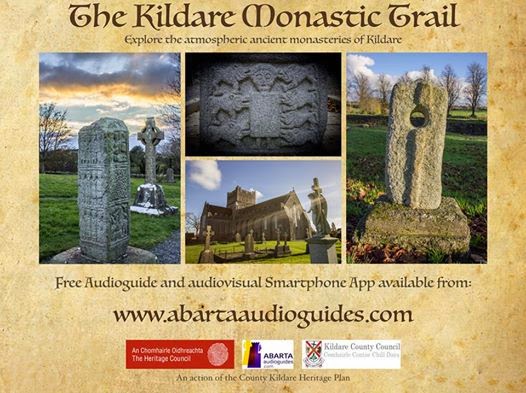
The Kildare Monastic Trail

Abarta Audioguides have made a copy of their Kildare Monastic Trail available to download free of charge:


We are absolutely delighted to announce the release of our latest audioguide: The Kildare Monastic Trail

This free to download audioguide helps you to explore the atmospheric ancient monasteries of County Kildare. The guide consists of 10 tracks and features sites like Castledermot, Old Kilcullen, Moone, Oughterard and more. Narrated by Kildare actor Liam Quinlivan, it tells of the history, archaeology, heritage and folklore of these fascinating sites and gives panel by panel descriptions of the spectacular high crosses at places like Moone and Castledermot.

The guide is free to download as a MP3 audioguide from our website:
http://abartaaudioguides.com/our-guides/Kildare-Monastic-Trail

Or download directly to your smartphone or tablet with our free app version (for Android and Apple). The app version is packed with images and comes with a map to help you navigate your way around the trail:
https://www.guidigo.com/Tour/Ireland/Kildare/Kildare-Monastic-Trail/b4ZmkCsGurI

This audioguide was produced by Abarta Audioguides in conjunction with Kildare County Council and with the kind support of The Heritage Council. We would like to thank Sharon Greene of Castledermot Local History Group, Noel Dunne National Roads Authority archaeologist, Mario Corrigan of Kildare Library Service and Kildare Heritage Officer Bridget Loughlin for all of their advice, support and information during the production of this guide.

This audioguide is an action of the County Kildare Heritage Plan.


Friday, 15 August 2014

Who is Patrick? – Answers from the Saint Patrick's Confessio HyperStack

A useful review of the Royal Irish Academy's Confessio Hyperstack from a German academic:

Who is Patrick? – Answers from the Saint Patrick's Confessio HyperStack

Franz Fischer

University of Cologne

Cologne Center for eHumanities

Universitatsstr. 22, D-50923 Koln

franz.fischer@uni-koeln.de

Abstract

Not everyone realizes that there are two Latin works, still surviving, that can definitely be attributed to Saint Patrick’s own authorship.

On 14th September 2011 the Royal Irish Academy published his writings in a freely accessible form on line, both in the original Latin and in a variety of modern languages (including Irish). Designed to be of interest to the general public as well as to academic researchers, the Saint Patrick’s Confessio Hypertext Stack includes such features as digital images of the medieval manuscripts involved, a specially commissioned historical reconstruction that evocatively describes life in pre-Viking Ireland, articles, audio presentations, and some ten thousand internal and external digital links that make it truly a resource to be explored.

Read the paper in full here.

Saturday, 27 April 2013

"Becoming Mary of the Gael"

The medievalists net site has published an interesting summary of a paper delivered earlier this month by scholar Dorothy Ann Bray. This site has many good articles, news snippets and links to theses on Irish saints and is well worth a browse:

“Becoming Mary of the Gael”

The Celtic Studies Association of North America Annual Meeting – The University of Toronto, April 18-21, 2013

Dorothy Ann Bray (McGill University)

The second paper of the opening session moved away from archaeology and towards religious devotion and saint’s cults. Dorothy Ann Bray presented a paper on the background of St. Brigit’s association with the Virgin Mary in Ireland. St. Brigit is often represented as the Virgin Mary in Irish worship – this paper explored the reasons behind this phenomenon.

Texts offer a lengthy eulogy of the saint. This term, “Mary of the Gael”, has been firmly attached to St. Brigit. The Middle Irish version is based on an even earlier version and there is long tradition comparing St. Brigit to the Virgin Mary,

‘A fair both, fair dignity which will come to thee thereafter from thy children’s descendants, who shall be called from her great virtues truly pious Brig-eoit; she will be another Mary, mother of the Lord.” (‘The Old Irish Life of Saint Brigit’, Irish Historical Studies 1:2 (1938): 348)

Brigit has had a constant, insistent comparison to Mary but only in vernacular texts. The first instance appears in a ninth century biographical hymn. Naming of Brigit as the Mother of Jesus is bold and audacious but this has not received much mention by scholars. Bray has not found any women outside of Ireland so closely associated with Mary as Brigit. There was nothing heretical or especially devious about it but Bray wondered, ‘How did this arise?’. The assertion of Brigit as the mother of Christ was explained in 1955 as an Irish convention of symbolically sharing in motherhood. However, this doesn’t explain why other Irish saints are not associated with the mother of God. Some saints are associated as a sister but not Mother. What about the laity? They would be the most likely audience of these hymns. When the cult of Mary in Ireland began is indeterminate but there is an indication that there was worship of Mary as early as the sixth century in Ireland and that a cult was well in place by the seventh century. Devotion to Mary carried Eastern influences; she was often referenced to the Queen of Sheba. Sheba became interpreted as a kind of Mary. In the East, she is celebrated more as the Queen of Heaven, in the West, she is worshipped more as the Mother of Christ. Jerome, Augustine and other theologians reinforced Mary’s role as a mother. Augustine grounded his thoughts on Mary in scripture, and the new “Eve” was the Church, not Mary. Under the influence of Ambrose, Augustine regards Mary as a model disciple. The emphasis on Mary as the Mother of Jesus is in line with earlier medieval views of martyrology. Most hymns to Brigit were heavy on praise and light on biography and in Latin hymns she is described “like” Mary but not taken to the complete level of identification as in Irish texts. Mary as the Mother of Christ was a powerful symbol in Irish devotion.

Content Copyright © Trias Thaumaturga 2012-2015. All rights reserved.


Wednesday, 14 November 2012

Slí Cholmcille/The Saint Columba Trail


Slí Cholmcille is a very useful online resource on the places in Ireland and Scotland associated with Saint Colum Cille. Here's a description from the website:

Slí Cholmcille 
Slí means ‘way’, and Slí Cholmcille explores the language and heritage of Ireland and Scotland through the life of Colmcille or St Columba. It is a trail between Ireland and Scotland and between many sites associated with the saint and his followers; it links Gaelic-speaking communities in the two countries.
Slí Cholmcille is the result of connections made over a number of years and of input from many parties. It is hoped that the connections will grow and flourish in years to come. The project has been developed by Colmcille (www.colmcille.net), an initiative named after the saint. It was set up to promote links between Irish and Scottish Gaelic in 1997, a year which saw commemorations of the 1400th anniversary of the death of the Colmcille or St Columba. It is now a partnership between Foras na Gaeilge, which promotes the Irish Language in the island of Ireland, and Bòrd na Gàidhlig which promotes Scottish Gaelic in Scotland and internationally.
The site provides an opportunity to make a virtual visit to the places associated with the saint and has many links for further information. In addition to the Irish and Scottish Gaelic language organizations involved, some leading scholars in the field of Columban studies, both Irish and Scottish, help to provide an overview of Saint Colum Cille and his times. 

Slí Cholmcille is well worth a visit and can be found here.

Content Copyright © Trias Thaumaturga 2012-2015. All rights reserved.

Friday, 9 November 2012

Confessio: A Resource for the Study of Saint Patrick's Writings

The Royal Irish Academy have made a wonderful online resource available for the study of Saint Patrick's writings. The site is called Confessio and brings together the original Latin of the Confessio and Epistola texts along with translations in English, Irish, German, Italian and Portuguese. In addition there is a special features page which introduces the writings and provides an exhaustive bibliography. The texts from Saint Patrick's original hagiographers, Muirchú and Tírechán, are supplied there along with two articles on these writers. A novel, 'Seeking Patrick' by Derick Mockler is available in both print and mp3 audio form and there is also an audio reading of the Confessio as a dialogue. There is a separate Manuscripts/Prints page which provides illustrations and downloads of the various editions of Saint Patrick's writings throughout the ages. All in all this is a superb resource and highly recommended.