Showing posts with label Downpatrick. Show all posts

Sunday, 10 June 2012

Translation of the Relics of Saints Patrick, Brigid and Colum Cille


Saint Columba also shares his feastday of June 9 with that of the Translation of his relics, along with those of Saints Patrick and Brigid to a common grave at Downpatrick, County Down. The history of this feast is a curious one, with many inclined to believe that it is purely an attempt by the Norman conqueror of Ulster, John de Courcy, to win over the locals by honouring important native saints. Indeed, some would trace the whole idea of Ireland having a trio of patrons back to this time, certainly it was an idea which was accepted by succeeding generations, as the 17th-century illustration of our three patrons at the head of this blog shows. Here is Canon O'Hanlon's account of the Feast from Volume 6 of his Lives of the Irish Saints:

Feast of the Translation of the Relics of St. Patrick, St. Columba, and St. Brigid, Chief Patrons of Ireland.

[June 9.]

Far distant from each other lay the sacred relics of the great Apostle of Ireland St. Patrick, of the renowned Virgin St. Brigid, and of the illustrious St. Columkille, for many generations after their respective dates of departure from this life. The former, first in order of time, was deposed at Downpatrick, and according to a long-preserved tradition, in a very deep earth-pit, without the site of that cathedral. After the lapse of years, the body of the Irish Apostle seems to have been drawn from that position, and it was probably enshrined or entombed within the church. In the century succeeding that of St. Patrick died St. Brigid, and her remains appear to have been deposited within the church at Kildare, attached to her convent. They rested in a shrine, at one side of the high altar, and they were held in great veneration by the people, especially on the day of her chief festival, when multitudes flocked thither for devotional purposes. Many miracles were wrought there through her intercession. The body of St. Brigid remained in Kildare, until the beginning of the ninth century. The magnificent shrine in which her relics were encased invited the cupidity of the Scandinavian invaders, and as Kildare was greatly exposed to their ravages, it was deemed more desirable to have St. Brigid's relics removed to Downpatrick, where they should be in a more defensible position, and more secure from plunder or profanation. When the happy soul of St. Columba departed from the tenement of his body after his useful missionary career in Scotland had terminated, and until the time of Adamnan, the place where his sacred bones reposed was well known and reverenced. Frequently did his monks resort thither, less to offer prayers for the loved and lamented Father of their institute, than to prefer their own petitions for his powerful patronage. Visited by the holy angels, and illumined in a miraculous manner by heavenly light, was that grave, which for many long years succeeding his decease had been exposed to the winds, that played freely over the ancient cemetery at Iona. Those visions were clearly manifested, but only to a select few. It would appear from the words of Adamnan, which are borrowed from the earlier work of Cummian, that at least a century was allowed to elapse, before the remains of St. Columba were disinterred. In the course of the eighth century, it seems probable, that the bones of St. Columba had been removed, and that they had been deposited in a shrine or shrines. Afterwards, they must have been transferred to the church of the monastery in Iona, where they were religiously preserved, so long as it was deemed safe to keep them in that venerated spot.

Ireland is said to have been selected as a country best suiting such a purpose, when the occasion arose, which demanded their removal. Towards the close of the eighth century, the Scandinavian sea-rovers began to sail southwards, in quest of new settlements and bent upon plunder. The appearance of the Northman invaders on the Hebridean coasts gave warning to conceal the precious shrine, in which, doubtless, the relics of St. Columba had been encased. But such a temporary expedient could not long save it from their cupidity and profanation. The accounts contained in our Irish Annals state, that the remains of St. Columba had been brought to Erin, after his death, and on more than one occasion. A belief seems to have existed, at the close of the eighth century, that his relics had been brought to Ireland from Britain, and that they had been deposited in Saul. Another mediaeval tradition sets forth Downpatrick, as having been his resting place. These contradictory accounts may be reconciled, however, by supposing a translation from Saul, when it became a subordinate church, and on the erection of Downpatrick into a Bishop's See.

Another thoroughly legendary account of a still later date gives us to understand, that when Manderus, son to a Danish king, and chief of the Northman piratical fleet, ravaged the northern parts of Britain with fire and sword, he also came to Iona, and there he profaned the sanctuary, while digging in the earth for treasures he thought to be concealed. Among other impieties, he opened the sarcophagus or case, in which lay the body of St. Columba. This he is said to have carried with him to that vessel, in which he sailed for Ireland ; but, on opening the chest, in which he found only bones and ashes, he threw it overboard. Then it miraculously floated on the waves, until it was wafted to the innermost part of Strangford Lough, near to Downpatrick. There, it is related, that the Abbot had a Divine revelation, regarding the sacred deposit it contained. Accordingly, he extracted the relics, and placed them with the lipsanae of Saints Patrick and Brigid. We need not attach the slightest credit to the foregoing account ; for, it may be observed, that the earliest recorded descent of the Northmen on Iona was in 802, nor does it seem likely, that the body of St. Brigid had been removed from Kildare to Downpatrick, at so early a date. However, it cannot have been very long after this year, when the relics of St. Brigid were removed from Kildare to Down. There, it seems probable, they had been kept in their own distinctive shrine, which was a costly work of art. Elsewhere, too, some other relics of this holy Patroness of Ireland had been preserved. [At the 9th of June, in the Calendar compiled by himself, the Rev. William Reeves has a festival for St. Brigid, at Downpatrick. It is to be presumed, that he has reference to St. Brigid of Kildare, whose remains had been translated to Downpatrick, where they repose with those of St. Patrick and St. Columkille. See "Ecclesiastical Antiquities of Down, Connor and Dromore," Appendix LL, p. 379. ] Moreover, in the year 825, when the Scandinavians again visited the Island of Iona, St. Columba's shrine adorned with precious metals was there, and to prevent desecration it was hidden

It seems strange, that while the relics of the three great Irish Patrons had been kept with such religious veneration in the Cathedral Church of Downpatrick, for a long lapse of ages, that in the twelfth century the place of their deposition within it was forgotten. It would appear, that the Northmen frequently attacked, plundered, and burned that town. It is probable, that the sacred remains had been buried in the earth, to preserve them from profanation, and that the secret place of their deposition had been confided to only a few of the ecclesiastics, who perished through violence, or who had not been able to return afterwards, to indicate that exact spot, in which they had been laid. For a long time, the bishops, clergy and people of Down lamented this loss, until about the year 1185, when Malachy III. was bishop over that See. This pious prelate had been accustomed to offer earnest prayers to the Almighty, that the eagerly desired discovery might be made. One night, while engaged at prayer within the cathedral, Malachy observed a supernatural light, resembling a sunbeam, passing through the church and settling over a certain spot. This astonished the bishop, who prayed that the light might remain, until implements should be procured to dig beneath it. Accordingly, these being procured, beneath that illuminated place, the bodies of the three great saints were found; the body of St. Patrick occupied a central compartment, while the remains of St, Bngid and of St. Columba were placed on either side. With great rejoicing, he disinterred the bodies of those illustrious saints, and he placed them in three separate coffins. He then had them deposited in the same spot, whence they had been taken, and he took care to have the site exactly noted. In fine, the bones of St. Columkille were buried with great honour and veneration, in the one place with those of St. Patrick and of St. Brigid, within Dun-da-lethgles or Downpatrick cathedral, in Ulster. About this time, the celebrated John De Courcy had procured possessions, in that part of the province; and to him, Bishop Malachy reported all the circumstances, connected with the miraculous discovery of the relics. Taking counsel together, it was resolved, that application should be made to the Pope at Rome, for permission to remove the sacred remains, to a more conspicuous and honourable position in the cathedral. At this time, Urban III. presided over the Universal Church. Supplication was made to him, that the relics of those saints should be translated in a solemn manner. Not alone was his sanction obtained, but the Pope nominated Cardinal Vivian, as his Legate for Ireland, with a commission to direct the undertaking. Accordingly, on the 9th of June, 1186, this public Translation of the remains was solemnized. No less than fifteen Bishops were present, besides many abbots and high dignitaries, with a great concourse of the clergy and laity, the Cardinal Legate himself assisting. An office, which is said to date back to the twelfth century, has been attributed to the approval of Cardinal Vivian, who assisted in the time of Pope Urban III., at this solemn Translation of the Relics of St. Patrick, St. Columba, and St. Brigid, in Downpatrick. This was a Double of the First Class, with an Octave. This is in a small and rare 18mo Tract, containing only 64 pages, but giving other Irish offices, and among them one of St. Columba, Abbot. At p. I, it commences with " Die Nona Junii, Translatio SS. Patricii, Columba; et Brigidae, trium communium Hibernise Patronorum, Duplex I. Classis, cum Octava per universam Insulam, cujus sequitur Oflicium approbatum a Viviano Cardinale titttli S. Stephani in Coelio Monte, quern ad Solemnitatem Translationis, An. 1186, Apostolicum Legatum demandavit Urbanus III." There is not a title page, at least in the copy, the property of Rev. Denis Murphy, S.J. and that used by the writer. The office has a First Vespers, with proper Antiphons, Capitulum, and Prayer. The Invitatorium of Matins is proper, with all the Antiphons and Six Lessons, the remaining three being from the Common of Evangelists, with proper Versicles and Responses. The Lauds, Hours and second Vespers are of a mixed character. Afterwards follows a proper Mass.

The Bollandists have fallen into an error, in placing the Finding of the Relics of Saints Patrick, Brigid and Columba, at this date, which should rather be called that for their Translation.

Canon O'Hanlon has a second entry for the feast at June 17 where he records:

Festival of St. Columba, and the Translation of the Relics of St. Patrick, St. Columba and St. Brigid. 
 
In 1620, an Office of St. Columba, Abbot, had been printed in Paris, and again in the same city, A.D. 1675, referring his Feast as a Double of the Second Class to the 17th day of June, on account of the Feast of the Translation of the Relics of St. Patrick, St. Columba and St. Brigid, falling on the 9th of June, and it being an Office of the First Class with an Octave. This contains proper Antiphons for Vespers and Lauds, with proper Hymns and Prayers, as also an Office of Nine Lessons, three of which are proper.

The foregoing is stated,and shown in a small 18mo tract, anonymously printed, apparently in the last century, and in Ireland. The copy, from which the writer quotes, was borrowed from Rev. Denis Murphy, S.J.


Content Copyright © Trias Thaumaturga 2012-2015. All rights reserved.

Wednesday, 14 March 2012

The Burial Place of Saint Patrick- Paper 3


In this final paper ecclesiastical historian, Father Sylvester Malone, argues for Saul rather than Downpatrick as the burial place of Saint Patrick. Although he examines the same evidence as Bishop John, Father Malone takes a more sceptical approach and reaches different conclusions.

ST. PATRICK'S BURIAL-PLACE

THE burial-place of our national saint, like other incidents connected with him, has been a matter of doubt and discussion. The doubt arises from the contradictory notices in the Book of Armagh. These notices appear in one place to favour the claim of Downpatrick to the burial-place; in a second place, the claim of Saul quite convenient to it; and in a third place, the claim of Armagh. The value of each of these notices is not the same, but depends on the intrinsic evidence of the statement, as well as on the bias and intelligence of the writer, and on the age to which he belonged.

The claim of Armagh is very slender, and rests merely on the possession of some relics of St. Patrick of some kind, coupled with the supposition of only one Patrick having been in the early Irish Church; but the existence of two Patricks and their respective identities have been established in a former number of the I. E. RECORD. I am not in accord with those who deny the existence of bodily relics of St. Patrick in Armagh during the ninth century. It was natural and usual to desire the possession of some relic of a saint less renowned than St. Patrick ; and that Armagh procured some bodily relic of him is clearly evidenced in a passage in the Book of Armagh. This passage, which must have escaped the notice of the advocates for Armagh, taken by itself would seem to favour their pretensions. [" In ecclesia australi ubi requiescunt Corpora Sanctorum peregrinorum de longue cum Patricio trausmarinoruin caeterorum que Justorum.'' (Book of Armagh, fol. 21, a. 1.]

The biographers of our national saint have surrounded his death and burial with childish miracles. A comparison instituted by them between him and Moses, however edifying it may be, has led to error on several incidents in his life and the circumstances of his burial. The advocates for Downpatrick have so rested the story of his death and burial on a supernatural basis, as scarcely to leave a human fringe for historical criticism. Nevertheless, the proofs adduced by them appear to me quite questionable, while I judge those in favour of Saul to be highly probable.

I now give a description of St. Patrick's burial-place from the oldest, most impartial, and consistent account in the Book of Armagh. Tirechan, in a lengthened summary of the saint's life, taken from the oral and written account of Bishop Ultan, who lived in the middle of the seventh century, states that St. Patrick was like to Moses in four things, and the fourth thing was that " no person knew where are his bones." The writer then continues to state that two hosts contended for his body during twelve days without night ; and on the twelfth day, as the contending parties were going to give battle, each party saw with themselves the body on a bier, and in consequence refrained from fighting.

Then, as if to justify a departure, by the discovery of Columkille, from the likeness to Moses, the writer continues thus in reference to the burial and the prophetic gift of Columkille :

" Columkille under the influence of the Holy Ghost pointed out the burial-place of St. Patrick, makes out for certain where it is, that is in Sabul-Patrick, that is in the church, as a sprout from the waves, beside the sea, where is the bringing together of relics, that is of the bones of Columkille from Britain, and the bringing together of all the saints of Ireland on the day of judgment."

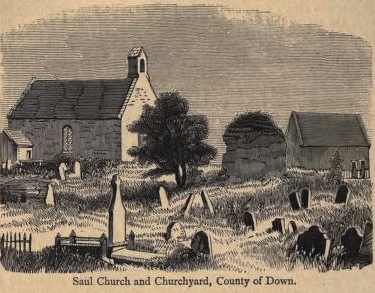
Now, nothing can be clearer than this valuable statement. The burial-place is stated to have been at the Sabul or Barn of Patrick : there was only one such place, and that within two miles of Down. The passage just quoted calls for a few remarks. First of all the absence of darkness during twelve days of waking is only a natural explanation of the effect of the lights over the corpse; and though there may have been a desire on the part of some people from Armagh to have the burial take place with themselves, we need not suppose there was a disposition to come to blows: a little exaggeration in the description is only very natural. The saint's wish was a command; and, as stated in the Book of Armagh that wish was carried out by his burial in Sabul or Saul. A holy rivalry for the possession of his body was a mark of religious zeal. Hence in another passage in the Book of Armagh, in reference to this subject, the writer states that without divine intervention, "it was impossible to have the peace kept about so illustrious and saintly a corpse." Friendly contention then about the body of our saint was only what decency required.

There is no good reason for doubting that some of the relics of St. Columkille may have been enshrined with those of St. Patrick, though the principal part of them were not located in Ireland till the end of the ninth century. St. Columkille in full health is said, in the Book of Cuana, to have come to St. Patrick's grave, and to have enshrined some of the relics buried with him ; and it is not unnatural to suppose that when dying he or his followers after his death wished to have some of his own relics rest with our national apostle.

The allusion to the gathering together of all the Irish saints at Saul is grounded on a petition found in his confession, to the effect that he should lose none of the Irish given him by God. In consequence of this, some Lives stated that God "left to him the judgment of the Irish on the day of doom." This tradition took another form, according to Tirechan : it was one of the three petitions which he made when dying; namely, ''that each of us repenting, even in the hour of death, would be saved on the day of judgment and escape hell." The church beside which our saint was buried - the sabul of Patrick stood, as a sprout from the wave, near the sea. The tidal waters flowing through the inlet of Strangford Lough flooded the low-lying grounds, even under the very shadow of Saul. Even down to the present century, the low ground was occupied by a standing lake, a mile in circumference, and is still called the salt marsh ;but, in early times, before a rampart was thrown up to dam the waters, the Sabul Church, peering above the wavelets, appeared to spring from the very waters. Now what is the reply usually given to this clear and natural statement, that he was buried in Saul ? This only that Saul meant Downpatrick! Such a reply scarcely deserves notice. We have another proof that St. Patrick was buried in Saul: it is found in the Fourth Life as given by Colgan. Saul is incidentally mentioned in connection with a plaything that accidentally fell into St. Patrick's grave there. The incident is alluded to as follows : -

"A boy playing about the church of Saul let his hoop drop into a chink in St. Patrick's grave; and having put down his hand to take it up could not withdraw the hand. Consequently, Bishop Loarn, of Bright, a place near at hand, was sent for ; and on his arrival addressed the saint thus: 'Why, O Elder, dost thou hold the hand of the child?'"

Here we have a statement incidentally made in reference to one of the incidents that filled up the life of our saint. It is made without a design of propping up a political or religious system. It was made at a time when Saul was comparatively insignificant, and when Downpatrick, owing to its situation, as a great emporium, had risen to importance, and was the seat of the chief of Ulidia.

Let us now examine what is said in reply to this proof. The reply is that St. Patrick did not hold the hand of the boy at all; that the phrase tenentem manum seems a translation of Irish in the Tripartite, gabail lama - expelling; that our saint only drove away the boy who gave annoyance; and that Bishop Loarn, who probably outlived our saint, was one of his religious family. The interpretation thus quoted is given on the authority of Dr. Stokes; but, with great respect for his accurate knowledge of Irish, he is not to be implicitly followed, as has been proved elsewhere. But before dealing with this, his opinion, I have to observe that though the Book of Armagh makes mention of a Loarn settled in Connaught, there is no warrant for stating that there was a Bishop Loarn in Downs, during the saint's lifetime; nor is there the least warrant for stating that he died before our saint. There is no valid reason then producible for denying the certain statement of the biographer -that St. Patrick was dead and in his grave when Bishop Loarn was sent for.

I now deal with the objection founded on the opinion of Dr. Stokes ; namely, that tenentem manum was a mistranslation of gabail lama, "expelling," and that consequently St. Patrick was not dead, nor his grave made on the occasion referred to, but "drove away" the playing boy perhaps with too much harshness : in confirmation of this latter view, the Tripartite is appealed to as an authority for stating that St. Patrick was not "always meek and patient;" and hence the rebuke of Bishop Loarn for probably too much harshness.

Well, an explanation that involves a censure on our national saint for harshness towards an unthinking boy at play is very suspicious. Besides, even if the boy were annoying the saint, as alleged, and if the saint exceeded the limits of moderation in correction, was it a case for having a bishop sent for, and have him rebuke his superior? Moreover, when the bishop came on the scene our saint's action was continued; and if tenentem manum meant expelling, the boy must have been persistently bold during the time the bishop was being sent for, and was coming to the church; and this fact should render impossible the charge of harshness for driving away the boy.

Again, if tenentem manum in the Latin Life be, as stated, a mistranslation of gabail lama in the Tripartite, and as Dr. Stokes has stated that the Irish Life was written in the eleventh century, while, the Latin was written in the ninth century, how could the latter be a mistranslation of the former?

In good truth, the writer of the Latin Life knew the meaning of tenentem manum ; and if he wished to express the idea of expulsion he had only to use the proper and natural Latin expello. On the other hand, if the writer of the Tripartite intended to express the same idea, he would have used, as on all other occasions he did use, the word indarb.

The Irish as well as the Latin phrase meant literally "seizing the hand," and figuratively "overpowering" or "thwarting." But I am told that other instances in the Tripartite countenance "expelling" as the meaning of the phrase. Well, all the instances which occur to me I will submit to a test. In looking into page 118 (Roll's Tripartite), I find the phrase gebthar do lam, "thy hand shall be seized." This was a reply from the angel to St. Patrick, who refused to budge till he obtained the privilege of rescuing as many souls from hell as hairs on his chasuble. The reply meant, "you shall be overpowered," and nothing more. The editor of the Tripartite inferred from the remark of St. Patrick about budging, that the reply had an antithetical meaning, but the inference was not correct.I alight on another instance. St. Patrick wished to establish a house in Assaroe, but was opposed by Coirbre " who sent two of his people to 'prevent him,'" gabail lama.

But a more crucial instance of the phrase occurs in page 156 of the Roll's Tripartite. Our saint wished to establish a house in Inishowen ; but Coelbad " prevented him in regard to it," gabail a laim ass, which the editor renders by "expelling thence." Now the addition of the word ass here, and not in the other instances, is translated by "thence." But surely we understand that when there is question of a person being in a place, and of his expulsion, the expulsion is from that place. The addition of the word ass then is unnecessary on the supposition that the phrase gabail lama in the other instances without it meant "expelling." I shall not dwell on another instance, in page 164, which has the same meaning ; and in these instances the word ass means not "thence" but "in regard to it."

That such is the meaning of ass, is very clearly brought out in page 163. It is there stated that our saint wished to take a place in Cell Glass, and (dlmotha do ass) "he was refused," according to Roll's editor, but properly and literally "it was refused to him in regard to it." The editor having no meaning for ass, but "thence," and seeing such a translation to be unmeaning, he did not translate it at all. The Irish word ass lends itself to various idiomatic phrases with which the learned editor is apparently not familiar. I hope now it may be admitted that the allusion to the detention of the boy's hand in St. Patrick's grave was not a mistranslation of the Irish, and that it establishes a belief in the writer of Vita Quarta as to the burial-place of St. Patrick in Saul.

Notwithstanding the political and social greatness to which Downpatrick had risen, and the comparative obscurity of Saul, there is evidence of its claim to St. Patrick's burialplace being recognised in succeeding ages. Thus, the Four Masters, under the year 1293, state that the relics of St. Bridget and Columkille were discovered with the remains of St. Patrick at Patrick's Saul. The discovery, witnessed by the Archbishop of Armagh, was accompanied by miraculous manifestations. The same statement is made in the Annals of Ulster. The fact remains, that at the end of the thirteenth century, we find solemn testimony, confirmatory of the statement made in the Book of Armagh, in the seventh century, in favour of Saul being the burial-place of St. Patrick.

Now, in reply to the several clear and natural statements made, without the aid of supernatural agency, in favour of Saul, what are we told ? This, that Saul meant Downpatrick, and that tenentem manum did not mean "holding the hand." And the proof in favour of the rival burialplace, of what is it composed? Merely of mystery, visions, and miracles ! That one angel was commissioned by another to send St. Patrick to him ; and the saint, having gone, was told by the angel from a flaming bush (a) that his death would be in Saul ; but, as a compensation to Armagh, that it should have primacy; (b) that there was to be no darkness for twelve days, or rather partial day for the rest of the year; that angels waked St. Patrick with vigil and psalmody during the first night, whilst all who came to the wake slept ; that oxen, yoked to the bier, were to be left to themselves to carry the corpse to the destined burial-place ; (c) that the rival provinces of Down and Armagh were kept from deadly fight by the swelling tide which became instinct with life ; that on the ebb of the tide the people of Armagh, fording the river, fancied they saw the bier carried on towards Armagh, till it disappeared at Cabcenne stream; that the corpse was to be buried, by angelic directions, seven feet deep in the earth ; that the relics should not be removed from the earth, but a church built over them; (d) and yet, that no person knew where was the burial-place : all this supplies material for the argument in favour of Downpatrick!

But I would offer a few hurried remarks (a) We are told in one place that St. Patrick went to the angel, but quite the contrary in the next page. (b) The primacy is said to have been given then to Armagh ; but it had been given, on as good authority, long before then to Armagh. (c) The angel directed a very practical direction that a church should be built where the oxen were to stop, over the corpse. What if they had not stirred from Saul, where there was a church, or moved to a place where there was already a church ? (d) It is strange that, as the Armagh people acknowledged the finger of God on the disappearance of the phantom bier, they paid no heed to the angel's directions, and were determined to give battle or have the corpse, (e) It is equally strange that a church directed by angels to be built, was undertaken only at the end of the seventh century. The narrator states that when a foundation for the church was being dug, quite recently ('novissimis temporibus'), flames issued from the grave. Does not this prove that the burial-place was known, notwithstanding the similarity to Moses ? Besides, the angel, in directing the building of a church, and directing that the delvers should sink the grave seven feet deep, must not have intended that the burial-place should be unknown. I may be told that a mistake in regard to Saul should rather be admitted than a whole cycle of miracles in defence of falsehood. Well, however unpleasant the fact, it must be admitted that unenlightened zeal or dishonest bias can sport with miracles for its own ends ; and the Book of Armagh affords ample proof of it in another passage.

The Book of the Angels tells its readers that an angel having tapped St. Patrick out of slumber, snatched from his long vigils, announced that God " gave him and to the diocese of Armagh all Ireland." The saint then is represented as deprecating such a large and unnecessary gift, because of receiving already a peculiar rent, given freely, though a debt ordained by God, from every free church, and as having no doubt that this debt would be decreed for the future bishops of Armagh by all cenobitical monasteries. What a caricature and profane libel this on the saint's disinterestedness! The writer ought to have remembered the Confession -

They have given me small voluntary gifts, and some of their ornaments upon the altar ; but I returned these to them, though they were displeased with me for so doing. But ... I wished to keep myself prudently in everything ... so that unbelievers may not, in my ministry, in the smallest point, have occasion to defame it."

But, perhaps, since I have baptized so many thousands, I may have accepted half a screapall. Tell it to me, and I will restore it. When the Lord ordained everywhere clergy, through my humble ministry, then if I asked the price of my shoe, tell it against me, and I will restore you more. I spent for you, that they may receive me."

In order to prop up the claims of Downpatrick, angels must commune with each other ; man had to abdicate the possession of his senses ; the brute beasts are brought to the scene to act their part ; and the waters became instinct with life " in digging deep valleys, while, at the same time, piercing the air" as a barrier against contending provinces. Heaven and earth are moved, with their inhabitants, in order to neutralize an historical and the earliest statement in favour of Saul. This simple and natural statement, in striking contrast to its contradictory, tells us that our saint, overtaken by the sickness of death at Saul, was there buried. Saul was his first love, the scene of his first missionary success, and the closing scene of his divinely-favoured apostolate. The alleged signs and wonders in connection with the burial resemble others on which, before the present, I had to observe that their extravagance appeared in proportion to the evidence of the falsehood in support of which they appeared to be manufactured. Downpatrick possessed nothing in fact, in association, in prophecy, not even a church, suggestive of a burial-place. Neither the glory of God, so far as it is allowed us to raise a corner of the mysterious veil, nor edification of man called for Divine interposition on the occasion. As to the dying wish of the saint, it certainly did not lean to Downpatrick, nor probably, notwithstanding the repeated and accentuated assurances to the contrary in the Book of Armagh, to Armagh; for his wish on such a matter would be an absolute command; and as to a chosen spot, "all Ireland was given to him as his diocese."

It was only natural, then, in the circumstances that the great high priest, the glorious national apostle, would lie where he fell; and, if it were not natural, it would be a matter of indifference to him who, in his extreme old age, had to say :

" I daily expect murder, or to be circumvented, or reduced to slavery, or to a mishap of some kind . . . And if ever I have imitated anything good on account of my God, Whom I love, I pray Him to grant me that, with those proselytes and captives, I may pour out my blood for His name's sake, even though I may be deprived of burial, and my corpse most miserably be torn limb from limb by dogs or wild beasts, or birds of the air should devour it."

In conclusion: the alleged angelic direction in regard to the burial of St. Patrick in Down, and to the church to be built over him, is still further proved to be false by the fact that law and custom forbade any person in the fifth century to be buried in a church, or a church to be built over him, unless he was a martyr.

SYLVESTER MALONE.

IER, vol 15, 1895 341-351

Content Copyright © Trias Thaumaturga 2012-2015. All rights reserved.

Tuesday, 13 March 2012

The Burial Place of Saint Patrick- Paper 2


" In Burgo Duno tumulo tumulantur in uno
Patritius, Brigida, et Columba pius."

WE have seen in our last paper, that there is very conclusive evidence that St. Patrick was buried, not at Saul or at Armagh, but at Downpatrick. And there is a very ancient and general tradition, that the relics of St. Columcille and of St. Brigid were also enclosed in the same tomb with those of our national apostle. So now we come to examine what historical evidence can be adduced in favour of this wide-spread tradition.

First of all, it is perfectly certain that St. Columba died in his monastery at Iona, about the year 597, in the seventy-seventh year of his age, and that he was buried by his devoted disciples in the monastery where he died. The testimony of his biographer Adamnan, a holy and learned man, with reference to those facts, cannot for a moment be called in question by any competent scholar. His blessed body, rolled up in clean linen, was placed in a busta or ratabusta, according to the common text, and was then buried with all due veneration. Lower down in the same chapter this humatio is described as a sepultio, and in the next section as a sepultura; so that the writer clearly meant that the remains of the saint were enclosed in a coffin, and then buried in the earth ; but he nowhere indicates the exact spot where the grave was made. The word ratabusta is not found in Du Cange, nor anywhere else, so far as we know. It is probably an error of the scribe, who wrote "in ratabusta" for "intra busta," the latter phrase according to its classical usage meaning a grave rather than a coffin. It matters little, indeed, because the meaning is in either case that the body of the saint was buried in an ordinary grave.

Adamnan, however, though so explicit as to the burial, makes no reference to any enshrining, or translation, or disturbance of Columba's relics; so that it is only natural to assume that up to the period when he wrote, Columba's grave was undisturbed. Adamnan became abbot in 679; and the Life of Columba was .certainly written during his tenure of office as abbot; but in all probability not before the year 690. After that period he spent most of his time in Ireland ; whereas certain references to Iona indicate that the life was written during his abbacy in that island.

Now, although Tirechan expressly declares that his Annotations were derived from the oral information, or from the book of Bishop Ultan, who died about 657, we need not assume that they were written during the lifetime of his master, and perhaps not even until many years after his death. Tirechan himself most probably lived on to the end of the seventh century: and he might well have composed his Annotations during the last ten years of his life.

The statement, which he makes, that there was a ''conductio martirum, id est, ossuum Columcille de Britannia," to Downpatrick, appears to be an explanation given by Tirechan himself to identify the "church very near to the sea," as that to which the bones of Columcille were carried from Britain. Bishop Reeves, indeed, thought these words were at first a gloss on Tirechan's text, which was afterwards inserted in the text by the copyist; but even in that case the gloss must have been there before 807, when the Book of Armagh was copied. Our own opinion is, that the words were an explanation, given either by Tirechan or his copyist ; that they cannot have been written before 690; and possibly may have been added by some copyist during the eighth century, but not later. Hence we infer that the bones of Columcille, or some notable portion of them, were actually transferred to Downpatrick at some time during the eighth century; and most probably about the beginning of that century.

But here several difficulties crop up, which it is necessary to explain.

The question occurs at once, if the relics of Columcille were transferred to Downpatrick so early as the beginning of the eighth century, or perhaps even earlier, how are we to explain certain entries in our national annals of a later date? For instance, when the Danes desolated Iona, in 824, we are told by Walafridus Strabo, who probably got his information from one of the companions of the martyred abbot, that when Blathmac refused to surrender the hidden treasure -

" Pretiosa metalla
Beddere cogentes, queis Sanctae Columbae
Ossa jacent, quam quippe suis de sedibus arcaru
Tottentes tumulo terra posuere cavato,
Cespite sub denso, guari jam pestis iniquae ;
Hanc praedam cupiere Dani "-

the saint was most cruelly martyred by the greedy pirates. But how to reconcile this story with an earlier translation to Downpatrick ?

The answer appears to be that a portion of the saint's relics were retained at Iona, when the rest were carried to Downpatrick; that this portion was enshrined, as might have been expected, during the eighth century, in a precious shrine preciosa metalla an expression that could hardly be used of the plain busta, or wooden coffin, in which they were first interred. In other words, it was the shrine of the relics of St. Columba that was hidden away ; a shrine richly adorned, as we know was then the custom, with gold and precious stones, but which at the same time did not contain all the relics of the saint, but only that portion of them preserved at Iona, when the rest were transferred to Downpatrick about the beginning of the eighth, or the close of the seventh century.

It is stated in the Annals of Ulster that some four years later, in A.D. 828, " Diarmait, Abbot of Ia, went to Alba with the reliquaries of Columcille." This seems to imply that they were carried from Ireland, to which they had been brought in 824, back again to Alba, or Scotland, by the newly-elected Abbot of Iona. Now the word Minna, which is used by the annalist, so far as we know, is not applied to designate the corporeal relics of a saint ; but it usually designates what may be called the extrinsic relics of the saint; that is, things intimately connected with him during life, but at the same time quite distinct from his bones or ashes. The late learned Bishop Reeves adopted this view as to the meaning of the word minna, as used in the Annals; and if this be true, the conveyance of the minna of Columcille from Erin to Alba and back again, more than once, does not mean that his blessed bones, or any part of them the "martira" of the saint were taken from Downpatrick, but that certain extrinsic relics of Columba his bell, his psaltery, his cowl, or his staff, it may be were carried hither and thither by the abbots of Iona. We venture to think that this is the true view of the various translations of the minna of St. Columba reported in the Annals; and it will go far to reconcile the apparently conflicting statements of Tirechan and of the writers who come after him.

All these subsequent writers of the Annals are, in our opinion, to be understood in the same sense. For example, in A.D. 830, the minna of Columcille were again brought back to Ireland; and once more, in 848, the minna of the saint were carried to Ireland, which shows that they must have returned to Iona in the meantime. Again, in 877, the "shrine of Columcille, with all his minna, arrived in Ireland to escape the foreigners." In all these cases we have reference to a scrin, or shrine, of the saint, containing, it may be, some small portion of the relics of his sacred body ; but it is quite evident that its chief contents were the minna, which according to the usage of the Annals must not be understood as martra, or martira in Latin, that is corporeal relics, but rather of extrinsic relics connected with the saint during life, of the character which we have already explained. It is quite obvious that all those translations of the minna of Columcille would, in that case, be quite compatible with the quiet rest of his corporeal relics in Downpatrick.

With regard to St. Brigid's remains, there is somewhat more doubt and uncertainty. That she was at first interred in her own church at Kildare, on the left-hand side of the high altar, is beyond question. This is expressly stated in her Life by Cogitosus. He declares that in that church "the glorious bodies of both, that is, of Bishop Conleath and of this virgin Saint Brigid, repose on the right and left hand of the decorated altar, placed within tombs richly adorned with various decorations of gold and silver, and gems and precious stones, with crowns of gold and silver pendant from above." As this passage is very important, and has in our opinion been greatly misunderstood, we have translated it literally, and subjoin the Latin text in the note.

From this passage Petrie makes a very strange deduction. He assumes that the "monuments" which are here described were shrines, in which the bodies of the saints, or rather their relics, were enshrined according to the custom that certainly became very general during the course of the eighth century. And as the Annals of Ulster, under date of A.D. 799, tell us that the relics of St. Conlaeth were placed in a shrine (scrin) in that year, he infers that the Life of Brigid, by Cogitosus, must have been written after that year, but before 835 ; when, as we know from the same Annals of Ulster, Kildare was plundered by Gentiles from Inver-Dea, and half the church burned. It is clear that the beautiful tombs would not be left intact in that raid, if they existed at the time.

But "monumenta" are not shrines at all. The word, both in classical and mediaeval Latin, when used in this connection, means a tomb, monument, or grave, in which the dead were buried. On the other hand, the shrine or scrinium, or scrin, as it is called in Irish, was a small and highly ornamental metal case for containing the relics or some memorial of a saint, of which we have several examples still existing. But they cannot with propriety be called "monumenta," and we do not recollect that the word has ever been applied to any of them. Then, again, Cogitosus describes the bodies of the saints as resting within the monuments ; whereas whenever there is question of enshrining the word always used is relics; that is, reliquiae in Latin, and matra (a loan word) in the Irish, to express corporeal relics.

In our opinion, therefore, Cogitosus in this passage describes the tombs in which the saints were buried where, as he says, their bodies reposed in his time; whence we infer that he must have written before any enshrining took place, and therefore in all probability long before the enshrining of St. Conlaeth's relics in 799, as described in the Ulster Annals. It is much more likely that Cogitosus died, as Dr. Graves thinks, about the year A.D. 670, or perhaps somewhat later. It is certain, however, that in his time the body of St. Brigid was reposing in a splendid monument within her own church at Kildare.

But the next, that is the eighth century, was the great period for enshrining the relics of the saints, We find no less than twelve instances expressly recorded in the Annals during that century. Doubtless, there would be great reluctance to disturb the bodies of the two saints that lay within their splendid tombs on either side of the high altar of the great Church of Kildare tombs at which wonderful miracles frequently took place "quas nos virtutes non solum audivimus, sed etiam oculis nostris vidimus" says Cogitosus, speaking of his own time.

That reluctance, however, would be overcome at the approach of the Danes. They had been hovering round the Irish coasts for some years. Rechra was burned by the Gentiles in 794; Sci was pillaged and wasted in the same year; Inis-Patraic was burned in 797; the shrine of Dachonna was also broken by them (the Gentiles), and they committed other great devastations both in Erin and in Alba. It was high time, therefore, to put the relics of St. Brigid and St. Conlaeth, as well as the gold, and silver, and precious stones, which adorned their tombs in a more portable form, to save them from the plunderers. So we are told that in 799 " the relics of Conlaeth were placed in a shrine of gold and silver." But, strange to say, there is no reference here to the enshrining of the relics of St. Brigid. Surely they did not leave her body in the tomb, when they took up and for greater security enshrined the remains of her companion saint in a shrine of gold and silver.

We think the only probable explanation of this omission is the fact that the relics of St. Brigid must at that time, or perhaps a very short time previously, have been taken up from the grave and carried for greater security to Downpatrick. At this time, as we know, Patrick, Brigid, and Columcille, were recognised as the national patrons of the Irish Church, and of the Irish people. The remains of Patrick and Columcille were already reposing together in Downpatrick what more natural than that, if they were to be disturbed at all, the remains of the third great patron of Ireland should also be carried thither to repose in the same grave. This, however, would be done as quietly as possible, not only for fear of the Danes, but also for fear of the people, who certainly would not readily permit the transfer. So we have no reference to the date of this translation in our annals, as it was not a public fact ; but afterwards we find it expressly stated by those who must have known that it was true.

The principal authority for this translation to Downpatrick is the author of the Fourth Life of St. Brigid, as published by Colgan. Colgan himself attributes the authorship of the Life to a certain Animchad, Latinized Animosus, who appears to have been first a monk and afterwards Bishop of Kildare, and whose death is assigned in the Chronicon Scotorum to the year A.D. 979. The author of the Life was manifestly, as may be gathered from his prologue, a monk of Kildare, and therefore must have been well acquainted with the tradition of the translation of the saint's relics then current amongst his community.

In one passage of this Life it is expressly stated that St. Patrick was buried in Down, and that St. Brigid also, and the relics of the Blessed Columcille were many years afterwards placed in the same tomb. This passage, however, is suspiciously like an interpolation in the text of Animosus, and as such has been printed between brackets in the Fourth Life of St. Brigid. But in the same chapter there is given an alleged prediction of St. Brigid that she herself with Patrick and Columcille would arise from the same tomb on the day of judgment ; which proves that at the time of the writer, the bodies of those three saints were supposed to be within the same tomb in Downpatrick. The evidence, indeed, is not quite satisfactory; but still it goes far to show the existence of this belief in Kildare so early as the middle of the tenth century.

It will be observed that we place the translation of the remains, both of Brigid and Columcille, to Downpatrick at an earlier date than that commonly assigned. However, we have given our reasons, which will doubtless be estimated at their proper value. There is one fact which goes far to show that the remains of St. Brigid were not transferred to Downpatrick until a somewhat later period. It is this, that we find the same ecclesiastic, Ceallach, son of Ailill, was abbot both of Iona and Kildare at the very time that the ravages of the Danes were most severely felt at Kildare. What more natural than that this eminent man should transfer the holy remains to Downpatrick, a place of comparative security, where, as he well knew, the remains of the great apostle of the Picts had already been transferred? There is much plausibility in this view ; and the only thing that makes us hesitate to accept it is, that there is no mention of the enshrining of St. Brigid's relics in 799, when the relics of St. Conleath were certainly enshrined. This, in our opinion, goes far to show that the remains of St. Brigid had been already carried elsewhere, although for prudential reasons their destination was not made public at the time.

This brings us to the alleged invention and translation of the relics of our three great national patrons towards the close of the twelfth century.

It is remarkable that our native annalists make no reference to this discovery of the relics of the three saints in Downpatrick. The Four Masters, for instance, although careful to give an account of the visit of Cardinal Papiron, in 1151, and the Synod over which he presided in 1152, and also of Cardinal Vivian's visit in 1177, make no reference at all to the visit of Cardinal Vivian in 1186. Gerald Barry, however, a contemporary writer, and at that very time in Ireland with Prince John, expressly declares that the bodies of the three saints, Patrick, Brigid, and Columcille, were found in his time in the city of Down in the very year that Prince John first came to Ireland hidden, as it were, in a triple hole or cave Patrick lying in the middle, with the other two on either side. Thereupon, under the direction of John de Courcy, then ruling in Ulster, these three noble treasures were by a divine revelation made known and translated.

Cardinal Vivian came to Ireland as Papal Legate in the beginning of the year 1177, and met John De Courcy in Down. He afterwards held a Synod in Dublin, on the 13th of March, the first Sunday of Lent, to which the Four Masters refer; but the Masters make no subsequent reference to his reappearance in Ireland in 1186 ; nor does any other Irish annalist so far as we are aware. This invention and translation of the relics of the three saints is narrated in minute detail by several modern writers. It is, however, greatly to be regretted that the contemporary evidence is very unsatisfactory as to these circumstantial details. Usher quotes John Brompton, Ralph of Chester, and others ; but these were English and later writers, who knew very little about Ireland. Gerald Barry's testimony as to the substantial fact is most valuable ; but he gives no details ; and the verses usually given as quoted by him are not found in the best MSS. of the Topographia; that is:

" In Burgo Duno tumulo tumulantur in uno
Brigida, Patritius, atque Columba pius."

Messingham, who has collected so many other important documents in his Florilegium gives us also the Lessons for the Feast of this Invention and Translation, which was first celebrated on the 9th of June, 1186. They furnish, perhaps, the weightiest evidence in favour of the truth of the details connected with this remarkable event. Here is the substance of these historical Lessons :

" It is said [fertur] that at the time of the conquest of Ireland by the English, there was a certain Malachias, a man of great merit, and of holy life and conversation, who was Bishop of Down, where the bodies of the aforesaid saints were buried. This bishop being instant in prayer, almost daily besought the Lord that He would deign to make known to him, in His own time, where that precious treasure, the relics of the aforesaid saints, was hidden. One night whilst he was thus most earnestly praying in the Church of Down, he saw as it were a ray of sunlight beaming through the church up to the place of burial of the bodies of the aforesaid saint. The bishop, greatly rejoicing in this vision, prayed still more earnestly that the ray of light might not depart until he should find the hidden relics. Thereupon rising up he took quickly the necessary tools, and going to that bright spot he dug there until he found the bones of the three aforesaid bodies. Then on the spot where the light was shining he enclosed the bones separately in wooden shells [illa in tabbulis separatim inserebat] and thus enclosed [tabulata] replaced them under ground in the same spot."

Then the Bishop narrates his vision to John de Courcy, the Conqueror of Ulster, "a man much given to the service of God," by whose advice and assistance supplication was made to the Pope for the translation of the relics. The Pope graciously assented, and sent over John a Cardinal Priest, under the title of St. Stephen on the Caelian Mount, as Apostolic Legate in Ireland, who, on the 9th day of June, with all due reverence and devotion, transferred the holy relics from the spot in which they were laid by Malachias, the Bishop, to an honourable place, specially prepared for them in the church. There were present at this translation, besides the Legate, fifteen bishops, with very many abbots, provosts, deans, archdeacons, priors, and other orthodox men, who, in solemn assembly, decreed that the festival of this Translation was thenceforward to be observed on the 9th of June, the feast of St. Columba, which latter was to be transferred to the day after the octave of the Feast of the Translation.

It has been frequently insinuated that this invention and translation was a political device, arranged by John de Courcy and the bishop, to reconcile the Ultonians to the conquest, by giving it a kind of heavenly sanction in their eyes. But John de Courcy was not a schemer; and the Bishop Malachias was a native Irishman, who was no friend of the conquest or the conquerors. Indeed if the bishop were an Anglo-Norman the entire business would look very suspicious; but, as it stands, the narrative is entirely trustworthy, for the revelation is made to this Celtic bishop, and as we Catholics know often happened before, in answer to humble and fervent prayer.

It has been said also that if the remains of Columba and St. Brigid were carried to Down in the eighth or ninth century, and were enclosed in the grave of St. Patrick, a spot so sacred could not be utterly forgotten even by the clergy of the Church. There is an obvious answer to this that during the depredations of the Danes, the churches .were burnt, sometimes frequently burned to ashes, and the clergy were often all slaughtered. What grave of our early saints is known outside the Aran Islands ? Hardly a single one. The same motive, too, that led to bringing the remains to Down would lead to the place where they were buried being kept a profound secret, except from a very few. Thus, in the course of generations, the knowledge of the place might be utterly lost, although it was well known that the sacred remains were hidden somewhere within the Church of Down. Similar events have led, even in more recent times, to the same uncertainty as of old. Although the relics of St. Patrick, Brigid, and Columba were then buried in Down, no one now can tell the exact spot where these holy relics repose.

There is, indeed, in the cemetery attached to the Protestant Cathedral, or the abbey, as it is still called by the people, an ancient grave, which is commonly reputed to be the grave of St. Patrick. It is now hollowed out by the excavations of pious Catholics, who, when about to emigrate, always carry away with them a small portion of "the clay from St. Patrick's grave." It is said that over this grave there was formerly erected a granite cross to mark the sacred spot, but it was carried off and broken in pieces by certain bigots amongst the Orangemen of Downpatrick, who afterwards, as might be expected, all came to a bad end. No one can regret if St. Patrick showed his power on men like these. This grave, however, could not have been the original grave of St. Patrick, nor that into which the remains of the Trias Thaumaturga were enclosed in 1186; for in both cases, the grave was within the cathedral, and no church ever stood over the present grave.

But a certain writer in the Ulster Examiner, under date of Feb. 9th, 1870, declared that, thirty years before, a man of the name of Millar told him that he remembered the time when the cathedral was restored (in 1790) ; that three stone coffins were discovered near the high altar; that these holy remains, supposed to be those of the three saints, were transferred to a new grave in the churchyard, and to mark the spot an ancient market cross was carried there and placed over the grave that very cross, we must assume, that was afterwards broken to pieces by the Orangemen. It is a point that deserves further investigation, which we must leave to the zeal of the local antiquarians.

+JOHN HEALY.

IER, Vol 15, (1894), 203-215

Content Copyright © Trias Thaumaturga 2012-2015. All rights reserved.

Monday, 12 March 2012

The Burial Place of Saint Patrick- Paper 1


In the first of two papers on the subject of the burial place of Ireland's three patrons, the Catholic Archbishop of Tuam, John Healy, advances the claims of Downpatrick against those of Armagh. Although modern scholars would cast a rather more critical eye over the historicity of the claims of all the parties, the author provides a useful summary of these and of the case for associating the burial of Saint Patrick with Downpatrick in the pre-Norman era. Both of his papers and a third by Father Sylvester Malone arguing the case for Saul, Co. Down, were published in the Irish Ecclesiastical Record for 1894. Please refer to the original volume to access the footnotes.

THE BURIAL-PLACE OF ST. PATRICK

IT is well known that the birthplace of our national saint has been the subject of much controversy ; but up to the present we hardly thought that his burial-place was open to reasonable doubt. This, however, is an age not only of inquiry, but of scepticism; and hence we are not so much surprised that the ancient traditional claim of Downpatrick to possess the remains of St. Patrick, has been rather lightly set aside, and it is sought to bestow on Armagh the double honour of his tomb and of his "kingdom." It is worthwhile, therefore, in the first place, to examine the evidence in favour of the Ulidian claim; and then to weigh the newly-found arguments in favour of Armagh. The subject is surrounded by many difficulties, and even so capable and impartial a critic as the late lamented Bishop Reeves admitted that the evidence in favour of Downpatrick was "not altogether unexceptionable." We shall, therefore, briefly examine the evidence and the exceptions, such as they are ; and, at the same time, we shall touch on the wider question, whether the relics of Bridget and Columcille also repose in the sacred soil of Downpatrick.

In our opinion the oldest, though perhaps not the clearest, reference to St. Patrick's burial at Down, is contained in Fiacc's Hymn, which is older even than Muirchu's memoir contained in the Book of Armagh. The arguments hinted at by Todd and Stokes, against the authenticity of this hymn, will be found to disappear on close examination. Fiacc says :

" In Armagh there is a kingdom, it long ago deserted Emain
A great church in Dun-leth-glaisse ; that Tara is a waste, is not pleasant to me."

The Lives of St. Patrick generally declare that the angel told him his "kingdom," or spiritual sovereignty, was to remain in Armagh, but that his body was to rest in Downpatrick; that is, of course, Dun-leth-glaisse, or, as it has been written in later times, Dun-da-leth-glaisse ; that is, the Fort of the Two-Half-Chains alluding, it is said, to the broken fetters of the two sons of Dichu, who were kept in bondage by King Laeghaire, but whose bonds were broken miraculously by St. Patrick, and carried by them to their father's stronghold at Down. The only meaning of the reference to the great church of Down in this couplet, in connection with our apostle, must arise from the fact that he was buried there. Its church cannot be conceived as great for any other reason in connection with St. Patrick. His spiritual sovereignty continued in Armagh, but his body remained at Down.

Still more explicit is Muirchu's statement in the Book of Armagh, dating at least from the end of the eighth century.This author, writing in that very book which was always esteemed as the most cherished treasure of the Church of Armagh, declares expressly that, when Patrick felt the hour of his death approaching, he was anxious to return to Armagh so that he might die there, ''because he loved it before all other lands." ' But the angel Victor sent another angel to the saint to tell him to return to Saul, where he was then staying ; that his petitions to the Lord were granted ; and that at Saul his earliest foundation he was destined to die. As the end approached, Tassach of Rathcolp gave him the "sacrifice," and there the saint gave up his holy soul to God. But the same angel told them to harness, after the obsequies, two wild steers to a waggon, and let them go whither they would with the saint's body. This was done, and they came, by divine guidance, to Dun-lethglaisse, where Patrick was buried. Then we are told of the contest with the men of Oriel for his remains. It is impossible to have more explicit testimony than this of the burial in Down.

Then in the Tripartite we have the same testimony in a somewhat different form. " Go back," says Victor, "to the place from which thou hast come, namely, to Saul (the barn church) ; for it is there thou shalt die, and not in Armagh.""Let," he added, " two unbroken young oxen, of the cattle of Conall, be brought out of Findabair, that is from Clochar, and let thy body be put into a little car behind them, and be thou put a man's cubit into the grave, that thy remains and thy relics be not taken out of it." Thus was it done after his death. The oxen brought him as far as the stead, " wherein to-day standeth Dun-leth-glasi, and he was buried in that place with honour and veneration."

Now here is practically the same statement given by our two most ancient and perfectly independent authorities one written in Latin, and the other in Gaelic ; and the substance of that statement is : first, that St. Patrick, feeling his end approaching, wished to return to Armagh, the city of his love, that he might die there; secondly, that, instead, he was commanded to return to Saul, which shows that he was already on the road for Armagh ; thirdly, that he died at Saul ; and, fourthly, that he was buried not there, but some two miles distant at Dun-da-leth-glaisse, or Downpatrick.

It is worth noting also that a command was given to bury him deep in the ground five cubits according to one account, or a man's cubit according to this Tripartite account ; which seems to mean the height or depth that a man standing up could reach with his arm, that is, between seven and eight feet in either case. And the reason is given : "that thy remains may not be taken out of the grave," either by the men of Oriel or by any other marauders : a very wise and necessary precaution, as subsequent events clearly proved.

The later Lives of St. Patrick, by Probus and Josceline the former writing in a German monastery in the ninth century, and the latter in an English monastery of the twelfth repeat the same statements, which at least go to prove that the tradition in favour of Downpatrick was universal and unquestioned in the time of those writers. Moreover, there is collateral evidence of a very early date. Usher quotes from an early Life of St. Brigid a paragraph which states that St. Patrick was buried in Dunleth-glaisse, and that his body will remain there until the day of judgment. And in the Testamentum Patricii, a work also of very ancient date, we have in Irish and Latin the couplet :

" Dun i mbia m-eseirgi a Kaith Celtair Mic Duach,"
" Dunum, ubi erit mea resurrectio in colle Celtaris filii Duach,"

in which the saint proclaims that it is in Down his resurrection will be.

The "hill" of Celtar, to which this verse refers, is the great rath a little to the north of the modern cathedral of Downpatrick, which still rises to a height of about sixty feet above the plain with a circumference of more than seven hundred yards, surrounded by a treble line of circumvallations. A right royal fort it was in size and strength, and fitly took its name from Celtar of the Battles, who was either its builder or its most renowned defender. This hero was one of the knights of the Red Branch, who flourished about the beginning of the Christian era. His fort was called Dun-Celtair, and sometimes Rath Celtair, and also Aras Celtair, or the habitation of Celtair. This "habitation," or civitas, as it is called in Latin, is described in the Life of St. Brigid, by Animosus, as situated in regione Ultorum prope mare, which explains the statement of Tirechan, who describes the church of St. Patrick's grave as juxta mare proximo, close by the sea, because at that time a small arm of the sea from Strangford Lough flowed almost quite up to the ancient Dun and the church beneath it. There are other considerations also which leave no reasonable doubt that St. Patrick was buried at Downpatrick.

The men of Orior and the Hy Niall around them, though very anxious to possess the body of St. Patrick, and quite ready to engage in a bloody conflict to order to secure it, never claimed to have succeeded in their purpose. On the contrary, the Book of Armagh, belonging to their own great church, whose prerogatives it would naturally exalt, expressly testifies that the saint was buried, not at Armagh, as he wished, but at Downpatrick ; and that too by the direction of an angel. If there was any doubt about the matter, if they had even a shadow of claim in their favour, is it likely that the scribes who wrote the Book of Armagh, and certainly make the most of its privileges and rights, would not also claim this great honour instead of yielding the glory to Downpatrick? They certainly never failed to exalt the prerogatives of their own church, as they had a right to do ; but, on the other hand, they never claimed to possess the body of their great apostle, which is of itself a conclusive argument that history and tradition always pointed to Down as the place of his burial. And the fact that the authors of the Book of Armagh so distinctly admit it, is a strong proof of their honesty as historians ; for we may well believe them in other things, when they are so truthful in what tells against the renown of their own royal city. In Armagh was his "kingdom," as Fiacc says, but in Down was the "great church " that contained his remains.

Now this brings us to examine the objections or arguments on the other side, if we can call them such. First of all, there is Tirechan's statement in the Book of Armagh, where he says Patrick was in four things like to Moses; and the fourth is, that "where his bones are no one knows." Therefore it certainly follows that they were not in Tirechan's time known to be in Armagh ; in fact, Armagh, as we have seen, never claimed to possess them. Tirechan, however, explains what he means clearly enough in the following paragraph, which has not been faithfully rendered by Rev. Mr. Olden, in his paper read before the Royal Irish Academy, and which is meant to be explanatory of the statement that "no one knows where his bones are" :

"Two hostile bands [he says] contended during twelve days for the body of the blessed Patrick, and they saw no night intervene during these twelve days, but daylight always ; and on the twelfth day they came to actual conflict; but the two hosts, seeing the body on its bier with each party, gave up the conflict. Columcille, inspired by the Holy Ghost, pointed out the sepulchre of Patrick, and proves where it is ; namely, in Saul of Patrick ; that is, in the church nigh to the sea, where the gathering of the relics is that is, of the bones of Columcille from Britain, and the gathering of all the saints of Erin in the day of judgment."

As this is an important passage, we append the Latin text below, as given by Dr. Stokes in his edition of the Tripartite.

This passage gives rise to several very interesting questions. Its author at the outset declares that Bishop Tirechan wrote these things (in the Book of Armagh) from the oral information (ex ore) or from the Book (vel libro) of Bishop Ultan, whose alumnus or disciple he was. Bishop Ultan, of Ardbraccan, died in A.D. 655 or 676, according to Usher; and, therefore, Tirechan, who was certainly his disciple, and in all probability his successor, must have written the annotations afterwards copied into the Book of Armagh before or shortly after the death of the saint ; that is, at the latest, towards the close of the seventh century. As they are now found in the Book of Armagh, they appear to be in the handwriting of Ferdomnach, who wrote, it is generally said, in 807. What puzzles Reeves and Todd is how in that case there could be reference to the "conductio" of the bones of Columcille from Britain, which they assume to have taken place during the ninth century ; and, therefore, they think this transcript in the Book of Armagh is not earlier than the beginning of the tenth century. But Dr. Stokes says that all the Book of Armagh seems to be the work of the same scribe, ie., Ferdomnach ; and, therefore, Reeves' supposition can hardly be admitted. Were the bones of Columcille brought to Ireland before the death of Tirechan? We have no other evidence of the fact but the statement here ; and, what is more strange still, Adamnan makes no reference to it, although in all probability his Life of Columba was written about that period ; for he was only a novice in 650, and did not become abbot until 679 ; yet his relics, we are told, were carried to Ireland in 726 ; that is, about twenty-two years after his death ; and why might not the relics of Columba have been carried to Ireland before 655; that is, nearly sixty years after his death? We shall return to the question again.

The meaning of Tirechan, however, is clear enough, although the Latin is rather rude. No one knew the exact place where Patrick's bones were deposited until Columcille pointed out the spot ; and that spot is, in Saul, that is, in the church near to the sea, where the relics of Columcille were brought, and where all the saints of Ireland will be gathered, doubtless as assessors to Patrick, who is to judge the Irish on the day of judgment. " In Saul" here clearly means in the neighbourhood of Saul, for it is explained to mean the church very near the sea, whither the relics of Columcille were brought from Britain. Downpatrick is only two miles from Saul ; the church very near the sea is, as we have already shown, the church of Downpatrick. Saul had no church quite close to the sea, and it was to that church of Downpatrick the relics of Columcille and Bridget were afterwards brought to the very spot which Columcille himself had pointed out as the grave of Patrick.

Taking this account of Tirechan in connection with the other early accounts given in the Tripartite, and in the Book of Armagh, we can fairly judge what took place after the death of Patrick. He died at Saul, as all admit, and news of his illness first, and afterwards of his death, was quickly carried over all the north, and bishops, priests, and people came in crowds from all quarters to be present at the obsequies of their beloved father in God, to whom they owed their salvation. The obsequies were prolonged for twelve days, to give them all time to arrive, and the lights in the little church around his body and without the church, where " the elders of Ireland were watching him with hymns, and psalms, and canticles," were so many and so bright, that "there was nonight in Mag Inis ;" or, as it is elsewhere said, there was almost no darkness, but rather a bright angelic radiance, which is certainly not unlikely.

But meantime the men of Orior from Slieve Gullion to the Bann, and the fierce Hy Niall of Lough Neagh, had resolved, when the obsequies were over, to carry home, at any cost, the body of their beloved Patrick to his own cathedral of Armagh ; and, on the other hand, the proud Ulidians were as sternly resolved to prevent them. With themselves he founded his first church in Erin, that very Barn, where his remains now lay ; with them he came to die by direction of God's angel ; and with them he would be buried in spite of all the warriors of Orior. The two parties were watching each other all the time that the priests were praying ; but as soon as the body was moved, the strongest party would try to carry it off. The men of Orior and O'Neilland were gathered on the northern shore of the estuary running up to Downpatrick from Strangford Lough, now called the Quoile river; the Ulidians stood watching them on its southern shore between Saul and Down. When all was ready, the body was placed by divine direction, it is said, on a wain drawn by two unbroken steers, and it was to be buried at the spot where the steers would stop of their own accord. And now a battle was imminent, but the Ulidians wisely took the opportunity of setting out, when there was a high tide in the estuary, and Providence divinely interposed and raised still higher the swelling waves, so that the men of Armagh could not cross the ford at the Quoile bridge, as it is now called, or Drumbo, as it seems to have been called at that time. So the Ulidians utilized the favourable time ; probably they had the grave already made nigh to their own royal fort, and before the tide receded they had the saint's body buried seven feet deep with a huge flag over it, and the earth and the green sward over all, so as to leave no visible trace of the exact spot, for they feared that the men of Orior might come and remove it either by stealth or by the strong hand.

Still, however, the men of Armagh were resolved to cross the ford, and fight for the sacred treasure, which the Ulidians were guarding ; when suddenly, to their great joy, there appeared amongst the men of Orior that very identical waggon drawn by two steers and bearing the saint's body, which they had seen coming from Saul to Drumbo. It was the saint himself, as they thought, gave his body to Armagh, so they set out with great joy to return home ; but, alas ! when they came near to Armagh, to the river called Cabcenne, the steers and waggon and body suddenly disappeared from their eyes, and were seen no more. Then the men of Orior and the Hy Niall knew that it was God's will that the saint's body should not be in his own city on Macha's height, so they made no further attempt to recover it. Whether the appearance of the second waggon was a real miracle, or a pious ruse to prevent bloodshed, or a later invention to gratify the disappointed vanity of the Hy Niall, it is now impossible to ascertain. The story, however, is quite consistent and natural, and clearly shows why for greater security the saint was buried at Down near the royal fortress rather than at Saul, and why in a few years no man knew the exact spot where his bones were laid, until Columcille revealed it sixty years later, in A.D. 552. In that year we are informed by the scribe of the Ulster Annals a high authority who quotes from the Book of Cuanu, that :

" The relics (minna) of Patrick were placed in a shrine at the end of threescore years after Patrick's death by Columcille. Three splendid minna were found in his tomb ; to wit, his Goblet, and the Angel's Gospel, and the Bell of the Testament. Columcille, at the bidding of the angel, gave the Goblet to Down, the Bell of the Testament to Armagh, and kept the Angel's Gospel for himself; and the reason it is called the Angel's Gospel is, because it was from the angel's hand that Columcille received it."

The first scribe of the Book of Cuanu was probably as ancient as Tirechan himself. This entry is very interesting, because it not only explains and confirms Tirechan's statement regarding the burial of the saint, but also goes to prove that the date of his death was 493, since his relics were enshrined threescore years after his death. The word coach, which has been translated "goblet," means a cup, and usually a wooden cup. The cup found by Columcille in the grave of St. Patrick was probably a chalice, and perhaps a wooden chalice, although the word cailech, obviously a loan word from the Latin, is that which is used for "chalice" in the Irish Tripartite. Chalices, both of glass and wood, were certainly used, although, of course not exclusively in the early ages of the Church. St. Boniface is reported to have said that in old times they had wooden chalices but golden priests ; now, however, there were golden chalices but wooden priests. It was the custom too in the earlier ages of the Church, and to some extent the custom is still preserved, to bury with the deceased the insignia of his office. It would be more pagan than Christian-like to bury an ordinary drinking goblet with the saint, and the clergy who stood round his bier would never permit it. But to bury a chalice with him perhaps the very one he first used in the Barn-church at Saul would be appropriate, if not usual. The three splendid minna found by Columcille in Patrick's grave would thus be the appropriate insignia of his high office the chalice would typify the sacrificing priest, the Gospel the preacher, and the bell was always taken in the early Irish Church to signify the jurisdiction of the saint, which extended at least as far as its sound could be heard. 

There seems to have been no church in Down when Patrick was buried there; but the church was afterwards built around his grave, although the exact spot where his body lay seems to have been doubtful. For we are told that the workmen, when digging the foundations of the church, suddenly beheld flames issuing from the grave, and thereupon withdrew fearing the burning fire. The grave was, doubtless, then closed in again, and no one dared to disturb it until Columcille was inspired to enshrine the holy relics.

Another reference to the alleged burial of the saint at Saul occurs in Colgan's Fourth Life, where:

"It is related [says Rev. Mr. Olden] that a boy playing in the churchyard there lost his hoop in a chink in St. Patrick's grave, and having put down his hand to recover his plaything was unable to withdraw it. Upon this Bishop Loarn of Bright, a place near at hand, was sent for, and on his arrival addressed the saint in the following words : ' Why, Elder, dost thou hold the child's hand ?'"

This entire passage is founded on a mis-translation of an incident, which is correctly recorded in the Tripartite :

" Then Patrick went from Saul southwards, that he might preach to Boss, son of Trichem (the brother of Dichu of Saul). He it is that dwelt in Derlus, to the south of Downpatriok there stands a small town there to-day, namely, Bright ubi est episcopus Loairn, qui ausus est increpare Patricium tenentem manum pueri ludentis ecclesiam juxta suam."

The incident occurred during the lifetime of St. Patrick, for Loarn was of his familia, and probably died before him ; and, as Dr. Stokes observes, the phrase tenentem manum in the Latin seems to be a translation of the Irish gabail lama, which is constantly used in the Tripartite to signify expelling or driving away showing one off the premises. Loarn was Bishop of Bright, three miles south-east of Down, and the south of Saul. We are told that St. Patrick often resided at Saul during the intervals of his missionary labours ; the boy doubtless disturbed him, and the saint drove him away, perhaps with too much severity ; and, therefore, his disciple "rebuked " him for his harshness to the child. This story is intelligible, and even probable, for Patrick, if we can believe the Tripartite, was not always meek and patient. But the incident, as recorded in Colgan's Fourth Life, is evidently due to the imagination of a scribe who did not understand the record from which he was copying. The author of the Tripartite was apparently so much afraid of scandalizing anybody by the story, that he narrates the incident in Latin, and not in the vernacular. When Loarn was in Bright and Patrick in Saul there was, as we have said, neither church nor bishop in Downpatrick. That church became famous because it was Patrick's burial-place ; and hence the first prelate of Down of whom we know anything is "Fergus, Bishop of Drumlethglas," who died in 583 ; that is, thirty years after Columcille had revealed St. Patrick's 'grave.

In Colgan's Latin Tripartite, as quoted by Bishop Reeves, there is a passage which might be easily misunderstood. The angel Victor is described as saying to Patrick : "Revertere ad monasterium Sabhallense, unde veneras, ibi et non Ardmachae migrabis ad Deum, tuumque sepelietur corpus." But the last clause is not in the Irish Tripartite, as we have it ; and if it were it could only mean in the neighbourhood of Saul ; for on the same page it distinctly states that the oxen carried his body from Saul to Dun-lethglaisse, and that he was buried there with honour and veneration.

There is also a strange entry in the Annals of the Four Masters, A.D. 1293. " It was revealed to Nicholas MacMaelisa (Coarb of Patrick), that the relics of Patrick, Columcille, and Bridget were at Sabhall ; they were taken up by him, and great virtues and miracles were wrought by them, and after having been honourably covered were deposited in a shrine." The Dublin copy of the Ulster Annals have a similar entry. These entries seem to ignore the celebrated invention and translation of the same relics, which took place in the Cathedral of Down, in 1185, in presence of the Papal Legate, the Bishop of Down and John de Courcy. Could the shrine have been lost or stolen in the meantime? Or was it, as some writers suggest, an Irish Invention of the relics got up from Armagh, as a set-off against the Anglo-Norman Invention by John de Courcy in Down? Or, what is much more probable, was the Saul, of which there is question, the church of that name which undoubtedly existed at Armagh, and which contained relics of the three saints originally brought from Down, but forgotten or hidden there during the wars of the Danes, and the subsequent disturbances in the primatial city ?

There are several other arguments put forward by Rev. Mr. Olden in favour of the saint's burial at Armagh. One of them, but not his main argument, is based on the assumed identity of our national apostle with Sen Patrick, who is said to have died at Armagh. This is not a question into which we can now enter ; but, inasmuch as no attempt is made to prove this identity, and the epithet itself implies distinction from the great St. Patrick, we may dismiss this argument without further discussion.

Then we are treated to another line of reasoning in favour of Armagh. Both Muirchu and Tirechan, it is said, agree in stating that "at the time of his (Patrick's) death, Armagh claimed to possess his remains." We could not find the least foundation for this extraordinary statement. On the contrary, both writers state that at or after the obsequies the men of Orior tried, but tried in vain, to secure the precious treasure. And hence Bishop Reeves, who was so well acquainted with the contents of the Book of Armagh, says that the claim of Down was in the early ages conceded by Armagh ; that the Book of Armagh would scarcely introduce a fiction in favour of Down or Saul; and that the church of Armagh would never have acquiesced in a mock translation at Down in the twelfth century, if the general belief had not given sentence in favour of Down. Besides neither Muirchu nor Tirechan anywhere state that "Armagh claimed to possess bis remains at the time of his death." Muirchu distinctly states that he was buried in Down ; and then adds that, through the mercy of God and the merits of Patrick, the sea swelled up between the opposing hosts of Orior and Ulad, so that bloodshed was prevented. "Seduced," he adds," by a lucky deception, they fancied they had secured the waggon and oxen that bore the saint's blessed body, but when they came to the River Cabcenne the body disappeared."We have already explained Tirechan's statement at length, in which he declares that the burial-place of Patrick was shown by Columcille to be near Saul, in the church close to the sea, whither the relics of Columcille were also brought from Britain.

But it is urged that frequent reference is made to the shrine of Patrick, which was in the custody of his successors at Armagh during the ninth century. Yes ; but it is beyond all reasonable doubt that the shrine in question contained not any part of the saint's body, but the celebrated "Bell of the Will," which, as we have already seen, was given to Armagh by Columcille. That bell was the symbol of the primatial jurisdiction ; and it was deemed so sacred and so precious, that it had a hereditary custodian assigned for its preservation. A new shrine was made to contain it, about the close of the eleventh century, and the inscription thereon records that it was made for Domiiall M'Loughlin, King of Erin, i.e., at his expense, and for Domnall M'Auley, the Comarb of Patrick, and for Cathalan O'Mailchallan, the custodian of the bell. We know also from other sources that these ancient bells were deemed very sacred, and that the violation of an oath, if taken on the bell, was deemed a most terrible crime, which was sure to bring the vengeance of the outraged saint on the head of the perjurer. There can be no reasonable doubt, therefore, that the shrine of Patrick which Artri, Abbot of Armagh, carried into Connaught in 818, and which Forannen the Primate brought to Munster in 841, when driven by the Danes from his primatial city, was the enshrined Bell of the Will, the possession of which was the symbol and the pledge of the jurisdiction which he derived from St. Patrick.

As to the obiter dictum of St. Bernard, where he speaks of the primatial see of Patrick, "in which he presided when alive, and rests now that he is dead," it is obvious that it is a loose rhetorical expression designed rather to round the sentence than to make any definite assertion regarding the place of St. Patrick's burial, of which he probably knew nothing. And the same may be said of the statement of another foreign writer, William of Newbridge, who informs us that the primacy was bestowed on Armagh in honour of St. Patrick, and the other indigenous saints whose remains rest there. Such a statement from a foreign source is too vague to weigh for a moment against the explicit testimony of our native annalists.

Lastly, Mr. Olden finds a reference to the tomb of St. Patrick as existing at Armagh, in the Book of Armagh, although he admits that it has hitherto escaped notice even the great learning and critical acumen both of Todd and Reeves were unable to detect it. In that portion of the Book of Armagh called the "Angel's Book," the following passage occurs :-

' The foundation of the prayer on every Sunday at Armagh on going to and returning from the Sarcophagus of the relics is ' Domine clamavi ad Te' to the end ; Ut quid ' Deus repulisti' to the end; and 'Beati immaculati ' to the end of the blessing, and with the twelve Gradual Psalms it finishes"-

It is surprising what a superstructure it is sought to build up on this passage of bad Latin in the original.

The words "sargifagum martyrum," are glossed in the margin by the Irish du ferti matur that is, to the " Grave of the Relics." Now it is argued, this "Grave of the Relics" must have been a place of pilgrimage, for the prayers of the "Station" are here prescribed. The place which bore the name of the Ferta at Armagh was so called from this grave, and it was the place where St. Patrick established his first church at Armagh. He lived there a long time before he removed to the greater church on the hill; and when he died he must have been buried there, for there seems no other adequate reason for calling it the Grave of the Relics, and for making it a place of pilgrimage, than the fact that it possessed his relics.

It is surprising that the people who argue in this fashion did not first read the Tripartite, where they would find a very clear and simple explanation of the name and of the pilgrimage. Ferta means a grave, but as a proper name it means here the cemetery ; in fact, both church and churchyard, as the following passage with reference to this very Ferta clearly shows : " In this wise then Patrick measured the Ferta, namely, sevenscore feet in the enclosure, and seven and twenty feet in the Great-House, seventeen feet in the kitchen, and seven feet in the oratory."

The writer then proceeds to tell us that an angel told Patrick "this day the relics of the Apostles are divided in Rome for the four quarters of the Globe;" and thereupon he carried Patrick through the air, and afterwards with the help of a ship of Bordeaux, brought the saint to Rome, whence Patrick carried away as much as he wanted of the relics.

" Afterwards these relics were taken to Armagh by the counsel of God, and the counsel of the men of Ireland. Three hundred and threescore and five relics, together with the relics of Paul, and Peter, and Laurence, and Stephen, and many others. And a sheet was there with Christ's Blood, and with the hair of Mary the Virgin. And Patrick left the whole of that collection in Armagh according to the will of God, and of the Angel, and of the men of Ireland".

Furthermore a letter was brought to him from the Abbot of Rome, directing that there should be "watching of the relics with lamps and lights in the night always, and mass and psalm singing by day, and prayer in the night, and that they should be exposed every year for the multitudes (to venerate them). These relics were, of course, kept in the only church then to be had at Armagh ; that is, the church afterwards called the Ferta, and which on that account came to be called Ferta Martyr, or the Fertae Martyrum, as Muirchu has it, or the Sarcophagus Martyrum, as the Book of the Angel has it. Thus the simple narrative of the Tripartite overthrows all the ingenious speculations put before the Royal Irish Academy as to the origin of the name.

St. Patrick had numbers of churches and altars to consecrate, for which purpose he needed relics ; he either sent for them or brought them from Rome ; they were kept in his church at Armagh in a Ferta, or sarcophagus, or sepulchre made for the purpose, hence called Ferta Martyrum, which name afterwards passed to the church itself as it became a place of public pilgrimage for the faithful to venerate the relics. In our next paper we shall discuss the alleged preservation of the remains of St. Columkille and St. Bridget, together with those of St. Patrick in the Cathedral of Down.

+JOHN HEALY, D.D.

THE IRISH ECCLESIASTICAL RECORD VOL. XV. JANUARY, 1894, 1-17.

Content Copyright © Trias Thaumaturga 2012-2015. All rights reserved.