Showing posts with label Irish Ecclesiastical Record. Show all posts

Wednesday, 27 June 2012

Saint Columba's Churches

Below is an 1890 paper dealing with the churches associated with Saint Colum Cille (Columba) in his homeland. It begins with a critical look at what earlier scholars had to say on the subject. The Anglican Bishop, William Reeves, produced a richly-annotated edition of the Vita Sancti Columbae in 1857 and listed thirty-seven churches as having been founded by Saint Columba. The work of the 17th-century Franciscan hagiologist, Friar John Colgan, had contributed to this list, some of which the ever-sceptical Father John Lanigan, writing in the 1820s, took issue with. In a sense it does not seem to matter whether Saint Columba personally founded places like Kells and Raphoe, for they are viewed as part of the Columban family of churches. The 1988 work of Professor Máire Herbert, Iona, Kells and Derry: the history and hagiography of the monastic familia of Columba, provides a fascinating account of the relationships and changing fortunes of the Columban churches in Iona and in Ireland. Her scholarship is thus more up-to-date than this paper of a century earlier, but within this 1890 work the author has gathered together an enjoyable collection of the lore associated with some of these churches. If this is an area of interest then you may also enjoy another nineteenth-century paper on 'The Columbian Monasteries and Rule' here.


ST. COLUMBA'S CHURCHES.

I SHALL not treat of the life and miracles of St. Columba, his sanctity and visions, but rather of the churches which he founded in Ireland; those attributed to him, and which bear his name. Dr. Reeves, in his valuable work, Adamnan's Columba, gives a list of thirty-seven churches, which claim the saint as their founder. We must receive with caution Dr. Lanigan's opinion regarding these churches. He totally rejects the authority of Colgan, and disregards the claim of Raphoe, Kells, Swords, and Tory Island, as having St. Columba for their founder. We should be slow to reject the authority of the learned Franciscan, whose zealous labours have done so much to make us familiar with the lives of the Irish saints. If we respect tradition, and the wonderful veneration still held in Tory Island for St. Columba, and in other places rejected by Lanigan, we must certainly give credence to the old lives of the saint, and the authority of O'Donnell, in the facts stated of Columba's connection with these places. Lanigan, no doubt, reasonably disregards the two Skreens as having the saint for founder; for we find in our Annals that Skreen in Meath long preserved a relic of the saint; hence the name was changed from Aichill to Scrinium S. Columba.

Again, we must remember that the Columban monks were founders of churches, some of which date immediately after the time of Columba, and it is natural to suppose that these churches were called after the saint, and dedicated to him. Derry and Durrow were the most important foundations of Columba. " The age of Christ A.D. 535, the church of Doire Calgaich (Derry) was founded by Columbkille, the place having been granted by his own tribe, i.e., the race of Conall Gulban, son of Nial." The Annals of Ulster give the date as 545, and Dr. Reeves accepts it as the true date. Doire or Daire signifies an oak wood, and it is called by Adamnan Roboretum Calgachi. Calgach was a man's name, common among the ancient Irish, and signifies "fierce warrior." Doire Calgach was the old pagan name used for ages before the time of St. Columba, and it was so called until the tenth or eleventh century, when the name was changed to Derry Columbkille. The oaks of Derry were famous trees; a great storm occurred there in 1178, which prostrated one hundred and twenty of them. In Trias Thaum.  Derry is described "Doire Chalguich priscis, nunc vulgo Doire Cholumchille et latine Doria nunc sedes Episcopalis et civitas nobilis in Tirconnalia region e Ultoniae." Derry was a favourite spot with the saint :

"The reason why I love Derry is,
For its quietness, for its purity;
Crowded full of heaven's angels
Is every leaf of the oaks of Derry."

The original church was called Black Church, as we find stated in the ancient lines of Tighernach:
"Three years without light was Columb in his Black Church. 
He passed to angels from his body,
After seven years and seventy."

Again, we find in an old document of the fourteenth century, the church called Cella Nigra, and it is probable that it was so called to distinguish it from the more modern church erected in 1164.

Durrow was the best known of Columba's churches. The Annals of Clonmacnoise state that "Hugh MacBrenayn, king of the country of Teffia that granted Dorowe to St. Columbkille, A.D. 588." The Four Masters dates it 585. Dairmach (Durrow) is situated in the north of the King's County, close to the boundary of Westmeath. Durrow, at the period of its foundation comprised part of the territory of Teffia, and the chieftain Brendan, who bestowed it upon St. Columba, was ancestor of the O'Carharney clan, whose name was afterwards changed to Fox.

 Adamnan describes Durrow thus:- " Vir Beatus in medi terranea Hiberniae parte Monasterium quod Scotice dicitur Darmaig divino fundavit nutu."

Venerable Bede tells us, " Fecerat (Columbae) priusquam Britanniam veniret monasterium nobile in Hibernia quod acopia Roborum Dearmach lingua Scotorum hoc est campus Roborum cognominatur."

A sculptured cross, called St. Columbkille's Cross, stands in the churchyard, and near it is the saint's Well. The most interesting relic of the Abbey is the beautiful Evangeliarum, known as The Book of Durrow, a MS. now preserved in the Library of Trinity College, Dublin. Mr. Gilbert, the eminent historian, describes The Book of Durrow, in his Facsimiles National MSS. of Ireland:

“The Book of Durrow is an ornamental copy of the Four Gospels, in Vulgate version, written across the page, mainly in single columns, and preceded by the Epistle of St. Jerome to Pope Damasus, explanation of Hebrew names, Eusebian canons and synoptical tables. . . This volume [continues Mr. Gilbert] acquired its name from having belonged to the monastery founded by St. Columba, about A.D. 553, at Durrow, or Darmaig, the Plain of the Oaks, in the central district of Ireland. A now partly obliterated entry in Latin prays ' remembrance of the scribe Columba, who wrote this Evangel in the space of twelve days.'"

In The Martyrology of Donegal it is stated that the book of Columbkille, called The Book of Durrow, a copy of the New Testament, in Irish, was at Durrow (circ. A.D. 1620) in the district of the Mageoghegans, with gems and silver on its cover.

In The Annals of Clonmacnoise, Mageoghegan states that The Book of Durrow, like other MSS. written by the saint, was impervious to water.

The Book of Durrow was presented to Trinity College, by Henry Jones, who became Protestant bishop of Meath, 1661.

The Martyrology of Donegal gives the feast of a St. Cormac of Burrow for June 21st:" Corbmac Ua Liathian, Abbot of Durrow (he was an. anchorite), successor to Columbkill; he was of the race Oilioll Olum." O'Curry, in his Lectures on Ancient Irish History, alludes to the crozier of Durrow, a fragment of which has been preserved. It is believed that the crozier belonged to St. Columba, and was presented by him to Cormac, " his dear friend and successor."

The Canons Regular of St. Augustine, in the twelfth century, founded a monastery at Durrow, under the patronage of the Blessed Virgin and St. Columba. There are no traces of St. Columba's Church at Kells. It is not till about 806 that our Annals relate anything of a monastic foundation in that town. However, the saint's name is associated with Kells; for it is mentioned that it was granted to him by Diarmait, to make amendment for injuries which he had done to him; and his son, Aidh Slaine, was a consenting party.

We find Kells called a "fort of Diarmada, son of Kerbaill; and Columbkille marked out the city in extent as it now is, and blessed it all, and said it would become the most illustrious he should have in the land." The most interesting relic of St. Columba at Kells is the old stone house bearing his name, which he is said to have used as an oratory. This house is nineteen feet long, by fifteen broad, and is twenty five feet from the level of the floor to the highest part of the arched ceiling. A subterraneous passage is said to have existed, which led from it to the church. Our Annals inform us that St. Columba's Church at Kells was destroyed in the year 807.

Tory Island is situate off the north coast of Donegal, in the barony of Kilmacrenan, and diocese of Raphoe. It was formerly called Torach, from the Torrs, or pinnacles of rock, for which it is famous. A strange legend is still vividly preserved of St. Columba's journey to Tory Island, and of the monks who accompanied him. The legend runs as follows: "The servant of Christ proceeded into the part of the country commonly designated Tuatha, territories in the northern plain on the sea-coast of Tirconnell. Being there admonished by an angel of the Lord to cross into Tory an island in the open sea of those parts, stretching northward from the mainland and, having consecrated it, to erect a magnificent church, he proceeded towards it, accompanied by several other holy men. On reaching, however, Belach-an-Adhraidh, 'the Way of Adoration' a high hill that lay in his course, whence Tory is obscurely visible in the distance there arose dissension amongst the holy men, with respect to the individual who should consecrate the island, and thereby acquire a right to it for the future, each renouncing, from humility and a love of poverty, the office of consecrator and right of territory. After discussing the question in all its several bearings, they all assented to the opinion of Columba, that such a difference was best settled by lot, and they determined on his recommendation to throw their staves in the direction of the island, with the understanding that he whose staff reached it nearest, should perform the office of consecrator, and acquire authority over Tory. Each threw his staff; but that of Columbkille, at the moment of issuing from his hand, assumed the form of a dart or missile, and reached the island by supernatural agency. The saint called before him Baedan, Toparch of the island, who refused to permit its consecration, or the erection of any building. Columba demanded then as much land as his cloak would cover. To this proposal the Toparch assented. Columba's cloak stretched over the entire island. The Toparch was so enraged at this miraculous occurrence, that he let loose a ferocious dog to attack the saint, but by the power of the Sign of the Cross, the dog was destroyed. The saint met with no further opposition; he consecrated Tory, and built a magnificent church, over which he placed St. Ernan as first Abbot.

Dr. Reeves observes that there are many traces of antiquity in Tory Island. The most remarkable is the round tower, fifty-one feet high, which was the nucleus of an old monastic establishment. It is worthy of notice that almost in every place where St. Columba founded a church, there you are sure to find a round tower, or the remains of one.

Drumcliff (Drium cliabh) lies in the barony of Carbery, County Sligo. St. Mothoria is said to have been the first Abbot placed there, by the founder St. Columba. There still remains a portion of a round tower. The date of foundation as given by Lewis is 590. In the tenth century there ruled over this monastery St. Torannan, who afterwards was regarded as the special patron of Drumcliff.

Kilmacrenan bore the ancient name Doire-Ethne, and is a parish in Donegal connected with the labours of St. Columba. In the immediate neighbourhood in his birthplace, Gartan, which likewise claims a church founded by the saint. Temple Douglas is where he was baptized. The old Church of Kilmacrenan stood a little north of the village of the same name, and beside it are the remains of a small Franciscan monastery. The hereditary wardens of this Church were the O'Firghels (now Freel) whose privilege it was to inaugurate the chiefs of the O'Donnells at the rock of Doon, in this parish.

A strange legend is preserved about Temple Douglas, namely, that it was here, the saint first learnt how to walk. The remains of an old church still exist. Raphoe is mentioned by O'Donnell as having a church founded by St. Columba ; but St. Adamnan is the patron of the place. The round tower of Raphoe is mentioned by Sir James Ware as "built on a hill in which the bishops of Raphoe formerly kept their studies ;" but when he wrote, the tower did not exist.

Glencolumbkill, in the barony of Banagh, Donegal, has connected with it one of those wonderful legends so frequently to be met with in the life of our saint. This place was formerly called Seangleann. When St. Columba was proceeding hither, he took up his abode in this wild district, and by the direction of an angel he rid the place of its foul inhabitants. He engaged in a violent struggle with the demons, and succeeded in driving them into the sea with the help of his Dubh-duaibseach, or little bell. At Drumcolumb, in the diocese of Elphin, Co. Sligo, St. Columba placed his disciple, St. Finbarr, in charge of the church, and gave him a bell called Glassan, and a cross.

Swords, in the Co. Dublin, claims St. Columba as the founder of the original church in that place: A.D. 512, is the date given, Sord was the old name for it, and afterwards Sord- Cholum-chille.

Colgan states that St. Finan, the Leper, was placed over this church by St. Columba. The memory of the latter has always been held in special veneration by the people. To St. Finan, our saint presented a copy of the Gospels. The round tower surmounted by a cross marks the site of the ancient church.

It would be beyond the limit of this paper to enumerate the various other churches in Dr. Reeves' list, or to relate the antiquities connected with them; it will suffice to mention Moore, in Kildare; Clonmore, in Louth; Lambay, in Dublin; Mornington, in Meath, as among the number of St. Columba's churches.

How wonderful was the zeal and energy of the saint, when we take into account his labours in Scotland and the churches he founded there!

Columba, though absent from Ireland, was always there in spirit; his poem discloses that intense love he had for the land of his birth:

" Beloved are Durrow, and Derry;
Beloved is Raphoe in purity;
Beloved Drumhorne of rich fruits;
Beloved are Swords and Kells."

Again, filled with enthusiasm for his fellow-countrymen, he tells us:

"Melodious her clerics,
Melodious her birds,
Gentle her youths,
Wise her seniors;
Illustrious her men, noble to behold;
Illustrious her women, for fond espousal."

JOHN M. THUNDER.

Irish Ecclesiastical Record, Volume XI, (1890), 821-827.

Content Copyright © Trias Thaumaturga 2012-2015. All rights reserved.

Tuesday, 26 June 2012

The Columbian Monasteries and Rule


Below is an 1882 paper on the monasteries and rule of Saint Colum Cille published in the Irish Ecclesiastical Record. I had the impression that the author wanted to see Saint Columba as a monastic founder in the style of later figures such as Saint Francis or Saint Dominic, men with a specific religious charism who therefore founded monastic orders with a distinctive identity. Yet he was forced to admit that no such distinctive Columbian rule existed. That said, however, the paper is still an enjoyable and informative read, and the author acknowledges the influence that eastern monasticism, which does not have the same tradition of distinctive monastic orders as the west, had on Ireland. The writer credits Saint Patrick with bringing this influence to Ireland after his sojourn at the monastery of Lerins. Modern scholarship still acknowledges the Gaulish influence but many contemporary academics are not convinced that Saint Patrick ever studied there. The paper ends with a sideswipe at Protestant appropriation of the 'Celtic church' and a stout rebuttal of the charges that monks were lazy and ignorant. Instead the author demonstrates what a source of pride the Irish monastic heritage was to the national revival movement of the nineteenth century. The paper also left me with a desire to read more recent scholarship on the Columban family, I've had Máire Herbert's 'Iona, Kells and Derry: The History and Hagiography of the Monastic Familia of Columba' on my must-read list for some time.

THE COLUMBIAN MONASTERIES AND RULE.

[Follow up from IER August 1881]

HAVING already considered the negative side of the equation, and shown what the Columbian monks were not, let us now look at the positive side of our friend's query, " What was the mode of life, the religious rule of the monks of St Columba?"

All the houses founded by St Columba, or in his name and by his authority or that of his successors, in Ireland, then called Scotia, and in Caledonia or Albyn, were united by subjection to the same head, and the practice of the same role of life; formed in fact one great Religious Order. Columba himself during his lifetime, and his successors, the abbots of Iona, down to the ninth century, exercised jurisdiction over all these monasteries, as superiors-general. The monks of all these houses formed one religious family, just as the Jesuits, the Franciscans, the Dominicans now. So many as thirty-seven different monasteries in Ireland alone recognised Columba as their founder and ruler. The Order was known as the Family of St. Columcille or the Columbian Order. Constant communication was kept up between the monasteries, which were visited by the superior-general, and monks were removed from one monastery to another by the authority of the superiors. It is evident from the lives of the Saint that Columba made many journeys to Ireland to visit and direct the many monasteries which he had founded here. His later visits are rendered memorable by the miracles which he wrought and by the wonderful demonstrations of enthusiasm, veneration, and affection, of monks and people towards him. The continuous solicitude and love with which this great Father regarded all his children, as well those who were far away as those under his eye, are shown in the touching narrative of Adamnan, the relative and ninth successor of Columba as Abbot of Iona, born only a quarter of a century later. One day he was observed to stop suddenly short in the transcription in which he had been engaged in his little cell in Iona, and was heard to cry out with all his strength, " Help, Help !" This cry was addressed to the guardian angel of the Community, and the appeal was made in behalf of a man who had fallen from the top of the round tower, which was then being built at Durrow, in the centre of Ireland.' Another time at Iona, on a day of chilly fog, he was seen suddenly to burst into tears. When asked the reason of his distress, he answered, " Dear son, it is not without reason that I weep. At this very hour I see my dear monks at Durrow condemned by the Abbot to exhaust themselves in this dreary weather building the great round tower of the monastery, and the sight overwhelms me." The same day and at the same hour, as was afterwards ascertained, Laisran, the Abbot of Durrow, felt within himself something like an internal flame, which enkindled in his heart a sentiment of pity for his monks. He immediately commanded them to leave their work, to warm themselves and take some food, and even forbade them to resume their building until the weather had improved. The same Laisran, who afterwards came to deserve the name of Consoler of the monks, was a relative of Columba, and became his third successor at Iona, showing further the union between all the Columbian monasteries. In the history of Libranus we are told that the Saint prophesied to him, " you shall die after a good old age in one of my monasteries in Scotia (Ireland)." He died accordingly in Columba's famous monastery of Durrow. The Four Masters at the year 936 have the record, " Dubhthach, successor of Colum Cille and Adamnan in Ireland and Alba, died." For from the beginning of the Danish invasions in the ninth century, during which the Northmen ravaged the island and burned the monastery three different times, the Abbots of Iona ceased to exercise the office of Superior-General. The government of all the monasteries belonging to the family or order of Colum Cille was removed from Iona to another of the Saint's foundations at Kells, where a successor of Columba, Superior General of the Order, titular Abbot of Iona, Armagh, or some other great Irish monastery, and bearing the distinctive title of Coarb, resided for three centuries more. Yet even in the thirteenth century the monastery of Iona existed as a house of the Columbian Order. Colgan relates that in 1208 Kellach who seems to have been the Abbot, erected a monastery in Iona in opposition to the monks or seniors, A Council was held in Ireland attended by the Bishops of Tirone (Derry), Tirconnell (Raphoe) the Abbots of Deny and Armagh, O'Cobhtoich, a Columbian monk, afterwards Abbot of Derry. They decided against Kellach, whose monastery at Iona was destroyed, and Amalgod O'Ferral, Abbot of Derry, was elected Abbot of Iona.

There can, we presume, be no doubt that the religious of all these Columbian communities in Scotia and Albyn, observed the same monastic rule. But was there a written rule drawn up by Columba, different from the rule of other Irish monasteries founded by St. Patrick? St. Wilfrid in his answer to St Colman, at the Conference of Whitby, speaks of the "regulam ac praecepta" of Columba and his followers. Colgan reckons the Columbian rule as one of the eight principal rules formerly observed in Ireland. Usher and Ware speak of Columba's rule as still extant. The former observes that it is written in very old and difficult Irish.

Still we believe that at the present day the opinion of the most competent authorities is, that no rule of the Columbian Order distinct from that of other Celtic monasteries is at present known to exist. It is true that a very ancient Irish monastic rule, of which a summary is given by O'Curry, is called the rule of St, Columcille. But from its contents it is clear that this rule applied not to the Columbian communities, but only to hermits or anchorites, always numerous in Ireland, and who lived in solitary cells, in islands, in caves, on mountains, and in deserts, perhaps under the direction of St. Columcille. O'Curry gives a brief account of the eight Celtic monastic rules referred to by Colgan, of whose authenticity, he says, there can be no reasonable doubt. The fourth is the rule of St, Columcille, and is a "precept for the regulation of the life of a religious brother who preferred solitude to living in community." This evidently is the rule spoken of by Usher and Ware. Colgan speaks of two rules written by St. Columcille; one for his monasteries, of which, if such were ever written by him, no trace can now be discovered, the other for brethren living in a desert. On the whole, it seems that we may safely conclude with Cressy, who tells us that Columba's rule was a rivulet from that of St. Patrick, that is to Bay, founded on the monastic system first brought into Ireland by her great Apostle. That was the system followed in the monastic establishment of St. Martin of Tours, where St. Patrick spent four years, and received his training for the ecclesiastical state, and at Lerins, the constitution of whose monastery was the same as that of St. Martin. Baronius tells us, that the system of life brought into Gaul by St. Martin, was the same as that established by St. Augustine, in Africa. That most noble kind of life led by the solitaries of the Thebaid was first introduced into Gaul by the great St. Athanasius, the friend, the disciple, and the biographer of St. Anthony," father and head of all the anchorites of the Thebaid, and first founder of the monastic life. Athanasius lived in the desert as one of Anthony's monks, for six years. Exiled to Treves by Constantine, in 336, he instructed the clergy by word and example in the religious life which he had learned from St. Anthony. From Treves it quickly spread through Gaul, and was first regularly established by St, Martin, who, when Bishop of Tours, founded the famous monastery of Marmoutier, on the Loire. Having served twenty campaigns with the cavalry, he then devoted himself to a more arduous warfare, and like St Augustine, at Hippo, lived with his priests and religious, from whose number were drawn so many saintly bishops. The monastery of Lerins, whose constitution was the same as that of St. Martin, and where St. Patrick also studied the religious life, was founded by St. Honoratus, on a rocky and desert island, off the coast of Provence, changed by the labours of the monks into a paradise of verdure and bloom, and it became a famous school of theology and philosophy, and a nursery also of saints and bishops. The great and modest St. Vincent, the first controversialist of his age, was the contemporary there of St. Patrick; so also was Salvian, the most eloquent man of his time after St. Augustine, surnamed the Master of Bishops, though himself only a priest In such sanctuaries of religion and learning, and under such masters, did St. Patrick study that religions life, first practised by St. Anthony, carried into Gaul by St. Athanasius, and regularly established there by St. Martin, Such was the system of religious life taught and established here by our great Apostle, and practised in the Celtic monasteries. It was the same system, as we have seen, which St. Augustine established in Africa, inasmuch as it was derived from the same source.

After his conversion Augustine returned to his native place, Thagaste, where he formed a religions community; and after his ordination," he established a house at Hippo, in a garden given to him by Valerius, the Bishop. This, also, like th establishments of St. Martin of Tours, and St Honoratus, became a school of the Church, a seminary of bishops. Posidius, the pupil and friend of Augustine, mentions ten bishops of his own acquaintance who had studied in his school When raised to the episoopacy he left his monastery, but still continued to lead the same kind of life with the clergy of his see, who gave up all personal property, and were supported by a common fund. We have seen, that after this example, most of the early Irish bishops were monks or the disciples of monks, and continued to live in conventual life after their elevation to the episcopacy, and their houses were also the colleges in which students were trained for the sacred ministry.

The rule therefore [scanned text unclear] by St Augustine [scanned text unclear] founded at Hippo, and over which he had placed his sister, together with his great work " De Opere Monachorum," drawn from the same source as the system of St Martin, cannot fail to give us a true idea of the manner of life and religious rule of these ancient Irish monks; and an examination of the observances and peculiarities spoken of in Adamnan, O'Donnell, and the other biographies of St. Columba, will show us that the mode of life followed by the Columbian communities, was founded on the monastic system brought into Ireland by St. Patrick, and was substantially the same as that followed by the monks of St. Martin, St. Honoratus, and St Augustine, differing, no doubt, in some details in the case of Columba. The word regula, therefore, need by St Wilfrid and others, with regard to St. Columba, is fairly taken to mean the observance or discipline of the Celtic monasteries, not a written rule peculiar to St. Columba's monks. We have also in the rule of St. Columbanus, drawn up by him for the monasteries which he founded in Gaul, the religious practices and life of the Irish monks reduced to writing; for the rule of St. Columbanus embodies the religious spirit of his country, and is in this respect precisely, distinguished from the rule of St. Benedict. Columbanus formed his rule from the system followed in the monasteries of Ireland, of one of which, viz., Bangor, he had been himself a monk. Born some four years before the departure of Columba for Iona, and dying eighteen years alter him, his rule must be, in substance identical with that followed in the Irish monasteries of Columba; for down to the Danish invasions, the Irish monasteries, particularly in the North, were guided and controlled by the spirit of his successors and disciples.

In his celebrated treatise De Opere Monachorum, the greatest of the Fathers of the Church inculcates the strict duty of manual labour on all monks. He refers to the example of patricians who watered with their sweat the monastic gardens, and senators who toiled at hard labour. He refers to St, Paul making tents to supply his bodily needs. He met the reasoning of some who wished to give up manual labour, in order to sing more continuously the praises of God, by replying that they could both sing and work as the boatmen and labourers often did. The days of monks, he said, were to be divided between manual labour, study, and prayer. St. Columba established his monastery at Iona on thee same foundation of mental and manual toil. A prince himself of the royal race of Niall, and possible heir to the monarchy, he had learned under St Finnian in the monastery of Clonard, to practise that manual labour, which in Ireland, as in Africa and Gaul and the East, formed a chief part of the life of the monk. There he had ground over night the corn for the next day's food, with Kieran the carpenter's son from Fuerty, near Roscommon, destined to found at Clonmacnoise a centre of religion, learning, and civilization, scarcely less renowned than that of his young companion at Iona.

That postulants became members of the Columbian order by taking the monastic vows, we learn from various passages in Adamnan. Thus in the history of Libranus we are told that after he had confessed all his sins to St. Columba, after he had done penance for his sins for seven years, after he had discharged all obligations to his parents and others who had claims upon him, he was at length admitted into the brotherhood of Iona. "Libranus took at the same time the monastic vows with much fervour." And the Saint then foretold to him, " you shall die after a good old age in one of my monasteries in Scotia." He died accordingly in Columba's monastery of Durrow. He tells us also of two strangers who came to Iona from a distant land. The Saint having embraced them asked them the objects of their journey. They said: " We are come to reside with you for this year." The Saint replied: " With me you cannot reside for a year unless you take the monastic vow." " They entered the chapel with the Saint, and on bended knees took the monastic vow." Usually he did not admit postulants to the vows, till after a long probation. He made an exception in the case of these brothers, because his prophetic knowledge showed him that they should soon pass to their eternal rest. The Saint then said to his monks; " These two strangers, who have presented themselves a living sacrifice to God, who of Christian warfare have fulfilled a long time within a short space, will pass away from earth to Christ our Lord this very month.'" And so it was. A monk could not make these solemn vows, binding him to the religious state, till he was at least twenty years of age.

The same unquestionable authority shows us that in the communities of Columcille were practised fasting of a very severe kind, prayers to the saints, observance of festivals, on which they had solemn Mass as on Sundays, Masses for the dead; in fact, that in their houses all the rites and ceremonies of the Catholic Church were observed thirteen hundred years ago, just as they are observed in religious communities to-day. The simplicity of the fare of the monks is shown by what we read of a wicked man named Benan, who once sent to ask the remains of the meal which the monks of Iona had just eaten, in order to turn them into derision. Baithen, who succeeded Columba, sent him what remained of the milk which had made the meal of the brethren. After he had drunk it the scoffer was seized with such suffering that he was converted, and died confessing his sins. Besides milk, they used herbs, pulse, meal moistened with water, and a little bread or biscuit. They eat only in the evening, so as to render fasting a daily practice. They abstained from flesh meat, but were allowed fish. We have seen in a former number Columba directing his monks in fishing in the river Boyle, when following his advice they hauled in two salmon of enormous size, and St. Gall and his master were often occupied in fishing. They, however, supplied their visitors and guests with meat. They learned also that fasting and corporal austerities did not of themselves make saints, and obedience, humility, chastity, discretion were inculcated as even more necessary than bodily mortifications. In the intervals of labour, and through the watches of the night, they recited the canonical hours of the divine office, and prayed in their own cells. They had time, too, allowed to devote to study, and to attend the lectures of their professors. The Columbian monks wore mantles of white wool, over which was the monastic cowl, and all bore the Irish tonsure.

The illustrious prince and sainted Abbot Columba, set himself the example of labour and humility to the humblest of his monks, each of whom he loved as a dear child. We find him ever despising rest, untiring in labour. From various parts of the same authentic and edifying history we learn how faithfully St Augustine's precepts with regard to monastic labour were practised in the Columbian monasteries. The chronicles of these ruined abbeys and vanished monks indisputably prove that those on whom an ungrateful posterity have possessed themselves of the fruits of the labour of twenty generations of religious, have slandered as "lazy," were the most indomitable toilers, mentally and corporally, whom the world has ever known. They show us that the men "who cleared the thorns from the souls of our fathers were the same men who had cleared the soil" from forests, and left by their labour the fens and untilled moors, now rich and green pasturage around their plundered and desecrated sanctuaries. We read of Columba himself kneeling before pilgrims, and before his monks just come from the labours of the field, taking off their shoes, washing and respectfully kissing their feet. He dwelt in a hut built of planks, within the monastic enclosure. Up to the age of seventy-six he slept there upon the hard floor, with no pillow but a stone. His stone bed at Kells still remains there. He laboured at outdoor work, toiling like the least of his monks. His entire life bears the mark of his ardent sympathy with the labourers in the field, from the times of his early travels as a young man in Ireland, when he furnished the ploughman with plough-shares, and had the young men trained to the trade of blacksmith, up to the days of his old age, when he could only follow afar off the labour of his monks. The monks of Iona were also sailors, and besides cultivating the ungrateful soil of their desolate island, had also to "row, and cross the sea in their leathern barks," and accompany their abbot in his voyages through the islands. It becomes comparatively easy to represent to ourselves with Montalembert " the tall, old man, with his fine and regular features, his sweet, powerful, and penetrating voice, looked upon as one of his most miraculous gifts, the Irish tonsure high on his shaven head, and his long locks falling behind, clothed with his monastic cowl, and seated at the prow of his coracle, steering through the misty archipelago and narrow lakes of the north of Scotland, and bearing from isle to isle and from shore to shore, light, justice, and truth, the life of conscience and of the soul" .

Such was his love of the Sacred Scriptures that he in said to have made with his own hand, three hundred copies of the holy Gospels, a labour of love at which he toiled from youth to age. The last day of his life found him copying part of the Psalter, and leaving finished a page with a verse of the thirty-third psalm, he stopped and said: "Let Baithen (his successor) write the remainder." Of his immense labours in preaching the Gospel, we do not here intend to speak. His sainted biographer, kinsman, and successor relates, how when he could no longer go out to work with his brothers, he put down his pen to bless them as they came home from the fields.

Besides their manual labour, the monks of the Columbian Order, after the example of their great Father and founder, devoted themselves to literary work. Montalembert says that the Irish Church was entirely swayed by the spirit of Columba and his successors and disciples, during the time which is looked upon as the Golden Age of its history, down to the Danish invasions in the eighth century. Speaking with special reference to the Columbian monasteries, this celebrated writer, who spent many years of unremitting toil in drawing every fact and statement from original and contemporary sources, subjected to the moat rigorous investigation,' says : —

" It has been said, and cannot be sufficiently repeated, that Ireland was then regarded by all Christian Europe as the principal centre of knowledge and piety. In the shelter of its numberless monasteries, a crowd of missionaries, doctors, and preachers were educated for the service of the Church and the propagation of the faith in all Christian countries. A vast and continued development of literary and religious efforts is there apparent, superior to anything that could be seen in any other country in Europe. Certain arts— those of architecture, carving, metallurgy, as applied to the decoration of churches — were successfully cultivated, without speaking of music, which continued to flourish both among the learned and the people. The classic languages, not only Latin, but Greek, were cultivated, spoken, and written. And in Ireland, more than anywhere else, each monastery was a school, and each school a workshop of transcription, from which, day by day issued new copies of the Holy Scriptures and the Fathers of the primitive Church — copies which were dispersed through all Europe, and which are still to be found in continental libraries. Columba, as has been seen, had given an example of this unwearied labour to the monastic scribe; his example was continually followed in the Irish Cloisters, where the monks did not entirely limit themselves to the transcription of Holy Scripture, but reproduced also Greek and Latin authors, sometimes in Celtic character, with gloss and commentary in Irish, like that Horace which modern learning has discovered in the library of Berne. These marvellous manuscripts, illuminated with incomparable ability and patience, by the monastic family of Columba, excited four hundred years later the declamatory enthusiasm of a great enemy of Ireland, the Anglo-Norman historian, Gerald de Barry. Exact annals of the events of the time were also made out in all the monasteries. These annals replaced the chronicles of the bards; and so far as they have been preserved, and already published or about to be published, now form the principal source of Irish History."

We remark that according to O'Curry, the Annals erroneously called the Annals of Kilrouan, ought to be called the Annals of Inch-Mac-Nerin, in Loch Cé. This is the island, on which, as we have seen, St. Columba founded his monastery. Dr. Nicholson describes these annals in his Irish Historical Library thus: " Annals of the old Abbey of Inch-Mac-Creen, an island in the Lake of Loch Kea, very different from those of the Holy Trinity, an Abbey in the same Loch, of a much later foundation." The Columbian monastery of Inch-Mac-Nerin, now called Church Island, flourished down to the thirteenth century, if not later.

Let us add the testimony which the learned Usher has borne to the strict discipline of the ancient Irish monasteries, to the piety, purity, learning, and zeal of the Irish monks: —

" Our monasteries in ancient times were seminaries of the ministry; being as it were so many colleges of learned divines, whereunto the people usually resorted for instruction, and from whence the Church was wont to be supplied with able ministers, the benefit whereof was not contained only within the limit of this island, but extended itself to foreign countries likewise. For this it was that drew Egbert and Ceadda, for example, into Ireland, that they might there ' lead a monastic life in prayer and continency, and meditation of the Holy Scriptures.' This was the principal means whereby the knowledge both of Scriptures and of all good learning was preserved in that inundation of barbarism, wherewith the whole West was, in a manner, overwhelmed. They (the monks) did observe perpetual virginity, which is not commanded, whereas for not sinning it is sufficient to observe the precepts. Our monks were religious indeed. How then did these men live? Walafridius Strabo tells us that, ' some wrought in the garden, others dressed the orchard; Gallus made nets and took fish wherewith he not only relieved his own company, but also assisted strangers.' And the Apostle's rule is generally laid down for all monks in the Life of Fursaeus : ' 'I'hey who live in monasteries should work with silence, and eat their own bread." Such monks, as Bede affirms, loved to regulate their watches, fastings, and prayers, and manual labour according to the will of their governor."

Altogether, looking at the manner of life, religious rule, and observances of the Columbian monks, one is struck with the thought, that the " primitive Protestantism of the Celtic Church " was something very different from latter-day Protestantism; and when we are told that these ancient Irish Columbian monks were " good Presbyterians, and preserved for centuries the pure doctrine, church government, and discipline of Presbyterianism,'' we can only marvel that the present doctrine, church government, and discipline of Presbyterians, are so different from their primitive forms.

Such were the saintly monks who dwelt of old in St Columcille's monastery, at Aseylyn, by the swift flowing Boyle, and Inch-mac-Nerin, on the fair Loch Cé. Those who have possessed themselves of the lands watered by their sweat, and fertilized by their ceaseless labour, whose own lives are so filled with work, well may talk of their laziness. Those who owe their knowledge and civilization to their unwearied literary industry, well may talk of their ignorance.

J. J. K.

Irish Ecclesiastical Record, Volume 3 (1882 ), 23-35

Content Copyright © Trias Thaumaturga 2012-2015. All rights reserved.

Thursday, 15 March 2012

Saint Patrick and Saint Paul


In the following article from the Irish Ecclesiastical Record of 1891, Father James Halpin compares the 'apostle of the Irish' with the great 'apostle of the Gentiles'. I was interested to see how the writer expressed a degree of irritation with the Patrician scholarship of his day, and his perception that scholars almost seemed to be in danger of failing to see the wood for the trees. The good Father Halpin preferred not to neglect the devotional aspect for the scholarly, including, of course, the late Victorian taste for epic poetry...

THOUGHTS ABOUT ST. PATRICK: ST. PATRICK AND ST. PAUL.

There is a strong and growing feeling that there are already too many theories about the life and labours of Ireland's national saint. It may be well, therefore, to say at the outset, that the title of this paper which may, at first view, appear somewhat startling does not imply that yet another is to be added to the number. Many are beginning to think that recent Patrician literature has concerned itself too much about a few controverted points in the life of our saint ; and too little, very much too little, about that beautiful life itself. They think that much of the theorizing on the subject might have been omitted without detriment either to the cause of historical truth or to the honour of the saint himself ; and, however ingenious or original or brilliant it may appear, they are sometimes at a loss to understand either the ground on which it rests or the good purpose it could possibly serve. In a word, there are in the saint's life, a few points which have hitherto been subjects of controversy and doubt ; with present materials they are likely, or certain, to remain so ; and it is the opinion of those to whom I refer, that it is wiser even were it not so necessary as it is candidly to acknowledge as much. And this for many reasons. Such authorities as O' Curry assure us that the materials of Irish history, to be yet written, are all but unlimited. His own researches in the field of Irish archaeology were rewarded by many valuable discoveries. The Tripartite Life, one of the seven in Colgan's Trias Thaumaturga, and perhaps the most prized of all the ancient lives of St. Patrick, was long lost, and was discovered only in comparatively recent times. Is it too much to hope for other and yet greater discoveries still in the same field ? or, may not future research decide once and for all some or all of those questions we now discuss so warmly, and upset many a theory that had cost its author much precious labour and time?

Whatever of this, we repeat that, with present materials, there are some few questions that are not likely to be solved. About the exact year of his birth, for instance, we have no less than five opinions, resting each on respectable authority. What avails it to continue the discussion, unless for the privilege or pleasure of differing from such writers as Colgan and Lanigan, Villaneuva, Jocelyn, and Tillemont. Nor does the question of place appear nearer to solution. The weight of authority seemed in favour of France ; but the balance is, perhaps, on a level since Cardinal Moran decided in favour of Scotland. And when we come to localities, there are nearly a score that claim the honour.

Again, why should it appear a matter of surprise or importance if we must leave a few such questions unanswered? A very long list, we think, might easily be made out of names the greatest in history, sacred and profane, about which similar doubts exist ; nor would St. Patrick be the only national apostle in the list. Not to go further, is it settled where St. Augustine, England's apostle, was born? Indeed, it is wonderful how little we do know sometimes of even the greatest names. Someone has undertaken to put into one sentence and it does not err in length all that is known for certain of the greatest dramatist that ever lived ; and when it comes to the question of writing or pronouncing his name an. elementary one, as would appear the learned cannot agree. In future time there maybe similar doubt about the very name of the arch-heresiarch of latter times, for the very good reason that he seems to have changed it as often as his doctrines, and to have written it himself in no less than four or five different ways. What wonder if, in the case of a saint who lived fourteen hundred years ago, we cannot determine the place of his consecration or the exact year of his birth?

And, if another reason of the same kind may be added, what we do know for certain is very much, very edifying, and worthy of our deepest attention and study. It is found in his own authentic writings. Few as they are and this is one of the strange things about him they nevertheless tell us more of his inner self than what we know of saints who wrote at much greater length.

It is a picture unique in the history of God's Church ; a beautiful picture from whatever standpoint we look at it. A great soul prepared by God for the highest mission by fitting graces and rarest gifts ; labouring with a zeal, and rewarded with a success, the like of which the world had seldom, if ever, seen equalled! Even from another and lower standpoint there is much to study and admire in the story of his life : scenes varying from the tenderest pathos to the highest drama. No wonder that such a life, with the countless legends of pathos and beauty that circle around it, should have attracted the fancy of one of Ireland's truest poets, or that the genius of Aubrey de Vere should have weaved out of such a theme a work which of itself should place his name very high among the greatest of English poets.

With those who make the lives of God's saints a study, nothing is more common as we must have observed than comparison and contrast. All have much in common ; there is, as some one has said, a family likeness between them all ; but yet a beautiful study it must be to inquire how, like star differing from star in glory, saint differs from saint in some special grace or gift that is all his own. As an example of such study, we would have quoted, did space permit, a beautiful passage in which, writing of his own St. Philip, one of his greatest sons, compares him to other saints of his time, and in a few words, worthy of so great a master of language, pointing out what he had in common with each, as well as what distinguished him from all (Newman, Idea of a University, page 235.)

But why, it may be asked, do we go back, in order to find a prototype for our saint, to the Prophets and Apostles ? The answer is, the comparison is not ours. It has been made and repeated by the biographers of St. Patrick, from St. Evin, who lived in an age so close on the saint's own, down to Fr. Morris and Dean Kinnane. It occurred to us that there must be good reason for a comparison thus frequently and authoritatively suggested, and that it would be an interesting study to seek out what the reasons were. This is the aim of the present paper : the study must be flattering to us as children of St. Patrick ; it may be edifying; it certainly has the negative merit which some recent theories can hardly claim that it can do no harm; and if the tendency, if not the effect, of some of those latter was to make people begin to doubt of the very existence of a saint, every event of whose life was the subject of endless controversy, it will have a counteracting effect, if we so far take that life and all its main events as certain, as to compare him to so great a saint, and one of so decided a personality, as the Apostle of the Gentiles.

We have said that St. Patrick's biographers generally compare him to St. Paul: one or two examples will suffice :

"A just man, indeed, was this man : with purity of nature, like the patriarchs ; a true pilgrim, like Abraham ; gentle and forgiving, like Moses ; a praiseworthy psalmist, like David ; an emulator of wisdom, like Solomon ; a chosen vessel for proclaiming truth, like the Apostle Paul ; a man full of grace and the knowledge of the Holy Ghost, like the beloved John ; a fair flower-garden to children of grace, a fruitful vine-branch . . . a lion in strength and power, a dove in gentleness and humility, a serpent in wisdom and cunning to do good ; gentle, humble, merciful to the sons of life ; dark, ungentle towards the sons of death ; a servant of labour and service of Christ ; a king in dignity and power for binding and loosening, for liberating and convicting, for killing and giving life." (Tripartite Life)

And in the hymn, of St. Sechnall or Secundinus, nephew of our saint, we find :

"Quem Deus misit ut Paulum
Ad gentes apostolum
Ut hominibus ducatum
Proeberet regno Dei"

With most of the comparisons in these passages we are not concerned now. To some of the prophets St. Patrick bore an evident resemblance notably to Moses, to whom he is often likened in the olden lives ; but this we must leave to another time, if not to another pen. Moses on the mount with God, and Patrick struggling on Cruachan; Moses before Pharao, and our saint before Laeghaire, whose heart was hardened like that of Pharao ; Moses leading the Israelites through the desert, and Patrick, on his return from captivity, obtaining food miraculously for his followers in the wilderness are pictures which we need only place side by side ; and they are only some of the points of striking, and we might almost say mysterious, resemblance between the two. The grandeur of his miracles, his familiarity with heaven, his constant intercourse with and guidance by his angel Victor, remind us rather of a theocracy than the magisterium of the Church, and suggest comparison with the saints of the Old rather than of the New Law.

The name of St. Paul is specially mentioned in both of the passages quoted, and it is with it alone we will now concern ourselves. The saints of God are distinguished one from another chiefly in this, that each seems to have what may be called a characteristic gift, a peculiar grace, a spirit which may be called his own. If, therefore, we would compare or contrast one with another, our first thought must be about the distinguishing grace of each. What was the distinguishing gift of St. Paul? Fortunately we get an answer from the distinguished writer already referred to :he treats of this very subject in two places: - 

"And I think his characteristic gift is this that, as I have said, in him the fulness of divine gifts does not tend to destroy what is human in him, but to spiritualize and perfect it. According to his own words, used on another subject, but laying down, as it were, the principle on which his own character was formed ' We would not be unclothed [he says], but clothed upon ; that what is mortal may be swallowed up in life.'"

And again, in the sermon, "St. Paul's Characteristic Gifts," he says :

" To him specially was it given to preach to the world who knew the world; he subdued the heart who understood the heart. It was his sympathy that was his means of influence ; it was his affectionateness that was his title of empire." (Newman, Sermons on Various Occasions)

Readers of the life of St. Patrick need not be told that all this applies to him as literally as to his great prototype, Human sympathy, elevated by grace and spiritualized till it became a most burning zeal for souls, was also a characteristic of his. It is remarkable that of two of his most recent biographers one (Fr Morris and Dean Kinane) heads a chapter "St. Patrick's tenderness of heart," and another " St. Patrick's zeal for souls." Aubrey de Vere, in describing the saint addressing some chieftain and his court, thus beautifully touches the same trait in the conclusion of his description:

"... Gradual thus
With lessening cadence sank that great discourse,
While round him gazed Saint Patrick, now the old
Regarding, now tho young ; and flung on each
In turn his boundless heart, and gazing longed,
As only apostolic heart can long,
To help the helpless."

(Legends of St Patrick)

But the best evidence of this spirit of our saint is found in his Epistle to Coroticus, every line of which breathes the tenderest sympathy and the most ardent zeal for the souls of his people. Some of these had been carried away captive by the Welsh marauder ; from his hands they are likely to pass as slaves to the Picts and Scots ; and the saint after a first expostulation in vain sends a letter to Coroticus himself.

The tender pathos, when he speaks of his captive children, reminds us of the Epistle to Titus or Timothy or the beloved Philippians ; while the fierce denunciation of the tyrant himself vies with anything to be found in the Epistles to the Corinthians. Outside the parable of the Good Shepherd it would be hard to find a finer picture of what the good shepherd should be : -

"What shall I do, O Lord? . . . Lo ! Thy children are torn round me and plundered . . . Ravening wolves have scattered the flock of the Lord . . . Therefore I cry out with grief and sorrow : O beautiful and well-beloved brethren, whom I have brought forth in Christ in such multitudes, what shall I do for you ? I grieve, O my beloved ones ... I have abandoned my country and parents, and would give my soul unto death, if I were worthy.

Perhaps the virtue, after zeal and charity, that is most conspicuous in the two saints is humility. It may be said to be a characteristic of both, and both express it and they are constantly giving expression to it in language very similar. If St. Paul is the " last of the Apostles," a "persecutor of the Church," "carnal," and "sold under sin," St. Patrick is " a sinner," and " the unlearned," "the rudest and least of all the faithful," and was brought "captive to Ireland, as we deserved, for we had forsaken God."

If the spirit of the two saints be so similar, if their characteristic gifts be identical, we should expect that the resemblance should show itself (2) in the style of their writings and (3) in the method of their missionary labours. And so, we think, it is. Like everything about St. Patrick, his style is marked by a strong distinctive personality ; so much so, indeed, that some one has said it is inimitable. It is, according to an ancient writer, its own witness ; yet we are constantly met with passages in both the Confession and Epistle which remind us of St. Paul's Epistles, in phrase and style, as well as in sentiment. True, an explanation may be found in St. Patrick's thorough acquaintance with Sacred Scripture. That he studied in the most famous centres of learning and sanctity, and that Sacred Scripture formed part of his course, are equally certain. The Tripartite mentions his visit to St. Martin at Marmonties ; Probus assures us that he spent many years with St. Germanus at Auxerre ; and another writer assures us that he studied Scripture at Borne. Wherever he studied it, there can be no doubt of his remarkable familiarity with it ; his frequent quotations, and still more his constant allusions, bear ample testimony to a knowledge of every part of Scripture that was simply wonderful. This may explain any similarity in style, as well as in ideas, of the kind referred to; but we think it would be as satisfactory and, perhaps, more reasonable to say that, as the two great souls were similarly gifted by God, so, when they came to speak, their thoughts clothed themselves in like words and phrases.

The same principle would explain the similarity that is said to exist between passages of the Lorica and St. Francis Hymn to the Sun; for among more modern saints there is none to whom our national apostle can be better likened than the seraphic Francis; a fact which we may say in passing may go some way to account for the mutual attachment and devotion of their children to this day. Without making any attempt at collating, which would be unnecessary for those who are familiar with St. Paul's style, it will be sufficient to quote one or two passages from writings with which we are, perhaps, less familiar. Does not the following remind us of a conclusion of some of St. Paul's Epistles ?

" In that day we shall arise in the brightness of the sun, that is, in the glory of Jesus Christ, and all redeemed we shall be, as it were, the sons of God, and co-heirs of Christ, and made like to His image in the future. For from Him,and in Him, and by Him are all things ; to Him be glory for ever. Amen." (St Patrick's Confession)

In another part of the same we find and it shall be our last quotation :

" And on another night, whether in me or near me, God knows, I heard eloquent words, which I could not understand until the end of the speech, when it was said : ' He who gave His life for thee is He who speaks in thee,' and so I awoke full of joy. And, again, I saw one praying within me; and I was as it were within my body, and I heard, that is, above the inner man, and there he prayed earnestly with groans . . . and I awoke, and remembered that the Apostle said : ' Likewise the Spirit also helpeth our infirmity.'" (Rom. viii. 26.)

In fine, a word on the method of their labours. Both became all things to all men, and in a very special manner. The method of St. Patrick was not that of sweeping change or general revolution : the very opposite is particularly noted. He adapted and perfected rather than rejected. The laws he found before him he sought to purify, rejecting only what may not be retained. Witness his taking part in the compilation of the Senchus Mor in A.D. 439 :

" I to that people all things made myself,
For Christ's sake, building still that good they lacked,
On good already theirs". (Aubrey de Vere, Legends of St Patrick)

Even whatever knowledge of art and handicraft he found he carefully used for the glory of God, and the purposes of his mission. The same author, in a poem entitled St. Patrick's Journey to Armagh, describes his usual following ; and, after mentioning Benignus his psalmist, Lecknall bishop, Ere his brehon, Mochta his priest, he adds :

". . . And Sinnell of the bells,
Eodan his shepherd, Essa, Bite, and Tassach,
Workers of might, in iron and in stone,
God taught to build the churches of the faith
With wisdom, and with heart-delighting craft."

How like is all this to the spirit and method of him who became all things to all men, and who while he was "the special preacher of divine grace is also the special friend and intimate of human nature," who would circumcise the beloved Timothy to please the Jews, and who would himself conform to the rite of the Nazarites for the same purpose!

Again, it is pointed out by writers on St. Patrick and, indeed, we cannot fail to remark it that he, as if instinctively, first sought the enemy in his "centre and citadel" Royal Tara, Ailech of the Kings, Cruachan, and Cashel; such seemed to be the goals to which he would first direct his steps ; and if he turned aside at all it was to seek out the stronghold of another and more powerful enemy, that of idolatry ; for one of his first visits was to Magh Slecht to destroy the great idol Crom Cruach. In like manner do we find his great prototype in the great centres not of a nation only, but of the world in Athens and Corinth, in Jerusalem and Rome. St. Patrick, boldly preaching the Gospel before council of king and brehon and druid, seems but a counterpart of St. Paul, proclaiming the name of Christ to the Jews in their synagogues, and to Gentiles in the very Areopagus.

There are many other points of resemblance of a minor kind, which we can only mention in a few words. Their mission was the same: St. Paul preached to the Gentiles; St. Patrick to "a barbarous nation." In both cases there was a vocation direct from heaven ; its manner was like in each case, for the description of the scene in which St. Patrick heard a voice he knew not whether "within him or close by," and in which "fell scales from mine inner eyes," remind us, surely, of the great event that happened on the way to Damascus. St. Paul only knew Christ and Him crucified; St. Patrick Tillemont tells us was learned only in Scripture and sacred science. Both stand out unlike to, and distinct from, all around them, by a strong and peculiar personal character. In fine,when we hear of "the unearthly elevation" of his (St. Patrick's) character; that his character had a decided, though human share in his work ; that he " subdued rather than persuaded," and that the "peculiar character of his apostolate came from the conviction of a special message from God," we cannot but feel that all this applies equally to the great Apostle of the Gentiles.

We have stated that the comparison we have been thus far considering is suggested by all the biographers of our saint. The beautiful life by our distinguished countryman, Aubrey de Vere for, indeed, his series of poems may be said to be a life is no exception ; and, as we have quoted from him so often, we may fitly conclude by a passage in which he refers to it :

". . . The words that Patrick spake
Were words of power. Not futile did they fall ;
But, probing, healed a sorrowing people's wound.
Bound him they stood, as oft in Grecian days
Some haughty city sieged, her penitent sons
Thronging green Pnyx or templed Forum hushed,
Stood listening to that people's one true voice,
The man that ne'er had flattered, ne'er deceived,
Nursed no false hope."

JAMES HALPIN, C.C.

IER, Vol.12, (1891), 413-422

Content Copyright © Trias Thaumaturga 2012-2015. All rights reserved.

Wednesday, 14 March 2012

The Burial Place of Saint Patrick- Paper 3


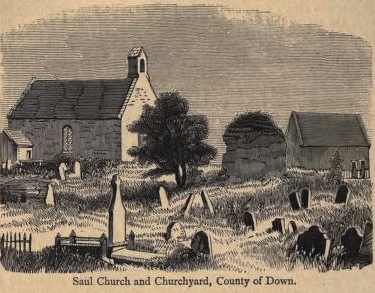
In this final paper ecclesiastical historian, Father Sylvester Malone, argues for Saul rather than Downpatrick as the burial place of Saint Patrick. Although he examines the same evidence as Bishop John, Father Malone takes a more sceptical approach and reaches different conclusions.

ST. PATRICK'S BURIAL-PLACE

THE burial-place of our national saint, like other incidents connected with him, has been a matter of doubt and discussion. The doubt arises from the contradictory notices in the Book of Armagh. These notices appear in one place to favour the claim of Downpatrick to the burial-place; in a second place, the claim of Saul quite convenient to it; and in a third place, the claim of Armagh. The value of each of these notices is not the same, but depends on the intrinsic evidence of the statement, as well as on the bias and intelligence of the writer, and on the age to which he belonged.

The claim of Armagh is very slender, and rests merely on the possession of some relics of St. Patrick of some kind, coupled with the supposition of only one Patrick having been in the early Irish Church; but the existence of two Patricks and their respective identities have been established in a former number of the I. E. RECORD. I am not in accord with those who deny the existence of bodily relics of St. Patrick in Armagh during the ninth century. It was natural and usual to desire the possession of some relic of a saint less renowned than St. Patrick ; and that Armagh procured some bodily relic of him is clearly evidenced in a passage in the Book of Armagh. This passage, which must have escaped the notice of the advocates for Armagh, taken by itself would seem to favour their pretensions. [" In ecclesia australi ubi requiescunt Corpora Sanctorum peregrinorum de longue cum Patricio trausmarinoruin caeterorum que Justorum.'' (Book of Armagh, fol. 21, a. 1.]

The biographers of our national saint have surrounded his death and burial with childish miracles. A comparison instituted by them between him and Moses, however edifying it may be, has led to error on several incidents in his life and the circumstances of his burial. The advocates for Downpatrick have so rested the story of his death and burial on a supernatural basis, as scarcely to leave a human fringe for historical criticism. Nevertheless, the proofs adduced by them appear to me quite questionable, while I judge those in favour of Saul to be highly probable.

I now give a description of St. Patrick's burial-place from the oldest, most impartial, and consistent account in the Book of Armagh. Tirechan, in a lengthened summary of the saint's life, taken from the oral and written account of Bishop Ultan, who lived in the middle of the seventh century, states that St. Patrick was like to Moses in four things, and the fourth thing was that " no person knew where are his bones." The writer then continues to state that two hosts contended for his body during twelve days without night ; and on the twelfth day, as the contending parties were going to give battle, each party saw with themselves the body on a bier, and in consequence refrained from fighting.

Then, as if to justify a departure, by the discovery of Columkille, from the likeness to Moses, the writer continues thus in reference to the burial and the prophetic gift of Columkille :

" Columkille under the influence of the Holy Ghost pointed out the burial-place of St. Patrick, makes out for certain where it is, that is in Sabul-Patrick, that is in the church, as a sprout from the waves, beside the sea, where is the bringing together of relics, that is of the bones of Columkille from Britain, and the bringing together of all the saints of Ireland on the day of judgment."

Now, nothing can be clearer than this valuable statement. The burial-place is stated to have been at the Sabul or Barn of Patrick : there was only one such place, and that within two miles of Down. The passage just quoted calls for a few remarks. First of all the absence of darkness during twelve days of waking is only a natural explanation of the effect of the lights over the corpse; and though there may have been a desire on the part of some people from Armagh to have the burial take place with themselves, we need not suppose there was a disposition to come to blows: a little exaggeration in the description is only very natural. The saint's wish was a command; and, as stated in the Book of Armagh that wish was carried out by his burial in Sabul or Saul. A holy rivalry for the possession of his body was a mark of religious zeal. Hence in another passage in the Book of Armagh, in reference to this subject, the writer states that without divine intervention, "it was impossible to have the peace kept about so illustrious and saintly a corpse." Friendly contention then about the body of our saint was only what decency required.

There is no good reason for doubting that some of the relics of St. Columkille may have been enshrined with those of St. Patrick, though the principal part of them were not located in Ireland till the end of the ninth century. St. Columkille in full health is said, in the Book of Cuana, to have come to St. Patrick's grave, and to have enshrined some of the relics buried with him ; and it is not unnatural to suppose that when dying he or his followers after his death wished to have some of his own relics rest with our national apostle.

The allusion to the gathering together of all the Irish saints at Saul is grounded on a petition found in his confession, to the effect that he should lose none of the Irish given him by God. In consequence of this, some Lives stated that God "left to him the judgment of the Irish on the day of doom." This tradition took another form, according to Tirechan : it was one of the three petitions which he made when dying; namely, ''that each of us repenting, even in the hour of death, would be saved on the day of judgment and escape hell." The church beside which our saint was buried - the sabul of Patrick stood, as a sprout from the wave, near the sea. The tidal waters flowing through the inlet of Strangford Lough flooded the low-lying grounds, even under the very shadow of Saul. Even down to the present century, the low ground was occupied by a standing lake, a mile in circumference, and is still called the salt marsh ;but, in early times, before a rampart was thrown up to dam the waters, the Sabul Church, peering above the wavelets, appeared to spring from the very waters. Now what is the reply usually given to this clear and natural statement, that he was buried in Saul ? This only that Saul meant Downpatrick! Such a reply scarcely deserves notice. We have another proof that St. Patrick was buried in Saul: it is found in the Fourth Life as given by Colgan. Saul is incidentally mentioned in connection with a plaything that accidentally fell into St. Patrick's grave there. The incident is alluded to as follows : -

"A boy playing about the church of Saul let his hoop drop into a chink in St. Patrick's grave; and having put down his hand to take it up could not withdraw the hand. Consequently, Bishop Loarn, of Bright, a place near at hand, was sent for ; and on his arrival addressed the saint thus: 'Why, O Elder, dost thou hold the hand of the child?'"

Here we have a statement incidentally made in reference to one of the incidents that filled up the life of our saint. It is made without a design of propping up a political or religious system. It was made at a time when Saul was comparatively insignificant, and when Downpatrick, owing to its situation, as a great emporium, had risen to importance, and was the seat of the chief of Ulidia.

Let us now examine what is said in reply to this proof. The reply is that St. Patrick did not hold the hand of the boy at all; that the phrase tenentem manum seems a translation of Irish in the Tripartite, gabail lama - expelling; that our saint only drove away the boy who gave annoyance; and that Bishop Loarn, who probably outlived our saint, was one of his religious family. The interpretation thus quoted is given on the authority of Dr. Stokes; but, with great respect for his accurate knowledge of Irish, he is not to be implicitly followed, as has been proved elsewhere. But before dealing with this, his opinion, I have to observe that though the Book of Armagh makes mention of a Loarn settled in Connaught, there is no warrant for stating that there was a Bishop Loarn in Downs, during the saint's lifetime; nor is there the least warrant for stating that he died before our saint. There is no valid reason then producible for denying the certain statement of the biographer -that St. Patrick was dead and in his grave when Bishop Loarn was sent for.

I now deal with the objection founded on the opinion of Dr. Stokes ; namely, that tenentem manum was a mistranslation of gabail lama, "expelling," and that consequently St. Patrick was not dead, nor his grave made on the occasion referred to, but "drove away" the playing boy perhaps with too much harshness : in confirmation of this latter view, the Tripartite is appealed to as an authority for stating that St. Patrick was not "always meek and patient;" and hence the rebuke of Bishop Loarn for probably too much harshness.

Well, an explanation that involves a censure on our national saint for harshness towards an unthinking boy at play is very suspicious. Besides, even if the boy were annoying the saint, as alleged, and if the saint exceeded the limits of moderation in correction, was it a case for having a bishop sent for, and have him rebuke his superior? Moreover, when the bishop came on the scene our saint's action was continued; and if tenentem manum meant expelling, the boy must have been persistently bold during the time the bishop was being sent for, and was coming to the church; and this fact should render impossible the charge of harshness for driving away the boy.

Again, if tenentem manum in the Latin Life be, as stated, a mistranslation of gabail lama in the Tripartite, and as Dr. Stokes has stated that the Irish Life was written in the eleventh century, while, the Latin was written in the ninth century, how could the latter be a mistranslation of the former?

In good truth, the writer of the Latin Life knew the meaning of tenentem manum ; and if he wished to express the idea of expulsion he had only to use the proper and natural Latin expello. On the other hand, if the writer of the Tripartite intended to express the same idea, he would have used, as on all other occasions he did use, the word indarb.

The Irish as well as the Latin phrase meant literally "seizing the hand," and figuratively "overpowering" or "thwarting." But I am told that other instances in the Tripartite countenance "expelling" as the meaning of the phrase. Well, all the instances which occur to me I will submit to a test. In looking into page 118 (Roll's Tripartite), I find the phrase gebthar do lam, "thy hand shall be seized." This was a reply from the angel to St. Patrick, who refused to budge till he obtained the privilege of rescuing as many souls from hell as hairs on his chasuble. The reply meant, "you shall be overpowered," and nothing more. The editor of the Tripartite inferred from the remark of St. Patrick about budging, that the reply had an antithetical meaning, but the inference was not correct.I alight on another instance. St. Patrick wished to establish a house in Assaroe, but was opposed by Coirbre " who sent two of his people to 'prevent him,'" gabail lama.

But a more crucial instance of the phrase occurs in page 156 of the Roll's Tripartite. Our saint wished to establish a house in Inishowen ; but Coelbad " prevented him in regard to it," gabail a laim ass, which the editor renders by "expelling thence." Now the addition of the word ass here, and not in the other instances, is translated by "thence." But surely we understand that when there is question of a person being in a place, and of his expulsion, the expulsion is from that place. The addition of the word ass then is unnecessary on the supposition that the phrase gabail lama in the other instances without it meant "expelling." I shall not dwell on another instance, in page 164, which has the same meaning ; and in these instances the word ass means not "thence" but "in regard to it."

That such is the meaning of ass, is very clearly brought out in page 163. It is there stated that our saint wished to take a place in Cell Glass, and (dlmotha do ass) "he was refused," according to Roll's editor, but properly and literally "it was refused to him in regard to it." The editor having no meaning for ass, but "thence," and seeing such a translation to be unmeaning, he did not translate it at all. The Irish word ass lends itself to various idiomatic phrases with which the learned editor is apparently not familiar. I hope now it may be admitted that the allusion to the detention of the boy's hand in St. Patrick's grave was not a mistranslation of the Irish, and that it establishes a belief in the writer of Vita Quarta as to the burial-place of St. Patrick in Saul.

Notwithstanding the political and social greatness to which Downpatrick had risen, and the comparative obscurity of Saul, there is evidence of its claim to St. Patrick's burialplace being recognised in succeeding ages. Thus, the Four Masters, under the year 1293, state that the relics of St. Bridget and Columkille were discovered with the remains of St. Patrick at Patrick's Saul. The discovery, witnessed by the Archbishop of Armagh, was accompanied by miraculous manifestations. The same statement is made in the Annals of Ulster. The fact remains, that at the end of the thirteenth century, we find solemn testimony, confirmatory of the statement made in the Book of Armagh, in the seventh century, in favour of Saul being the burial-place of St. Patrick.

Now, in reply to the several clear and natural statements made, without the aid of supernatural agency, in favour of Saul, what are we told ? This, that Saul meant Downpatrick, and that tenentem manum did not mean "holding the hand." And the proof in favour of the rival burialplace, of what is it composed? Merely of mystery, visions, and miracles ! That one angel was commissioned by another to send St. Patrick to him ; and the saint, having gone, was told by the angel from a flaming bush (a) that his death would be in Saul ; but, as a compensation to Armagh, that it should have primacy; (b) that there was to be no darkness for twelve days, or rather partial day for the rest of the year; that angels waked St. Patrick with vigil and psalmody during the first night, whilst all who came to the wake slept ; that oxen, yoked to the bier, were to be left to themselves to carry the corpse to the destined burial-place ; (c) that the rival provinces of Down and Armagh were kept from deadly fight by the swelling tide which became instinct with life ; that on the ebb of the tide the people of Armagh, fording the river, fancied they saw the bier carried on towards Armagh, till it disappeared at Cabcenne stream; that the corpse was to be buried, by angelic directions, seven feet deep in the earth ; that the relics should not be removed from the earth, but a church built over them; (d) and yet, that no person knew where was the burial-place : all this supplies material for the argument in favour of Downpatrick!

But I would offer a few hurried remarks (a) We are told in one place that St. Patrick went to the angel, but quite the contrary in the next page. (b) The primacy is said to have been given then to Armagh ; but it had been given, on as good authority, long before then to Armagh. (c) The angel directed a very practical direction that a church should be built where the oxen were to stop, over the corpse. What if they had not stirred from Saul, where there was a church, or moved to a place where there was already a church ? (d) It is strange that, as the Armagh people acknowledged the finger of God on the disappearance of the phantom bier, they paid no heed to the angel's directions, and were determined to give battle or have the corpse, (e) It is equally strange that a church directed by angels to be built, was undertaken only at the end of the seventh century. The narrator states that when a foundation for the church was being dug, quite recently ('novissimis temporibus'), flames issued from the grave. Does not this prove that the burial-place was known, notwithstanding the similarity to Moses ? Besides, the angel, in directing the building of a church, and directing that the delvers should sink the grave seven feet deep, must not have intended that the burial-place should be unknown. I may be told that a mistake in regard to Saul should rather be admitted than a whole cycle of miracles in defence of falsehood. Well, however unpleasant the fact, it must be admitted that unenlightened zeal or dishonest bias can sport with miracles for its own ends ; and the Book of Armagh affords ample proof of it in another passage.

The Book of the Angels tells its readers that an angel having tapped St. Patrick out of slumber, snatched from his long vigils, announced that God " gave him and to the diocese of Armagh all Ireland." The saint then is represented as deprecating such a large and unnecessary gift, because of receiving already a peculiar rent, given freely, though a debt ordained by God, from every free church, and as having no doubt that this debt would be decreed for the future bishops of Armagh by all cenobitical monasteries. What a caricature and profane libel this on the saint's disinterestedness! The writer ought to have remembered the Confession -

They have given me small voluntary gifts, and some of their ornaments upon the altar ; but I returned these to them, though they were displeased with me for so doing. But ... I wished to keep myself prudently in everything ... so that unbelievers may not, in my ministry, in the smallest point, have occasion to defame it."

But, perhaps, since I have baptized so many thousands, I may have accepted half a screapall. Tell it to me, and I will restore it. When the Lord ordained everywhere clergy, through my humble ministry, then if I asked the price of my shoe, tell it against me, and I will restore you more. I spent for you, that they may receive me."

In order to prop up the claims of Downpatrick, angels must commune with each other ; man had to abdicate the possession of his senses ; the brute beasts are brought to the scene to act their part ; and the waters became instinct with life " in digging deep valleys, while, at the same time, piercing the air" as a barrier against contending provinces. Heaven and earth are moved, with their inhabitants, in order to neutralize an historical and the earliest statement in favour of Saul. This simple and natural statement, in striking contrast to its contradictory, tells us that our saint, overtaken by the sickness of death at Saul, was there buried. Saul was his first love, the scene of his first missionary success, and the closing scene of his divinely-favoured apostolate. The alleged signs and wonders in connection with the burial resemble others on which, before the present, I had to observe that their extravagance appeared in proportion to the evidence of the falsehood in support of which they appeared to be manufactured. Downpatrick possessed nothing in fact, in association, in prophecy, not even a church, suggestive of a burial-place. Neither the glory of God, so far as it is allowed us to raise a corner of the mysterious veil, nor edification of man called for Divine interposition on the occasion. As to the dying wish of the saint, it certainly did not lean to Downpatrick, nor probably, notwithstanding the repeated and accentuated assurances to the contrary in the Book of Armagh, to Armagh; for his wish on such a matter would be an absolute command; and as to a chosen spot, "all Ireland was given to him as his diocese."

It was only natural, then, in the circumstances that the great high priest, the glorious national apostle, would lie where he fell; and, if it were not natural, it would be a matter of indifference to him who, in his extreme old age, had to say :

" I daily expect murder, or to be circumvented, or reduced to slavery, or to a mishap of some kind . . . And if ever I have imitated anything good on account of my God, Whom I love, I pray Him to grant me that, with those proselytes and captives, I may pour out my blood for His name's sake, even though I may be deprived of burial, and my corpse most miserably be torn limb from limb by dogs or wild beasts, or birds of the air should devour it."

In conclusion: the alleged angelic direction in regard to the burial of St. Patrick in Down, and to the church to be built over him, is still further proved to be false by the fact that law and custom forbade any person in the fifth century to be buried in a church, or a church to be built over him, unless he was a martyr.

SYLVESTER MALONE.

IER, vol 15, 1895 341-351

Content Copyright © Trias Thaumaturga 2012-2015. All rights reserved.