Showing posts with label Poems. Show all posts

Saturday, 3 February 2024

Saint Brigid, Fair Jewel of Erin


We continue the series of posts in honour of the feast of Saint Brigid with another gem from Down Under. Signed W.W. of Sydney, this poem celebrates all of the traditional Christian virtues of Saint Brigid. Verse three emphasizes Saint Brigid as an exemplar of purity for Irish women, a message no longer in fashion in contemporary presentations of our patroness. This 1922 poem thus illustrates how differently Saint Brigid was perceived one hundred years ago:

SAINT BRIGID.
(February 1.)

Blessed Saint Brigid, fair jewel of Erin,
Perfect exemplar to shield us from
wrong;
Ardent to-day is the love of thy people,
Hallowed thy name through the centuries
long!
 
Forth from Kildare spread the fame of thy
virtue,
Reaching through Ireland from shore
unto shore,
Breathing a message of hope to the hope
less,
Spurring the fervent to love God the
more.
 
Bright is the light thou hast shed down
the ages,
Burning white splendour of purity's ray,
Pointing the path for the daughters of
Erin;
Brigid, oh, help their descendants to-day!

Sundered by sorrow, thy people have wandered,
Finding in Austral a refuge, a home
Bringing the light of the faith that they
cherished,
Teaching thy glory wherever they roam!
 
Dear to thy heart were those children of
Erin, 
Grant us a share in thy love, too, we
pray;
Swift in our veins runs the blood of our forebears;
Brigid, protect us and guide us alway!
 
W.W.

Sydney.
 
'SAINT BRIGID.', The Catholic Press, Thursday, 2 February, 1922, p. 18. 


Content Copyright © Trias Thaumaturga 2012-2024. All rights reserved.

Tuesday, 7 February 2023

Saint Brigid's Fire


Although I have found many examples of verse in praise of Saint Brigid by nineteenth-century Catholic writers, below is one by a Protestant author, Alessie Bond (1841-1902), daughter of a Church of Ireland rector and wife to another. Although she would share with Catholic writers of the period an approval of Saint Brigid's womanly role as a practical exhibitor of Christian charity, there is no mention of our patroness here as the 'Mary of the Gael'. The Protestant tone of this lady's work is perhaps visible in the second verse with the reference to Saint Brigid learning that life was 'in Christ alone' and in the evangelical zeal of the final verse. I do find it somewhat ironic though that she has chosen for her theme the perpetual fire that supposedly burnt at Kildare, since this was a victim of the Reformation suppression of the monasteries and was reputedly extinguished on the orders of a bishop of her own church!

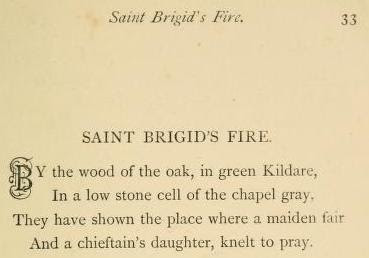
SAINT BRIGID'S FIRE.

BY the wood of the oak, in green Kildare,
In a low stone cell of the chapel gray,
They have shown the place where a maiden fair
And a chieftain's daughter, knelt to pray.

She had heard the tidings by angels brought,
She had learn'd that life was in Christ alone;
She had clasp'd the faith the Apostles taught,
And had cast away her gods of stone.

On the things of Heaven she placed her mind,
And watch'd for the way her love to show;
She tended the sick and she led the blind,
And she taught the poor what they should know.

Saint Brigid died, but the legends tell,
She had lighted a flame where none now appears,
Charging her maidens to tend it well,
And it died not out for six hundred years.

Plunder and tempest and hostile band
Might ravage the valleys of green Kildare,
Might kill the peace of her lovely land,
But not that flame, nor her people's prayer.

Where is the fire of devotion now,
To burn through a lawless age and ill?
Shall clearer light show neglected vow.
And wiser virgins have fainter will?

Arise and shine! for the spell is o'er.
Wave high the torch they would rend away!
Let the words of God, as they were of yore.
Be the beacon of Erin till break of day !

Alessie Bond, The Cairns of Iona and Other Poems, (Dublin, 1873), 33-34.

Content Copyright © Trias Thaumaturga 2012-2023. All rights reserved.

Sunday, 5 February 2023

To Dear St Brigid, Ireland's Patroness


Another offering today from the Victorian popular religious press as we continue the series of posts in honour of Saint Brigid. The following poem originated in 'The Irish Catholic', but was syndicated in the Australian press, in this case the Advocate, a weekly Catholic newspaper published in Melbourne.  Our patroness is here depicted in her role as an intercessor for Ireland and its people. Verses two and three ask that she cast her mantle over the people as a protecting shield from unspecified dangers which threaten, just as she sheltered their ancestors from 'cruel foes' in days of yore. Verse four asks that the youth of Ireland be preserved from falling away from the way 'of loyal faith and stern duty', a peculiarly Victorian way of appealing to the young.  In verse five Saint Brigid's intercession is also sought for the dying, with the hope that in the struggle to leave this life she will banish their fears. But it is the final two verses which really reflect the era of the nineteenth-century national revival in which this tribute was written. The penultimate verse, with its naive hope that 'soon' the praises of God and Saint Brigid would be sung in our own dear language, reminds us that the revival of the Irish language was a part of the national movement. In what is presumably an allusion to the shamrock, the poem ends with a soaring statement of the Irish nationalist vision in a request that Ireland will never sever the 'triple leaf' of faith, in prayer and love and duty, to God and country unto death:

To Dear St. Brigid, Ireland's Patroness.

Soft as an angel's whisper
Comes the thought of thee, sweet Saint,
Erin's bride, and gentle guardian,
Free from evil, and its taint.

Come, and with thy mantle shelter
The children of our Isle,
Dangers threaten, O protect them
From the demon's treacherous smile.

'Neath that shield no dart shall pierce them.
Oft of yore it screened from foes
Those who claimed its truthful succour,
In the midst of cruel foes.

Save the youth; the tempter's watching
To beguile them from the way
Of loyal faith and stern duty,
Oh! dear saint, we humbly pray.

Come to those who claim thy succour,
The evening of whose life draws near.
Stay, uphold them in the struggle;
Near thy heart they need not fear.

Soon our "Gaelic tongue" will echo
Thoughts of thee and all thy ways,
In our own dear Irish language
God and thee we all shall praise.

Ask that Ireland ne'er may sever
The 'Triple leaf' of Faith,
Faith in prayer, in love, in duty,
To God and country unto death.

—"Irish Catholic."

To Dear St. Brigid, Ireland’s Patroness,  Advocate, ( March 16, 1901),  p. 2.


Content Copyright © Trias Thaumaturga 2012-2023. All rights reserved.

Sunday, 25 December 2022

Saint Patrick's Flowers


It seems strange perhaps to be writing about Saint Patrick at Christmas, but the shamrock is not the only plant to which our national apostle has a link. Below is a poem by Irish-American poet Patrick Joseph Coleman, a frequent contributor to the popular religious press. In this offering from the December 1908 edition of The Rosary Magazine he recounts a legend of Saint Patrick, travelling in France at Christmas time on a visit to Saint Martin of Tours, where he is offered shelter by a thornbush which miraculously burst into flower. Father William Bullen Morris, author of a substantial Life of Saint Patrick, gave a short summary of this story: 

The inhabitants of St. Patrice record an ancient tradition, which in its simplicity is full of freshness and poetry. St. Patrick, it is said, being on his way from Ireland to join St. Martin in Gaul, attracted by the fame of that Saint's sanctity and miracles, and having arrived at the bank of the Loire, near the spot where the church now bearing his name has been built, rested under a shrub. It was Christmas time, when the cold was intense. In honour of the Saint, the shrub expanded its branches, and shaking off the snow which rested on them, by an unheard-of prodigy arrayed itself in flowers white as the snow itself. St. Patrick crossed the Loire on his cloak, and on reaching the opposite bank, another blackthorn under which he rested at once burst out into flowers. Since that time, says the chronicle, the two shrubs have never ceased to blossom at Christmas, in honour of St. Patrick.

When the present writer visited St. Patrice in August, 1881, he was struck by the extraordinary beauty and luxuriance of the foliage on the tree: it was so dense from the ground upwards that it was impossible to distinguish the stem, and he could under- stand how, when it flowers at Christmas, it supplies the country round with trophies of St. Patrick. It also appears that they are objects of religious veneration, as we learn that M. Dupont always kept a branch of the Fleurs de St. Patrice, hung up in his room...

Rev W.B. Morris, Life of Saint Patrick, with a Preliminary Account of the Sources of the Saint's History (4th ed., London, Dublin and New York, 1890), 271. 

Coleman's poetic rendering of the legend sticks very closely to the story recounted by Father Morris but adds a postscript telling us that the thorn bush flowers every Christmas night. Nollaig Shona daoibh go léir!


St. Patrick's Flowers 

By P. J. Coleman 

Beneath the freezing winter gale 
Poured Loire its waves in sullen flow; 
’Twas Christmas Eve, and hill and dale 
Lay mantled deep in snow. 
 
’Twas Christmas, and of Christ, our Lord, 
To hut and hall the church bells told, 
When to the river’s bank there trod 
A pilgrim, faint and old. 
 
A pilgrim, worn with many a mile 
Of weary journey since the dawn — 
’Twas Patrick, Saint of Erin’s isle, 
To Tours of Martin drawn. 
 
At Tours lived Martin, Patrick’s friend. 
Upon the river’s southern shore. 
How shall he gain his journey’s end. 
Or win him passage o’er? 
 
There was no sound of boat or bark, 
Nor fisher’s keel, nor ferry frail; 
Deserted flowed the river dark, 
With not a single sail. 
 
Deserted lay the lonely shore 
Beneath the cruel winter storm; 
No cheering light, no ruddy door 
To give him welcome warm. 
 
Then, while he paused upon the bank, 
Footsore with many a weary league. 
Beneath a leafless bush he sank. 
All spent with sore fatigue. 
 
Now shall he perish in the storm, 
The pilgrim, wearisome and faint; But no! 
A breath of summer warm 
Blows round the sleeping saint. 
 
A breath of fragrance, as if June 
Had culled a rosy coronal, 
And on the gentle saint aswoon 
Had let the blossoms fall ! 
 
And lo! as if the snow-drifts blanch 
Its boughs, — oh, miracle divine! — 
The bush in every bole and branch 
With blossoms ’gins to shine. 
 
And spreads above Saint Patrick’s head 
Its fragrant canopy of bloom; 
Bestrews for him a petalled bed, 
And pillows of perfume. 
 
And draws around, of leaf and flower, 
To shield the sleeper from the storm. 
The woven branches of its bower, 
Its shelter sweet and warm. 
 
So, sheltered by the blessed thorn, 
Slept holy Patrick all the while. 
Until at last the glorious morn 
Across the land did smile. 
 
N. B. — This event occurred at the village of St. Patrice on the northern bank of the Loire. The white-thorn blossoms every Christmas night.

The Rosary Magazine Volume XXXIII, December 1908, 642-643.


Content Copyright © Trias Thaumaturga 2012-2016. All rights reserved.

Tuesday, 17 March 2020

The Story of Saint Patrick - A Legend in Verse

To celebrate Saint Patrick's Day, below is a poem describing his life by a nineteenth-century priest ministering to an Irish expatriate congregation working in the heavy industries of England. The introductory paragraph tells us that the writer, Father George Montgomery, wanted to foster devotion to Ireland's patron among the young and so adopted the form of street ballads, then popular in industrial towns and cities. Father Montgomery was an interesting character, this blog tells us that he was a convert from Protestantism in the heady days of the Tractarian movement. This perhaps explains his desire to emphasize in the poem that Saint Patrick had Papal approval for his mission. So on this day, let's honour the memory of this hard-working Black Country priest as well as that of our hard-working patron, Saint Patrick, as we enjoy The Story of Saint Patrick - A Legend in Verse:


.


HALF-HOURS WITH THE SAINTS.— No. II.

The Story of S. Patrick.

A Legend in Verse, by the late Rev. G. Montgomery, of Wednesbury.

[The following story, in verse, of the life of S. Patrick, here given in a somewhat abridged shape, was written in moments of leisure snatched from the laborious duties of a missionary priest, placed in the heart of the mining and iron-working district of South Staffordshire. Its writer had in view mainly the instruction of the young of his flock, to whom he wished a knowledge of the history of the Patron Saint of their native country to become a household possession. The better, as he thought, to secure this end, he has given his lines the form of the popular ballads often heard in the streets, sung or recited by ballad street-singers. We ask a prayer, for the honour of S. Patrick, for the repose of the writer’s soul, who is now passed away from the scene of his former labours by a death accelerated through the cares and troubles of his mission.]

Patrick, our Erin’s famous saint, the subject of this lay.
Was born in greater Brittany, the Church’s lessons say;
Nigh years three hundred and threescore from that great day of mirth,
When Angels sang the Saviour born, we date Saint Patrick’s birth.

He had not sixteen summers seen, when, lo, a pirate band,
Ruthless, on deeds of plunder bent, approached Taburnia’s strand.
Then, marching from their mooring place, by a bold captain led,
They to Taburnia’s peaceful homes with evil purpose sped.

They sacked the homes, they swept the fields, they bore the youths away;
They captured, with his sisters twain, our Patrick on that day.
They put to sea, this heathen crew, they gained the Irish soil;
They spread themselves along the beach, and there displayed their spoil.

A wealthy chieftain came to buy, to him was Patrick sold,
But what befel the little maids the legends have not told.
We trust that God, at Patrick’s prayer, took up the children dear,
To be in joy with Saints above, safe from distress or fear.

The steward of Saint Patrick’s lord now sent the lad to keep,
Upon a far wild pasturage, his master’s flock of sheep.
There, heedless of the frost and snow, and of the driving rain,
He rose before the light to pray upon the open plain.

He for his people did deplore, that they in sin were found,
Whereby their homes had been despoiled and they in exile bound.
For he who loves, the Scripture saith, shall pardon crave for sin,
And so did Patrick’s prayer avail the souls of men to win.

Now Patrick, by decree of God, was soon at large to be,
Yet twice again was captive ta’en, and twice again set free.
Thus oft was he by sorrow tried, as gold is tried in fire,
That from his heart God’s love might burn as dross all base desire.

For God had chosen him to teach, and by his zeal to save,
The very Pagan race with whom he once had lived a slave.
But he who goes the faith to preach, should be with knowledge fraught,
So Patrick humbly went to those by whom he might be taught.

He crossed to Gaul, he visited the great Saint Martin there,
And studied long with Saint Germain, the Bishop of Auxerre.
He learned all holy discipline, and piously he took
Most earnest care to be well versed in knowledge of God’s book.

But Patrick knew that ere he sought the heathen’s hearts to move,
He must commission have from Rome, at Rome his faith approve.
For Christ on Peter built His Church, surnaming him The Rock:
To Peter gave the keys, and said, “ Thou, Simon, feed My Flock.”

And every Christian ought to know that in the See of Rome
Peter doth ever live and speak, and ever hath a home.
So thither Patrick bent his steps, and found of Peter’s line
The prince who sat on Peter’s Throne, by name Pope Celestine.

This holy Pope he caused our Saint awhile in Rome to bide,
Then with full power he sent him forth a Legate from his side.
With holy haste our Saint proceeds unto Hibernia’s shore,
Eager to bless the land he loved, and gift it from God’s store.

’Twas on a glorious Easter Day, at Tara’s famous hall,
Saint Patrick met the Irish king, the bards and chieftains all.
“I come,” quoth he, “a humble man, the strong and proud to face.
In the Name of the Blest Trinity to bring you truth and grace.

"Let God arise, and let His foes scattered before Him be;
Let them that hate Him, like thin smoke, at His bright presence flee.”
Chanting these words the Saint dispersed the demons of the air,
Who then, with purpose fell, swarmed in the Court of Leogaire.

And God was with Saint Patrick’s work, and blessed all that he wrought,
Whereby the champion gained at last the prize for which he fought.
The people flocked to be baptised; pastors o’er all the land
Were consecrated and ordained by Patrick’s own right hand.

To many maids and widows, too, he gave the sacred veil,
And gathered them in order due within Religion’s pale.
And by the right he had from Rome, our Saint made this decree.
That in the city of Armagh the primate’s chair should be.

Thus he who once as slave did keep a farmer’s fleecy flock,
As Prelate great for Christ did fold the faithful Irish flock.
And God in mercy granted him before his course was run,
To see his loved Hibernia for Christ and Mary won.

Satan since then has often tried, with all his force and guile,
To seize again the land he lost when Patrick blessed our isle.
But quite in vain are all his wiles to change her steadfast will,
For Ireland's heart unfailing cleaves to God and Mary still.

And Erin’s faith hath well withstood the scoffer's biting gibe,
The scaffold, sword, and prison cell, and often-proffered bribe.
So let all pray that in this land, this holy faith may last,
By virtue of Saint Patrick’s prayer, till time itself is past.

The Monthly Magazine Of The Holy Rosary; Under The Direction Of The Dominican Fathers, Volume 1, 1872-1873, 211-214.


Content Copyright © Trias Thaumaturga 2012-2018. All rights reserved.

Wednesday, 4 February 2015

To Saint Brigid

Saint Brigid has been the subject of many poems over the centuries. I think it would be fair to say that this offering, published in 1926, would hardly be numbered among the greats, but it does at least see its subject as a Christian saint and opponent of paganism, a sentiment which is absent from so many contemporary offerings. I am also glad to see the writer give Saint Brigid her place as a patron of Ireland.

To St. Brigid

Dear Patron of our ancient race,
With Patrick and with Columcille,
The hand of Time can ne'er efface
The memory of thy zeal and grace -
It lingers with us still.

You saw the pagan darkness die
Within our country's shore,
And Faith's bright star illumined her sky,
For Erinn's golden age was nigh,
And Baal's reign was over.

Maurice R. Cussen

The Irish Monthly,Vol. 54, No. 639 (Sep., 1926), p. 483.

Content Copyright © Trias Thaumaturga 2012-2015. All rights reserved.

Tuesday, 10 June 2014

Colum Cille: a safe fort


He is the protection of a few, he is the protection of many,
safe is every one in peril to whom he is a fort;
he is a safe fort, it is a fair advantage
to be under the protection of Colum Cille.

Fergus Kelly, ed.and trans., A Poem in Praise of Colum Cille, Ériu, Vol. 24 (1973), 11.

Content Copyright © Trias Thaumaturga 2012-2015. All rights reserved.


Thursday, 8 August 2013

Saint Brigid and the Blind Nun

August 8 is the commemoration of Saint Daire, one of three female saints commemorated on the Irish calendars who bear this name. In his account of Saint Daire, which can be read at my other site here, Canon O'Hanlon suggests that she may have been the blind nun Daire, who features in a poignant episode from the hagiography of Saint Brigid. The miracle of the blind nun was rendered into verse by the poet Aubrey de Vere (1814-1902), whose work was widely quoted by Catholic writers like Canon O'Hanlon in their work on the Irish saints:

ST. BRIGID AND THE BLIND NUN.


ST. BRIGID is the mother, all men know,
Of Erin's nuns that have been or shall be
From great St. Patrick's time to that last day
When Christ returns to judge the world with fire.
Her life was full of marvels; here is one
Some deem than miracle miraculous more.

'Twas summer eve: upon a grassy slope
Which overlooks Cill Dara's boundless plain
She sat, and by her side a fair blind nun
Of them that followed her and loved her rule,
And sang her nocturn psalms. They spake of God,
The wonder of His dread inscrutable Being,
Round all, o'er all, in all; the wonder next
That man, so slight a thing, can move His love,
Can love Him, can obey: the marvel last
Of God made Man; the Infinite in greatness
By infinite descent a creature made,
Perchance within the least of peopled worlds

For saving of all worlds. The sun went down:
Full-faced the moon uprose: the night-wind sighed:
It broke not their discourse. For them it swayed
Not Dara's oaks but boughs of Olivet,
Brightened their midnight dews.

The dawn returned:
It flushed the clouds: it fired the forest's roof :
It laughed on distant streams. The splendour burned
In the green grass and lived in brake and bush:
Transfigured earth upreared a face as when
Man his terrestrial to celestial changed
Shall look upon his Maker ; such a face
As angel-hosts raised to God's universe
"When, first evoked, it burst upon their sight
From night primeval and that chaos old.

St. Brigid gazed upon that dawn: a thought
Keen as a lance transfixed her heart: she mused,
'Alas, this poor blind Sister sees it not ! '
She clasped that Sister's hand, she raised, she kissed
it:
That blind one spake: ' Why weepest thou, Mother
mine?
Thy tears are on my hand! ' The Saint replied;
'I weep because thou canst not see yon dawn,
Nor in it God's great glory.' Then the nun;
'If that thought grieves thee, pray and I shall see.'
St. Brigid knelt ; and, lo, the blind one saw!

'Twere sin to paint in words that creature's gladness:
 It lasted long: it passed: by slow degrees
A twilight shadow tinged the sweet, pale face:
She spake: 'Great Mother, you can watch yon dawn
Yet nothing lose of that more heavenly vision
"Which lights God's inner realm within our hearts.

That inner world hath been my comfort; there
Ever I saw my Jesus, first a Babe
Couched in His crib, a Boy within the Temple,
At Cana's marriage feast, by Lazarus' tomb,
Upon the mount of His Beatitudes,
Upon the mount of His Transfiguration;
I tracked His steps through fields of Palestine;
I heard His Parables; I saw Him lay
His hand upon the blind, the dumb, the dead;
I knew that voice in all its holy changes,
His footstep, and the joy upon the face
Of those who heard that footstep though far off
Martha, or Mary, or the loved disciple;
Daily these things I saw: that vision pales,
Dazed by the earthly splendours of this dawn,
Dim as earth dimmed when blindness near me drew.
Never be blindness mine to heavenly things!
Still let me feel when other help is none
That God is nearest to me, Mother mine!
A weakling I; grant me what weaklings need!
Kneel down once more, and give me back my blindness.'

Then knelt the Saint and prayed once more, and God
Restored to her she loved her holy blindness:
For forty years it lasted: then she died.

Aubrey de Vere, The Poetical Works of Aubrey de Vere, Volume II, (1895), 402-5.

Content Copyright © Trias Thaumaturga 2012-2015. All rights reserved.


Sunday, 16 June 2013

The Death of Saint Columba


THE DEATH OF ST COLUMBA.

The last faint glimmer of sunset gold
Hath sunk in the western wave;
Over the isle the night-winds blow,
Tenderly sighing, moaning low,
Like mourners o'er a grave.

'Tis only meet that his life should close
Where he watched and toiled so well;
How is he keeping this last, sad night,
That the taper burns so late, so bright
In his sternly simple cell?

A scribe sits there with parchment scroll —
“Now haste thee, my son, and write!
Take thou no rest till the death-rest fall,
And watch thou, too, for the Master's call,
That Cometh so oft at night."

The monk wrote on, with eager hand.
No other sound was there;
For the grief in his soul might find no breath
In the presence of work — in the presence of Death,
Till the bell should sound for prayer.

"I would thou hadst closed the golden psalm
With the close of this passing life;
But these words are meet for my last farewell —
They will call the next brother like matin bell
To pray for the holy strife."

The words that looked from the speaking page,
That had touched so deep a chord
In the old man's heart, would thine eyes, too, see ?
They were, "Come, ye children, hearken to me,
I will teach you the fear of the Lord "

Tis the midnight bell! I will enter in
Where my children kneel, once more;"
And there followed one, with torch a-light,
To guide his way through the gusty night
To the lowly entrance-door.

Alone he passed that portal dark,
For the storm had quenched the lights,
And there, as he knelt on the ground to pray,
His soul with the midnight soared away
To its home on the holy heights.

They found him there, the smile of God
Gleamed calm on his saintly face;
And when the deep hush of their pain was o'er,
And they bare him out through the lowly door,
A sweet anthem filled the place.

They laid him low for his quiet sleep
By the Church's western bound —
And few were there that had loved him best!
For the storm beat wild; and of all the rest
No boat could cross the Sound.

The days grew calm, and they bore him back
To the land of his earliest love;
And a coffin was laid in his own green Isle,
For her balmy tears, and her proud, sweet smile,
For her saint in the rest above.

ALESSIE BOND FAUSSETT.

Born in County Tyrone, Ireland.

Daniel Connolly. Ed., The Household Library of Ireland’s Poets, with Full and Choice Selections from the Irish-American Poets (New York, 1887), 649-650.

Content Copyright © Trias Thaumaturga 2012-2015. All rights reserved.


Saturday, 15 June 2013

The Story of Blessed Columba and the Horse


We continue the series of posts for the Octave of the Feast of Saint Colum Cille with a poetic retelling by Katharine Tynan of another story concerning the saint and animals. This one alludes to the tradition that the Columban monastic family were so devoted to their founder that their prayers detained Saint Colum Cille on earth, even though he was more than ready to leave for the glories of heaven. One creature who did understand how the saint felt, however, was an old pack horse which had served the monastery faithfully for many years. The animal places his head on the chest of the saint and weeps, its distress finally bringing the monks of Iona to the realisation that they must let their beloved founder go.

THE STORY OF BLESSED COLUMBA AND THE HORSE.

COLUMBA was kept back
Four years from his reward,
The brethren's prayers, alack,
Prevailing with the Lord.
"O children, let me go!"
'Twas oft and oft he prayed,
Yet still with prayer aglow
They held him from the dead.

They held him back with might,
Kissing his habit's hem,
His soul's wings set for flight,
Were prisoned long by them.
His soul was sick for death;
Yea, anguished long and dumb
To take the lonely path
Should lead the exile home.

At last one Autumn day
When woods were red and gold,
And the sea moaned alway
For summers dead and cold,
Columba, weary foot,
Went out and saw the sheaves,
And flames of yellow fruit
Trembling among the leaves.

He saw the sheep and swine,
The oxen and the ass,
The drying swathes in line
Of rich and honeyed grass:
Opened the granary door,
And saw the brethren had
Of fruit and grain great store
To last through winter sad.

Upon a brother's arm
The great Columba leant;
Bowed was that stately form,
The holy head down-bent.
Yet peace was in his eyes,
Happy and satisfied:
He blessed the granaries,
The beasts and pastures wide.

As slowly home they came,
There limped along the road,
The old horse tired and lame
That long had borne his load.
The horse that night and morn
Drew home the abbey milk,
Drew home the load of corn,
And swathes of grass like silk.

With a low whinnying neigh,
He ran full wild and fast
And hid his forehead grey
Against Columba's breast,
And wept against his neck,
Till any heart of stone
Were very like to ache,
Hearing the creature moan.

"O little horse, so kind"
The dear Columba said;
"How hast thou well divined
I should so soon be dead?
Thou wouldst not keep me, thou,
From glory and from grace
And from Queen Mary's brow,
And from the Lord God's face!”

But while the horse sobbed on,
Columba stroked his mane;
O, any heart of stone
Had ached to see that pain.
And still as home they went,
The horse came following yet;
His head deject and bent,
His eyes still strained and wet.

The brethren they ran out:
Columba, speaking then,
His tender arm about
His patient friend's grey mane.
"O kinder is the beast
That grieves, but lets me go,
Than ye who keep from rest
An old man, sad and slow!

"Far kinder is the horse:
He knows how pastures dim,
With many a water-course,
Beckon so sweet to him.
He too is tired and old,
And knows how sweetly call
The harps and hymns of gold
To me this evenfall.

"Long have they called to me,
My soul is hungered
The dear Lord God to see,
With glories round His head.
Sweet is the thought of rest,
While all the ages roll,
In that eternal Breast:
Yea, lovely to my soul!"

They cried then with one voice:
"No more we will retard,
Go, elect soul, rejoice,
Receive thy great reward!
And yet forget not there
The little ones who go
Like some sad wayfarer
When heaven lets out the snow!"

They led the horse away
Unto his manger brown.
Three days the sorrel-gray
Let the big tears fall down.
Three days the horse did mourn;
The fourth day dawn came faint:
Iona woke forlorn,
But heaven received its saint.

Katherine Tynan, The Story of Blessed Columba and the Horse in W. J. Paul, ed. Modern Irish Poets, (Belfast, 1894), 155-158.

Content Copyright © Trias Thaumaturga 2012-2015. All rights reserved.


Tuesday, 11 June 2013

Columba and the Dove

Below is a poem which captures the theme of exile which the Irish came to associate with Saint Colum Cille. It draws on the story that an exhausted, windswept bird from Ireland was blown on to the shore of Iona. The saint, for whom thoughts of his beloved northern homeland were never far away, nurses the avian exile back to health and sends him on his way home. The poem was published in an American religious journal of 1904 and the sentimental treatment of the theme of exile would, no doubt, have appealed to an Irish-American readership. In the version of this story which I am familiar with, the bird is actually a heron, but perhaps the writer here draws on the literal meaning of the saint's name - 'the dove of the church'. 


COLUMBA AND THE DOVE.

BY P. J. COLEMAN.

IN exile far from Derry's hill
It ached the sweet Columba sore
He nevermore might gaze his fill
On Erin's loved and lovely shore.

He nevermore might hear the finch
In Fanad's wood beside his home,
Nor watch round craggy cape and inch
The surges of Lough Swilly foam.

No more might see Ben Bulban fling
About his form his cloak of cloud,
Nor royal Edar, like a king,
Blaze out in heathery purple proud.

Nor see the shining salmon leap
The cascade white of Assaroe,
Nor net the trout, nor hear the sheep
Bleat in the meadows of Raphoe.

For so decreed the penance sore
That drove him forth an exiled man :
To see his native land no more,
While grass was green and water ran.

But daily, far from Derry's hill,
He walketh where the breakers roar,
And far through mist and sea-fog still
He watches from Iona's shore.

And gazeth o'er the ocean dim
Through smoking spume and drifting spray,
Where on the sunset's golden rim
His Erin lieth far away.

With arrowy sleet his eyes are blind,
The needles of the tempest sting;
When lo! against the northern wind
What cometh up on weary wing?

What cometh from the distant south,
The holy south where Erin lies?
A prayer leaps to Columba's mouth,
The tears well up within his eyes.

" My little bird from Derry's oaks,
Christ Jesu send him safe ashore,
That breasts the breeze with valiant strokes
Of wounded wing and pinion sore!'

So prays he, and through storm and sleet
It wins to land - oh, blessed thing!
An Irish dove, and at his feet
It droppeth with bedraggled wing.

The tears are on Columba's cheek.
" O little wanderer from home,
What dost thou in Iona bleak ?,'
Why wingest thou across the foam ?

" Why dost thou leave thine Irish nest
'Neath Derry's hill by reedy Foyle?
Oh foolish little bird, to breast
The wind that blusters over Moyle!'

" But thou, assuaged of grief and pain,
Shalt win again to Erin's shore.
O happy dove, to see again
The fields my feet may tread no more!"

So spake the Saint with tearful word,
The while with gentle hand he strook
Its plumage soft and raised the bird
And to his convent's shelter took.

And fed it there and brought it forth,
And set it free with happy smile,
And bade it hasten from the north
And win its way to Erin's isle.

'' O little wanderer from home !
Go, hasten hence and take my love
O'er golden leagues of sunset foam
To Durrow's hill and Derry's grove.

" 'Neath Derry's oaks, God's angels, go,
A shining host in garb of gold.
To Derry's oaks and sweet Raphoe
O take my blessing manifold!'

Up rose the dove in joyous flight
And winged its way unto the south,
As sure as by a beacon-light
The fisher gains the harbour's mouth.

And long with wistful eyes the Saint
Watched by the ocean's margin gray
The bird become more faint and faint
Until it vanished far away.

Catholic World, Volume 79 (1904), 620-622.

Content Copyright © Trias Thaumaturga 2012-2015. All rights reserved.

Monday, 24 December 2012

Patrons in Poetry: Saint Brigid's Lullabies

Below is a poem by Ethel Rolt-Wheeler (1869-1958) which draws on the legend that Saint Brigid assisted at the birth of Christ, an event made possible by her miraculous transport to Bethlehem. The author also wrote about Ireland's patroness in her 1913 work, Women of the Cell and Cloister, which is available to read through the Internet Archive here. There she examines Saint Brigid in relation to two themes - milk and fire. Rolt-Wheeler's work is representative of the various influences which went into the 'Celtic Revival' and she embraces the idea of Brigid goddess and saint, a concept which modern scholarship is starting to question.


ST BRIGID’S LULLABIES

(The Legend tells that Brigid was the Foster-Nurse of Jesus.)

I.

FIRST I kiss the eyelids sweet—
Little eyes that soon shall know
All the dark of human woe—
Peace that comes when sorrows seize us
Fill the dreams of Baby Jesus.

Then I kiss the little feet—
Hard your way, and sharp and fierce
Little feet the nails shall pierce.
Hope that lifts and Faith that frees us
Guide the feet of Baby Jesus.

Then the kisses I repeat
On the hands in slumber curled—
Little hands that hold the world.
Love whose circling arms appease us,
Cradle softly Baby Jesus.

II.

The burning blight of the midday might on meadow and city falls,
And shadow fails, and a Terror pales the dazzle of eyeless walls,
Fierce stifling gusts of the desert-dusts up lanes and up alleys beat—
And all things gasp in the fever grasp of the merciless hands of Heat.

I chant the tune of a mountain rune to screen my Babe from the glare.
And spells I weave of the dews of eve and of Ireland's radiant air,
I loop a twist of her rainbow mist, and a film of her twilit skies,
And silver strains of her rills and rains through the liit of my lullabies.

As low I croon of the pale green noon and the long Atlantic roll,
It sometimes seems as if Ireland's dreams may slide into Baby's soul.
That in the prime of a future time, on my hills and my isles remote
His words of speech all hearts shall reach with a sweet familiar note.

ETHEL ROLT-WHEELER.

The Dublin Review, Volume CLV, Quarterly No.310, 311; July-October 1914, 60-61.

Content Copyright © Trias Thaumaturga 2012-2015. All rights reserved.

Tuesday, 27 November 2012

Sechnall's Praise of Saint Patrick

November 27 is the feast of Saint Seachnall (Sechnall) to whom tradition ascribes the authorship of the hymn in praise of Saint Patrick Audite omnes amantes. A translation of this text has already been archived at the blog here, but below is a tribute in poetry to its author, first published in the 1880 edition of the journal of the Paulist Fathers. The anonymous writer has added a couple of quotes from other Patrician sources for good measure at the end. His poem is a typically romantic nineteenth-century retelling of the story of the bard and the saint he praised:


SECHNALL'S PRAISE OF ST. PATRICK.

SECHNALL, the sweet-voiced bard, at Patrick's feet
Steeping his heart in love of God and man,
At last the holy evening silence broke
Each soul had kept because of thoughtful love,
And, bending o'er his harp, he waked its chords,
That sighed as fearing, in their tremulous joy,
To give some note too harsh for hour so calm,
Yet feeling, 'neath that steadfast hand's control,
True must they give the message of the soul.
Then, lifting up his eyes to Patrick's face,
Out spoke the bard:

" Lo! Patrick, I would sing
The praises of a saint the earth still holds,
Whose feet still blessing to its blossoms give,
Whose eyes two holy mirrors still uplift
Wherein earth, smiling, sees her happy face
And men glad read the mysteries of Heaven."

Then unto Sechnall Patrick soft replied:
"Hasten thy song, for even now thou stand'st
Before the gates of death; upon thy face
Already lie the shadows and the light
Of thy last hour. So lift thy soul and sing,
And God's best blessing be upon thy song."

"O happy hour that wanes at Patrick's feet
And dies in song of Erin's greatest saint! "
Thus answered Sechnall, as his soul o'erfilled
And poured its last earth music from his lips.
"O happy Sechnall! whom his God accepts
When clasp his fingers his e'er faithful harp
And fade its sounds in consecrated song.

''All holy angels, draw ye nigh,
High-hearted seraphim;
Shade with your wings my earthly eyes
God's glory maketh dim:
Against my heart, that throbs with love,
Lay your strong hearts of fire,
That, kindled so, my words of flame
Shall but in Heaven expire.

"And thou, my harp, lift up thy voice,
Soon never more to wake,
And thrill the air with melody
Thou pour'st for Sechnall's sake.
Together thou and I this hour
A living saint must sing-
No more on earth our voices meet :
Thy soul be in each string!

"A living saint we sing, my harp,
Crowned even so on earth,
Who signed Ierne's maiden brow
With sign of heavenly birth.
O restless waves that seek our shore!
What blessing yours to bring
The holy life that spends itself
God's wide flocks shepherding.

"He spoke - the saint we sing, my harp-
And our green island lay
Bound to his feet with chains of love
Loosed not since that strange day;
Nor loosed to be through all the years-
Woe shall but stronger bind
As, in those Heaven-forged links, our land
True liberty shall find.

"God is his guide, God keepeth him,
God's wisdom makes him wise,
God ever lendeth him his ear,
His path before God lies.
So pure he walketh in God's sight
His love hath cast out fear :
The Holy Spirit rules his life,
Christ is his buckler here.

''And, as God shieldeth him, his hand
Guideth our earthly ways;
Our anchor amid stormy seas,
His strength the danger stays :
He is the sun that from our fields
Wins harvest rich for God,
And he the moistening dew that fresh
Shall keep our emerald sod.

''On his heart shall the history
Of our dear land be writ:
His life is like a holy book-
All honour brightening it.
He is the mirror where men find
The perfect image thrown-
No evil darkness dimming it,
God's shadow seen alone.

''And terrible his countenance
When kings their faith betray,
Oppress the poor through greed for gold,
And Erin's honour slay.
Not for himself his life is spent :
God and his people claim
His every thought, his every deed-
So wins he saintly fame.

"Within his heart rests Christ, the Lord,
And so his soul is meek;
He quencheth not the smoking flax,
The bruised reed doth not break.
He seeth Christ in each dear heart
That lifteth thought to God;
He bears the burdens of the weak,
As carrying Christ's own load.

"And as his heart is home for Christ,
The holy angels wait,
Unseen, on him whom God hath crowned
With super-earthly state:
They see the shining aureole
Hidden from mortal eyes,
The thoughts divine about his lips
Their grace doth recognize.

"Where'er he treads, beneath his feet
The virgin lilies spring,
Unto whose maiden purity
No earthly stain doth cling.
White as the foam that girds our shores
The holy garden gleams,
Filling tear-stained, earth-weary eyes
With light of heavenly dreams.

"Dim grow my eyes to earthly things,
And through the thickening mist
I see a golden glory stream
Down streets of amethyst;
I see tall lilies lift their bloom
Beside the jewelled ways;
I hear the voice of martyrs old
Their holy whiteness praise.

"'Lo!  see' so speak these saints of God,
The seed the Lord hath blessed,
Whose shining blossom, as he nears,
Lies softly on his breast.
O happy seed no storm shall blight,
O happy hand that sowed,
O soul beloved ! thy lilies e'er
Bestrew thy heavenly road !'

''Be still, my harp, my voice no more
Shall wake thy soul to song;
To mightier touch than Sechnall's hand
Thy strings henceforth belong.
We sought to praise a living saint-
Our song but does him wrong:
What need earth-poet's faltering voice
Where singing seraphs throng?

We sought to sing a living land,
A garden of the blest:
What words were meet to sing her grace
Whose home is Jesus' breast?
Yet shall a living people lift
Through years of countless days
To Patrick, 'mid his lilies crowned,
Unbroken songs of praise.

"No shadow shall make dim his name,
No sun its light efface;
Deep in his people's heart, no steel
Its graving shall erase.
Holy his prayers shall keep his isle,
Nor ever Erin's name
Shall be forgot, with Patrick's faith
Her dearest thought of fame."

Faint grew the singer's voice, and, lifting up
His misty eyes to Patrick's face, he smiled;
And laying down his harp at Patrick's feet,
He died content at heart that so his saint
Should speed his soul to Heaven with prayer;
Content that so his voice should die in song,
And that last thought of poet-heart should be
His Ireland's glory and his friend's true praise-
Her faithful fame that ever one should be
With that great saint his dying lips had sung.

NOTE. The bishop must be the hand which supports, the pilot who directs, the anchor that stays, the hammer that strikes, the sun that enlightens, the dew which moistens, the tablet to be written on, the book to be read, the mirror to be seen in, the terror that terries, the image of all that is good ; and let him be all for all. - ST.PATRICK.

May the wisdom of God instruct me, may the eye of God view me, may the ear of God hear me, may the way of God direct me, may the shield of God defend me. 

Christ be with me, Christ in me ; Christ be in the heart of each person whom I speak to. - ST. PATRICK.


The Catholic World, Volume 30 (1880), 737-741.

Content Copyright © Trias Thaumaturga 2012-2015. All rights reserved.