Showing posts with label Relics. Show all posts

Thursday, 8 February 2024

Saint Brigid: Greatest of Irishwomen


We conclude the series of posts in honour of the feast of Saint Brigid with an account from the Catholic Press in Sydney of the translation of her skull relic from Lumiar in Portugal to Killester in County Dublin. Canon O'Hanlon's full account of the history of this relic can be read at the blog here. In the 1929 newspaper account below, which seems to be based on the sermon preached on the occasion by the Very Rev. E. Cullen, C.M., D.D., President of St. Patrick's Training College, Drumcondra, we have a sketch of the history of the Killester area and its elusive former nunnery. We see the saint placed in the context of her patronage of Leinster but also as one of the three national patrons, indeed as 'the central figure in Ireland's wonder-working triad'. There were some very lofty hopes expressed on the occasion of this translation in 1929, looking back almost one hundred years later I am not sure we can say that they were ever realized.

THE MARY OF THE GAEL.

SAINT BRIGID. 

GREATEST OF IRISHWOMEN!

All the roads of Leinster led to Howth road, Clontarf, on Sunday, January 27, when his Grace Most Rev. Dr. Byrne, Archbishop of Dublin, performed the ceremony of enshrining a relic of St. Brigid in, the beautiful new church at Killester, dedicated to the Patroness of Ireland. There was High Mass at noon, at which the Archbishop presided, and the Very Rev. E. Cullen, C.M., D.D., President of St. Patrick's Training College, Drumcondra, preached. 

A Golden Link.

This in an epoch-marking event, and one that is likely to stand out in our ecclesiastical history through the ages to come. It is, indeed, an event to stir the hearts of Irish Catholics the world over — a landmark in the annals of the Faith in Ireland, said Dr. Cullen. The sacred relic — a bone of St. Brigid 's head from her famous shrine at Lumiar, in Portugal — spans the wide gulf of fourteen hundred years to form a precious link between our age and the Golden Age of our country's history, when Christianity in Ireland was nearing its full meridian splendour. 

A Proud Distinction. 

And what Cill-dara of St. Brigid was to our forefathers for nearly half a thousand years after Brigid's death, while it still held her holy relics — a place of national pilgrimage — St. Brigid's Church, Killester, should in time become. Of all the churches in Ireland to-day it alone possesses an actual fragment of the sacred body of our beloved Patroness, our own Brigid, the Mary of the Gael. What a singular privilege, not alone for Killester and the parish of Coolock, but for the Archdiocese of Dublin. 

Killester's Tradition. 

This new church of St. Brigid is but carrying on a particular veneration of the national Patroness, for which the neighbourhood of Killester was noted in earlier times. Far back in the ages of the Faith there was a church of St. Brigid adjoining the narrow by-road, known now as Killester Lane, the fragmentary ruins of which may still be seen in the old graveyard lying between the Malahide and Howth roads. 

Beyond the facts that it was an appendage to Christ Church Cathedral in the days of St. Laurence O'Toole, and passed at length into Protestant hands — like the ancient St. Bride's in Dublin city — little is known of its story. 

Brigidine Nunnery. 

That there was also a convent here in the distant past, probably a pre-Reformation nunnery under the rule and patronage of St. Brigid (as there was in the neighbouring parish of Swords), may be inferred from a name, 'The Nuns' Walk,' by which a secluded path near the old church Is still known. Though D"Alton who wrote his history of County Dublin ninety years ago, says nothing on the subject of a convent at Killester, the Ordnance maps mark a building 'Convent in ruins' in the immediate neighbourhood. 

Claimed by Leinster. 

Although born within the ancient division of Ulster, and regarded as a national figure even while she lived, Brigid has always been claimed by the people of Leinster as peculiarly their own. Thus in a very ancient Gaelic poem she is addressed as the 'princess of the men of Leinster,' while the hymn composed in her honour by St. Columcille alludes to her as the 'dear saint of Lagenia.' St. Ultan of Ardbrechan, who also sang her praises in elegant verse, leaves no doubt as to his own belief that there were special grounds for the claim when he exclaims: 'I shall be saved in all things by my Leinster saint.' Later writers have found a cause for this claim in the theory that Brigid's father was a chieftain of Leinster, whose principal fort was in Kildare, and that the birth of the saint took place at Faughart, north of Dundalk, during a visit of the family to that district. 

The Three Patrons. 

Be this as it may, the fact remains that Brigid is primarily a national saint, the central figure in Ireland's wonder-working triad — Patrick, Brigid, and Columcille. Patrick, the Apostle had planted the standard of the Faith in every part of the island when Brigid entered on her career, and to her as Abbess of Kildare he entrusted the duty of consolidating the marvellous victory over pagan error he himself had lived to achieve. When Brigid, in turn, was called to heaven, the entire land (which up to the coming of Patrick had been the 'Insula Sacra' of Druid worship) had been won for the Risen Christ; and Columcille was already a stripling of fair promise. 

Beloved by All.

Unlike the two others, Brigid lived her entire life in the island of the Gael. Her missionary labours brought her into every province and into close association with the mightiest as well as the lowliest in the land. In her cell of the Oak, the Kildare of our days, she was consulted by bishops and visited by kings, and yet was so. sympathetic and accessible that hunted slaves threw themselves into her arms for protection, while the simple poor ran to her for counsel and comfort in their everyday troubles Little wonder she was so personally beloved in her own time, or that the generations have crowned her spiritual queen of the Irish race, the Mary of Ireland. 

Her Name Cherished. 

Not alone did the fraternity of the olden poet-saints of Ireland — Fiaac, Nathfriach, and Ultan; Columcille, Brendan, and Brogen Cloen; Ninnidh and Kilian of Inisceltra — write each a metrical life of the Patroness, or compose a hymn in her honour, but local rulers assumed her name. Under the pious title of O'Maoilbrighde the 'majestic chiefs of Bredagh' in the West figure in song and story. This name, .according to Dr. O 'Donovan, was in later times shortened to O'Mulbride, and finally anglicised MacBride. 

Others linked her name to their own, and had their children christened Giollabrighde, signifying the Servant of Brigid; while priests and monks took the name in religion of Brigidianus or Calvus Brigitae, the Shaveling or Tonsured of Brigid. Thus, and in a hundred other ways, has the memory of the great St. Brigid survived as an intimate and tender part of the lives of her people down to our own times.

The shrine in which the relic of St. Brigid will repose in Killester Church is modelled on the exquisite shrine for St. Patrick's Bell, was designed by Mr. Robinson, the architect of St. Brigid's, and made by Messrs. Gunning.

Catholic Press, Thursday 21 March 1929, page 10.


Content Copyright © Trias Thaumaturga 2012-2024. All rights reserved.

Thursday, 23 March 2023

Saint Patrick's Staff of Jesus


In 2018 I posted a series of posts on one of the most famous of all of the relics associated with Saint Patrick - the
Bachall Ísu (Íosa), or Staff of Jesus. Below is a reminder of the story of how the Irish patron came to acquire Christ's staff, published in the American journal The Pilgrim of Our Lady of Martyrs in 1889:
 
ST PATRICK'S STAFF OF JESUS.

WHEN the young St. Patrick escaped to Gaul after his second term of captivity in Ireland, he heard in spirit the Irish people crying to him from the woods of Tirawley, in Mayo: " "We beseech thee, holy youth, to come and walk amongst us and set us free."

Come, holy one, long preordained!
For thee the swans of Lir are singing;
Come from the morning, orient-stained,
Thy Mass-bell thro' our valleys ringing.

Man of the hooded hosts, arise!
Physician, lo! our souls lie dying —
Hear o'er the seas our piteous cries,
On thee and on thy God relying.  [1]

Moved by their spiritual wants, the devout youth at once began his studies to prepare himself for holy orders.

In the course of these studies, St. Patrick travelled much in France and Italy and the islands of the Mediterranean. He stopped longest, perhaps, at the noble monastery of Lerins, shortly after the death of its founder, the great St. Honoratus,  and here he received his celebrated "Staff of Jesus."

He had had a vision in which an angel told him to repair to this island, and visit a holy recluse named Justus who was living there — doubtless the same as the Bishop Justus who assisted at the Synod of Arles in 450. St. Patrick eagerly sought him out, and noticed, by the way, that in a certain part of the island lived a number of devout men, some of whom were in the bloom of health while others were quite old and decrepit. Justus, he learned, had formerly been the leader of these men, but for some years latterly had retired apart for greater security in his heavenly meditations.

"Hail, servant of God!" exclaimed St. Patrick, on finally meeting the hermit at the door of his cell; "the peace of Christ be with thee!"

For a moment Justus looked astonished, and then, raising his hands in joy to heaven, cried: " Thanks be to God! Thou art Patrick, a messenger of Jesus Christ. Long, long have I awaited thy coming."

The two Saints spent some hours in spiritual conversation, hardly noticing the flight of time, so wrapt were they in God, when the deep shadows of evening began to fall about them. Hereupon Justus arose and begged St. Patrick to enter his cell and join him in his repast of cool spring-water and bread seasoned with a few small herbs.

"But stay, good brother," said St. Patrick ; "who has told thee my name ?"

"As we take our meal, I will tell thee," answered Justus, and as soon as they were seated he told him this story:

"My brethren whom you have seen," he said, "and I were from our youth, which was many, many years ago, devoted to works of charity. Our doors were always open, and no stranger sought our help in the name of Christ and went his way unaided. So it fell out, one night, that a footsore pilgrim asked us for food and shelter. He bore a long staff in his hand, and seemed to have come a long journey. We received him with warmest hospitality, putting him no curious questions and giving him the best that our means afforded.

"He seemed grateful, and on the morrow arose with a smiling face to depart; but, as we gathered round him to bid him adieu, a sudden transformation came over him. His garments turned white as snow, and his face radiant, though softer than the sun. A heavenly fragrance was diffused about him. We gazed at him only once, awe-stricken, and fell upon our knees in adoration. It was Christ Jesus whom we had sheltered.

" 'Fear not,' He said in the gentlest accents, you have received your God in person this time, to reward you for the thousand times you received the poor and the sick and the tired in His name. And thou, Justus,' He said, bending over me, receive My staff and keep it till, after long years from now, there come to thee a pious pilgrim named Patrick. Give it to him, for he shall have a mighty mission to perform for Me.' So saying, our Lord ascended into the clouds before us. Ever since that day, we have retained our youthfulness and vigour, while our children who then were only infants have grown decrepit with age. As soon as I saw thee, my brother, I knew that thou wast Patrick, and, lo! I fetch thee thy staff."

St. Patrick humbly knelt to receive the heavenly gift, which he regarded as a divine symbol of his call to preach the faith in Ireland. After lingering some days with Justus, he set out to throw himself at the feet of the Sovereign Pontiff, St. Celestine I.

Many were the miracles wrought by the sacred staff, and even the great St. Bernard tells us, in his life of St. Malachy, that in his own day it was held in highest esteem by the Irish as a venerable relic of their Apostle. A charter of Henry III., now preserved in the British Museum, confers "a Knight's Fee, at Inistioge, on John Comyn, Archbishop of Dublin, for guardianship of the Staff of Jesus."

But by and by thieves broke into the fold of Christ. The precious relics of Irish faith fared ill at their hands, and Browne, the Protestant Archbishop of Dublin, impiously ordered the sacred Staff of Jesus to be publicly burned with many other relics in High Street.

[1] From Thomas Darcy M'Gee's St. Patrick's Dream. 


Content Copyright © Trias Thaumaturga 2012-2018. All rights reserved.

Tuesday, 8 February 2022

The History of the Mantle of Saint Brigid


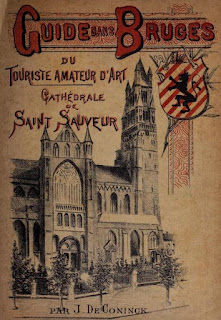
We conclude the series of posts in honour of Saint Brigid with a look at the history of the relic of her mantle, preserved at the Cathedral de Saint Sauveur in Bruges. In the previous post we looked at what the examinations of 1866 and 1935 revealed about the nature of the relic, as described by Henry McClintock. But what of its origins? How did la manteline de Saint Brigide d'Irlande come to Belgium? Let's start with a brief reminder of how the relic is displayed today:

What the visitor actually sees is a glazed frame of Gothic design, not unlike the fame of a picture, and underneath the glass, an ancient and, much worn, piece of cloth, roughly two feet square, of a dull crimson colour and of a strange make quite unlike any modern cloth with which we are now familiar. Its surface instead of being smooth is covered all over with tufts of curly wool so that at first sight it looks more like a piece of sheep skin's or astrakhan fur dyed red than any sort of fabric woven on the loom.

 Next, McClintock sketches the interesting provenance of this relic which goes back to the Saxon royal house:

The history of this piece of cloth is as strange and romantic as its appearance. It is said to have been brought to Bruges and presented to the Cathedral by the Princess Gunhild of England, a sister of King Harold, who took refuge there after the defeat and death of her brother, as well as that of her husband, at the battle of Hastings, 1066. The first documentary record of the relic is in the year 1347, and this earlier part of its history rests only on tradition, but there is no reason to doubt its truth and indeed there is much to confirm it. It is, for instance, a historical fact that Princess Gunhild settled in Bruges after the battle of Hastings and ultimately died there twenty-one years later; while the story is further supported by the fact that there was as close connection between her family and Ireland, for when her father, Earl Godwine, then the wealthiest and most powerful man in England, quarrelled with the King - King Edward the Confessor - in the year 1051 and was exiled to Flanders, two of his sons, Harold and Leofwine, went to Ireland where they stayed with the King of Leinster, Diarmaid Mac Mael-na-mbo, and busied themselves in collecting ships and men to help their father in gaining his restoration. Having thus raised a force they set sail for the English Channel and joined Godwine who had come with auxiliaries from Flanders, and the two fleets proceeded together along the south coast of England taking hostages and receiving promises of help and thence up the Thames to London where, at a conference with the King, matters were settled and Godwine was allowed to return and his property was restored. Now nothing could have been more likely, or more in keeping with the spirit of those days, than for the the two young princes, before embarking on a desperate adventure like this to have visited a famous shrine like that of St Brigid at Kildare in the heart of Diarmaid's kingdom, and to have returned with a relic of the saint in memory of their pilgrimage. This relic would have been carried with them during their subsequent successful expedition and would thenceforward have become one of the most treasured possessions of their family. It would, therefore, be only natural for their sister to rescue it with her other valuable possessions and to take it with her for safety to Flanders.
Sadly, the author declines to devote much time to the later history but nevertheless manages to include some interesting details, especially of how the relic was used for healing:

I will pass over the subsequent history of the relic - how about the year 1400, it was enclosed in a sumptuous covering of yellow silk and gold lace in the form of a cape, which used to be placed on the shoulders of the sick, and especially those of sick women, and was exposed for veneration of the 1st of February in each year; how it, together with other Church valuables, was preserved and placed in safety when the the Cathedral was destroyed during the French revolution....
McClintock, H. F. (1951). The “Mantle of Saint Brigid” at Bruges. Journal of the County Louth Archaeological Society, 12 (3), 119–122. https://doi.org/10.2307/27728777

As this is the Octave Day of the Feast of Saint Brigid I will close with the traditional prayer from her Office:

Deus, qui nos hodierna die beatae Brigidae Virginis tuae annua solemnite laetificas: concede propitius; ut ejus adjuvemur meritis, cujus castitatis irradiamur exemplis. Per Dominum. 

O GOD, Who year by year dost cause us to rejoice as upon this day, in the feast of Thy blessed hand-maiden Brigid, mercifully grant us help for her sake, the bright ensample of whose chastity doth still shed its light upon us. Through our Lord Jesus Christ Thy Son, Who liveth and reigneth with Thee, in the unity of the Holy Ghost, one God, world without end. Amen.

Content Copyright © Trias Thaumaturga 2012-2022. All rights reserved.

Monday, 7 February 2022

The "Mantle of Saint Brigid" at Bruges

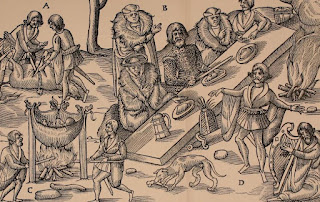
Derricke's Image of Ireland, 1581

The "Mantle of Saint Brigid" at Bruges is the title of a paper published in the Journal of the Royal Society of Antiquaries of Ireland in 1936. The author, Major Henry Foster McClintock (1871-1959), had a particular interest in historical dress and published a book on the subject, Old Irish and Highland Dress, in 1943. He was born in Dublin the first child of the sailor and polar explorer Francis Leopold McClintock, who was instrumental in uncovering the fate of the lost Antarctic expedition led by Sir John Franklin. After a military career Henry McClintock returned to Ireland in 1928 and settled in Ardee, County Louth. In his paper on Saint Brigid's mantle, McClintock begins by pointing out that the name of this relic is somewhat misleading:

...the name of "Mantle" is really a misnomer; it is not a complete cape or garment of any sort but simply a rectangular piece of woollen cloth measuring about 21 by 25 inches, of a dark crimson colour, and covered all over on its face with tufts of curly wool resembling the fleece of a sheep.
However, he goes on to explain that at one time this fleecy woollen cloth was enclosed in what sounds like a type of fabric reliquary in the form of a silk cape:

Until about 70 years ago it had the appearance of a cape, or shoulder-cloak, of yellow silk interwoven with gold thread and decorated with gold lace...But in 1866, when it was examined ..the cape was found to be merely a decorative covering  which appeared from the nature of its materials to have been made in about the year 1400. The original relic was discovered inside, and was found to consist of a piece of shaggy cloth, with some sort of lining of blue and green linen which showed signs of wear. It was at this time that the silk covering was removed and the relic enclosed in the glazed wooden case in which it is now kept...
The cloth was next examined in 1935 by a staff member of the Department of Textiles of the Royal Museum, Brussels, and McClintock provided a translation of the report. This is how the relic was described on that occasion:

In its present condition the fragment of St Brigid's cloak consists of a rectangular bit of stuff measuring 0.545m. wide and 0.64m. long (about 21 by 25 inches), kept in a modern triptych-shaped reliquary. It consists of a deep violet woollen fabric, to which a light lining of red silk taffeta was added - by oversewing it to the edges - after its official recognition in 1866. This woollen fabric is characterised by a thick curly fleece which entirely covers its outer surface, giving it the effect of astrakhan fur. The reverse side is perfectly smooth, and thus it is easy to follow the interlacements of the threads of the warp and weft which is of the simplest form, being that used in making linen...We must add to this that the fabric underwent some alterations in 1866; darning in several damaged places and putting back strands which had become detached.

 McClintock, H. F. (1936). The “Mantle of St. Brigid” at Bruges. The Journal of the Royal Society of Antiquaries of Ireland, 6 (1), 32–40. http://www.jstor.org/stable/25513808

McClintock saw this type of cloth as typical of the 'Shag-rug Mantles' worn in sixteenth century Ireland and mentioned by various English Tudor commentators. Some illustrations of these cloaks also survive including that from Derricke's Image of Ireland (1581) which I have reproduced above. It shows an Irish Chief with his wife and retinue at dinner. McClintock explains that "The Chief's wife is wearing a mantle with a shaggy exterior, while the two Friars appear to have similar mantles with the shaggy sides worn inwards." He admits that he cannot prove such mantles were made in the time of Saint Brigid but feels that it is reasonable to suggest that the weaving of such garments had a long history in Ireland and were part of a wider European tradition going back to the Bronze Age. He adds that a chemical analysis of a bit of the wool showed that the main dye used was iron oxide. The Belgian textile expert also informed McClintock that "she saw no signs of the green and blue lining said to have been attached to the piece of shaggy woollen cloth when the relic was examined and re-arranged in 1866."

 In 1951 Major McClintock published a second article on The Mantle of Saint Brigid in the and in the next post we will examine the fascinating provenance of the relic and trace its journey from Ireland to Belgium.


Content Copyright © Trias Thaumaturga 2012-2022. All rights reserved.

Sunday, 6 February 2022

Saint Brigid's Cloak


We continue the series of posts in honour of Saint Brigid with a reminder of one of her most famous relics - the Mantle or Cloak preserved at Bruges Cathedral. I have already brought a brief account here from an Irish writer who saw this relic in the 1880s, but an Australian newspaper of 1937 picked up on a paper by a 'Fellow of the Society of Antiquaries' which re-examined it. This is a reference to the 1936 article 'The "Mantle of St. Brigid" at Bruges ', published by H.F. McClintock in the Society's journal. I will bring a summary of his paper in the next post, but for now here is an introduction to the main details of the relic as published in the Auckland Star newspaper of January 16, 1937:

ST. BRIGID'S CLOAK.

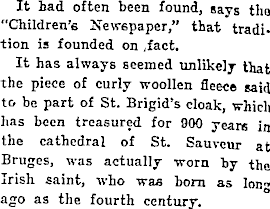
It had often been found, says the "Children's Newspaper," that tradition is founded on fact.

It has always seemed unlikely that the piece of curly woollen fleece said to be part of St. Brigid's cloak, which has been treasured for 900 years in the cathedral of St. Sauveur at Bruges, was actually worn by the Irish saint, who was born as long ago as the fourth century.

Now some remarkable evidence has been found in ancient documents by a Fellow of the Society of Antiquaries that the fabric, which is very ancient and shows signs of hard wear, actually may have been part of St. Brigid's mantle.

It is a piece of shaggy, dark crimson material, about 21in by 25in, and was, taken to Belgium by an English princess, after the Battle of Hastings in 1066.
 
Before he became King of England, Harold had lived in Ireland as an exile. While he was the guest of the King of Leinster it is likely that, when making a pilgrimage to the tomb of the saint at Kildare, he acquired this relic.
 
Shaggy weaving, which is extremely ancient in Europe, was probably an Irish custom long before Brigid's time, and there are many allusions in old manuscripts to shag-rug mantles. It has been found that the piece of shag-rug at Bruges was coloured with dye made from iron oxide, and artists of the future will be able to represent the exact tint of her mantle.


ST. BRIGID'S CLOAK. Auckland Star, Volume LXVIII, Issue 13, 16 January 1937, Page 7 (Supplement)


Content Copyright © Trias Thaumaturga 2012-2022. All rights reserved.

Thursday, 3 February 2022

Where Brigid is Honoured


We stay with the theme of devotion to Saint Brigid in Europe with a 1929 piece from Irish Benedictine writer Dom Patrick Nolan. He is perhaps best known for his 1908 book The Irish Dames of Ypres which looked at the history of the Irish Royal Abbey of Ypres founded by seventeenth-century Catholic exiles. Here, however, he provides us with a gazetteer of places outside Ireland which cherished Saint Brigid and describes some of the history and traditions associated with them. As the immediate inspiration for Dom Patrick's reflections seems to have been the return of a portion of the relics of Saint Brigid to Killester in 1929, he concludes with a brief sketch of the history of her relics:

WHERE BRIGID IS  HONOURED.

Europe's Devotion to Irish Saint.


BY DOM PATRICK NOLAN, O.S.B.

A recent interesting article in the 'Irish Independent' on St. Brigid and the celebrations in her honour at Killester, prompts me to remind Irish people that devotion to this great saint is not confined to Ireland, and that her 'cultus' is as far flung as are the numerous lands evangelised by Irish missionaries.

Devotion to St. Brigid has been a constant European tradition, and her fame has extended far beyond our Continent. It may, indeed, be said to be greater in some Continental countries than in her own native land.

St. Brigid and Britain.

On Sunday January 27, I announced to the congregation, mostly English Catholics, of a small Oxford village that Friday, February 1, would be kept as the feast of St. Brigid of Ireland throughout the diocese of Birmingham, and rightly so.

The ancient Saxon kingdom of Mercia, which comprised the territory of the present Archdiocese of Birmingham, was evangelised by the children of St. Brigid many long centuries go, and the erection of the present nourishing diocese was a direct result of the extensive immigration of St. Brigid's children in the 'forties and 'fifties of last century.

In Scotland.

Our Scottish kinsfolk do not yield to their Irish forebears in their veneration for our great Irish saint. To the Scottish Gael, as Fiona Macleod reminds us, she is the 'Fair Lady of February,' 'St. Bride of the Kindly Fire,' and 'St. Bride of the Shores.' February is her own month, the month of 'Bride Min,' gentle Brigid; or 'Brighid boidheach Muime Chriosd,' Bride the Beautiful, Christ's Foster Mother.

In the Gaelic Highlands and storm-swept Isles of the West her emblems are the dandelion, the lamb and the sea-bird known to the common folk as the 'oyster-opener.'

The humble dandelion, the harbinger of Spring and of St. Brigid, the dealan Dhe, 'the little flame of God,' or bhearnan Brighde, 'St. Bride's forerunner,' has from remotest times been associated with St. Brigid by the Scottish Gael.

St. Bride's Flocks.

'To this day shepherds on Ah Fhiell Brighde,' St. 'Brigid's feast, 'are wont to hear among the mists the crying of in numerable young lambs, and this without the bleating of ewes, and so by that token know that Holy St. Bride has passed by, coming earthward with her flocks of countless lambs. . . .'

'In these desolate far isles where life is so hard ... a rejoicing sound is that in truth when the Gille-Bhride is heard calling along the shores.' And well may this welcome visitor to the bleak Scottish coasts be called the 'Servant of Bride,' for does not its incessant, cheery cry 'gilly-breed, gilly-breed, ' come to Gaelic ears like an invocation to the Mary of the Gael?

Alsace.

It is a far cry from Scotland to Alsace, but there too the traditional devotion to our Irish saint still flourishes.

The Canons of Old St. Peter's at Strassburg used to distribute 'St. Brigid 's Bread,' their best wine was known as 'St. Brigid's Wine.' Alsatian farmers had such devotion to her that they placed their fields and field work under her special protection, and 'Buren-bridel' was a generic title for Alsatian farmers' daughters, many of whom bore the name of Brigid, a name still not uncommon in Southern Germany.

The festival of St. Brigid was solemnly kept almost universally throughout the mediaeval German Empire, and by all the religious Orders. Churches and chapels were dedicated to her at Cologne, Mainz,
and elsewhere, from an early date.

At Fosses, in Belgium, an ancient chapel of St. Brigid still tops the hill so conspicuous from the railway station. At Piacenza, in North Italy, there is a church of St. Brigid, said to have been founded in 868 by the Irish saint, Donatus, Bishop of Fiesole. Annexed to it was a hospice for Irish pilgrims on their way to Bobbio or Rome.

Story of St. Brigid's Relics.

Much more could be said about the 'cultus' of St. Brigid on the Continent, but I must conclude with a few remarks as to her relics.

Cogitosus tells us that St. Brigid's relics were kept in a richly-decorated shrine in Kildare. It is not known when they were 'translated' and placed with St. Columba's and St. Patrick's at Downpatrick, but Columba's relics were still at Iona in the beginning of the ninth century.

During native political broils, devotion to the saint nagged and all knowledge of the whereabouts of her relics was lost. But they were miraculously re-discovered through the prayers of a holy Bishop, Malachy, in the year that Earl, later King John, came to Ireland (1185), as related in a special office for the day, printed in Paris in 1620. 

The Shrine Desecrated.

They were solemnly authenticated, or translated, on June 9 (St. Colum's day) in the presence of a Cardinal Legate, specially sent from Rome, and 15 Bishops; but the shrine was desecrated by Lord Leonard Gray, Viceroy of Henry VIII.

The head of St. Brigid is said to have been previously transferred to Newstadt in Austria, where it was venerated in the chapel of the imperial citadel. Later on the Emperor Rudolph II. gave it to John Borgia, son of St. Francis Borgia, and Ambassador of Philip II., who took it to Spain in 1587, and gave it to the Lisbon Jesuits, who kept it in the chapel of their house of studies at St. Roch, the solemn translation, one of the most magnificent ever seen, taking place in 1588.

St. Roch or Lumiar.

But Cardosus says that the head of St. Brigid is preserved with very great veneration in the church at Lumiar, formerly known as. St. John the Baptist's, but now as St. Brigid's. Three Irish knights are said to have taken it into Portugal to King Dionysius, or Denis (d. 1225).

Don Philip O'Sullivan Beare supports the Lumiar tradition, so that we may suppose the relic at St. Roch's, Lisbon, to be that of another St. Brigid, for there have been more than one saintly imitator of the great Irish original. We presume the great St. Brigid of Sweden had the Irish saint for her patron and model, and we know that Scandinavian pilgrims frequented the hospice of St. Brigid at Piacenza.

"WHERE BRIGID IS HONOURED." The Catholic Press, 28 March 1929
Content Copyright © Trias Thaumaturga 2012-2022. All rights reserved.

Thursday, 22 March 2018

The Bachall Ísu at the Founding of Armagh


Although in recent days we have been looking at the Bachall Ísu in relation to Christ Church Cathedral in Dublin, it was once the prized possession of the Chuch of Armagh. The following vignette, taken from the Leabhar Breac Homily on Saint Patrick, depicts the Bachall Ísu as being present when Saint Patrick founded Armagh itself:
On the night thereafter Patrick beheld in a vision Victor, an angel, coming to him with Ireland’s elders along with him, and they marked out the city in his presence, and the place of the temple and of the kitchen and of the guest-house. And he went right -hand- wise round the rampart, and Patrick behind him with his Bachall Ísu— Jesu’s Staff — in his hand, and Ireland’s elders a-chanting around him.

Patrick afterwards built the city in the same wise as it had been shown to him. And the angel said to him: “Abundant will God’s grace be in this place and upon every one who shall do good therein.” The angel said to Patrick, “ God will heal for thee here twelve persons every Saturday and seven every Thursday, so long as the perfect faith of the menfolk abideth.” Overmany to recount and declare are all the wonders and miracles which Patrick wrought round about Armagh.
Whitley Stokes, ed. and trans., The Tripartite Life of Patrick with Other Documents Relating to that Saint, Vol. II (London, 1887), 474-475.

Content Copyright © Trias Thaumaturga 2012-2018. All rights reserved.

Wednesday, 21 March 2018

Did the Staff of Jesus Survive?


Yesterday we looked at the sources suggesting that the Bachall Isú, the Staff of Jesus had been publicly burnt in Dublin during the Reformation. However, there are other sources which leave open the possibility that it may have survived and it to these that we now turn. Scholar Sarah Erskine has made a special study of the Bachall Ísu and at the conclusion of one of her papers quotes some interesting observations from  Reformation scholar Raymond Gillespie:
Bachall Isú itself was reputedly burnt in Dublin in a public display presided by the Protestant archbishop George Browne in 1538, in a period of "state-sponsored iconoclasm". However, Raymond Gillespie reckons that Bachall Isú may have passed into lay hands, since the Dublin apothecary reported in 1561 that "men were going about the countryside 'with the bachal of Jesus as they call it' and using it to assist women in labour." During a time when clerical control on the use of relics in general was tightening up, the 1686 'statutes of Meath' stated that no one should be observed carrying Patrick's staff. 
R. Gillespie, Devoted People, Belief and Religion in Early Modern Ireland (Manchester, 1997), p.161 quoted in S. C. Erskine, St Patrick's Bachall Ísu: Its Origins, Tradition, and Rise to Prominence as Armagh's Premier Relic in Eolas: The Journal of the American Society of Irish Medieval Studies, Vol. 6 (2013), pp. 41-67 at p.67.

I think that these sources certainly open up the possibility of the relic's survival, but on the other hand, it struck me that the post-1538 staff is being employed in the countryside where perhaps the knowledge of its destruction in the urban centre of Dublin was less well-known. Or was another medieval crozier later co-opted as the Bachall Isú since the original could no longer be produced by Christ Church Cathedral to contradict the claims?  I suppose we will never know for sure.

Content Copyright © Trias Thaumaturga 2012-2018. All rights reserved.

Tuesday, 20 March 2018

The Burning of the Staff of Jesus

Christ Church Cathedral, Dublin
Photo Credit: Wikipedia

Yesterday we looked at some of the references to the Staff of Jesus (Baculus Jesu) in the Irish Annals, as compiled by James Henthorn Todd in his introduction to the1844 publication of The Book of Obits and Martyrology of the Cathedral Church of the Holy Trinity in Dublin. This cathedral, we have already noted, was the home of the Staff following its removal from Armagh in the late twelfth century. As Todd remarked himself of the historical references he provided:
"These examples are sufficient to prove the high veneration in which this relic was held, up to the period of the Reformation, when it was publicly burned, A. D. 1538, as an instrument of superstition." 
So we will allow Todd to continue his account of this next and supposedly final chapter in the history of Saint Patrick's Staff of Jesus:
This event is thus recorded by Sir James Ware in his Annals of the Reign of King Henry VIII. p. 99: "Also, about the same time, among the famous images whereunto pilgrimages were designed, the statue of the Blessed Virgin Mary was burned, then kept at Trim in the Abbey of the Canons Regular, and the gifts of the pilgrims were taken away from thence. The image of Christ crucified, in the Abbey of Ballibogan and St. Patrick's Staff, in the Cathedral Church of the Holy Trinity at Dublin which William, the son of Adeline, brought from Ardmagh and gave it as a gift to that church in the year 1180, underwent the like fate."  
A valuable manuscript volume of Annals preserved in the Library of Trinity College, Dublin, gives the following curious account of this destruction of images and of the staff of Patrick at the year 1538: 
"The most miraculous image of Mary which was at Baile Atha Trium, and which the Irish people all honoured for a long time before that, which used to heal the blind, the deaf, the lame, and every disease in like manner, was burned by the Saxons. And the Staff of Jesus, which was in Dublin, and which wrought many wonders and miracles in Ireland since the time of Patrick down to that time, and which was in the hand of Christ himself, was burned by the Saxons in like manner. And not only that, but there was not a holy cross, nor an image of Mary, nor other celebrated image in Ireland over which their power had reached, that they did not burn. Nor was there one of the seven orders which came under their power that they did not ruin. And the Pope, and the Church in the East, and at home, was excommunicating the Saxons on that account, and they not paying any heed or attention unto that, &c And I am not certain whether it was not in the above year that these relics were burned."  
The Four Masters have also recorded the burning of the Baculus Jesu, in the following passage, which is here quoted at length, as a curious specimen of the light in which the Reformation was regarded by a native Irish writer of the reign of Charles the First: 
"A.D. 1537. A heresy and a new error broke out in England, the effects of pride, vain-glory, avarice, sensual desire, and the prevalence of a variety of scientific and philosophical speculations, so that the people of England went into opposition to the Pope and to Rome. At the same time they followed a variety of opinions, and the old Law of Moses, after the manner of the Jewish people, and they gave the title of head of the Church of God, during his reign, to the king. There were enacted by the king and council new laws and statutes after their own will. They ruined the orders who were permitted to hold worldly possessions, viz., monks, canons, nuns, and brethren of the Cross; and the four mendicant orders, viz., the Minor order, the Preachers, Carmelites, and Augustinians. The possessions and livings of all these were taken up for the king. They broke the monasteries. They sold their roofs and bells, so that there was not a monastery from Arann of the Saints to the Iccian Sea, that was not broken and shattered, except only a few in Ireland, which escaped the notice and attention of the English. They further burned and broke the famous images, shrines, and relics of Ireland and England. After that they burned in like manner the celebrated image of Mary, which was at Ath-Truim, which used to perform wonders and miracles, which used to heal the blind, the deaf, the lame, and the sufferers from all diseases ; and the Staff of Jesus which was in Dublin, performing miracles from the time of Patrick down to that time, and which was in the hand of Christ while he was among men. They also made archbishops and sub-bishops for themselves; and although great was the persecution of the Roman Emperors against the Church, it is not probable that so great a persecution as this ever came, even from Rome hither. So that it is impossible to tell or narrate its description, unless it should be told by him who saw it." 
This sounds like the end of the road for the Staff of Jesus, but as we shall see in the next post, there just may be a chance that the relic survived.


 J. C. Crosthwaite, ed. The Book of Obits and Martyrology of the Cathedral Church of the Holy Trinity, Commonly called Christ Church, Dublin (Dublin, 1844), xvi-xviii.


Content Copyright © Trias Thaumaturga 2012-2018. All rights reserved.

Monday, 19 March 2018

The Staff of Jesus in the Irish Annals


Yesterday we looked at the account of The Staff of Jesus (Irish Bachall Ísu, Latin Baculus Jesu) by Archbishop John Healy in which he quoted the various manuscript Lives of Saint Patrick collated by Father John Colgan in the seventeenth century. Hagiography, however, is not the only source to feature this relic as the Irish Annals also make mention of it. These references have been usefully collected by the Irish Anglican church historian, James Henthorn Todd (1805-1869),  in his introduction to the Book of Obits and Martyrology of the Cathedral Church of the Holy Trinity in Dublin. This church, more commonly known as Christ Church, was the home of The Staff of Jesus after its 'translation' from Armagh in the late twelfth century until its reputed destruction during the Reformation, but that event deserves a post of its own.  For now, we can see how the Irish Annals made reference to this famous Patrician relic, with apologies that I cannot easily reproduce the beautiful Irish font the book uses for the original Irish text:
Two obscure notices of the Baculus are to be found in the Annals of Tighernach. The first of these is entered under the year 1027, ... which Dr. O'Conor renders: "Baculum Jesu sacrilege raptum" And in the year 1030, we have a record of another similar act of sacrilege: "The Baculus Jesu was profaned in a matter relating to three horses, and the profaner was killed three days after." 
Todd adds an explantory footnote to these references to 'sacrilege', challenging O'Conor's assumption that the original Irish suggests sacriligious theft. He argues that a reference in the Annals of the Four Masters which uses the same Irish word does not necessarily mean theft but rather to :
...profane a church by any act of violence, such as shedding human blood within it, or taking out of it one who had fled there for sanctuary. See Annal. IV. Mag, anno 1224, where we read: Seachnasach, son of Giolla na naomh O'Shaughnessy, was slain by the Clann Cuilen [Mac Namaras], and the Bachall mor [large crozier] of St. Colman of Kilmacduagh was profaned by the deed." Hence, when the word is applied to such relics as the Baculus Jesu, it implies that the vow made before them, or the covenant entered into in their presence, was broken or violated, or that they were treated with some indignity. The words of Tighernach are extremely obscure. In the second instance, especially, it does not appear what was done to the horses: they may have been stolen from some place which was sacred in consequence of the presence of the baculus, or from the keeper of the baculus, whose property was considered sacred; or else, perhaps, some contract relating to three horses, which was made in presence of the baculus, was violated.
Todd then goes on to quote some references from the Annals of the Four Masters which also illustrate the use of the famous relic as one of the sacred objects on which oaths were sworn:
In the Annals of the Four Masters, at the year 1080, there is the following mention of this relic: "A hostile expedition undertaken by Torlogh O'Brian to Dublin, and to Meath, when Maoileachlan came into his tent, with the baculus Jesu, and with the successor of Patrick, and with the clergy of Munster." Again in the same Annals, at the year 1143, the Baculus Jesu is mentioned, amongst other relics, as having been called in to witness a treaty of peace between two chieftains. The words of the annalist are as follows: "'Muiredhach O'Dubhthaigh, the Archbishop [of Tuam], the Lord of Connaght, and his chieftains, the successor of Patrick, and the baculus Jesu, the successor of Fechin [i. e. the Abbot of Fore], and the bell of Fechin, and the Boban of Caoimhgin [Kevin], all these were pledges between Tordhelbhach [O'Conor, King of Connaght] and Murchadh [O'Maoleachlainn, King of Meath] &c." 
Finally,  Todd cites some interesting historical snippets from English sources, including one use of the relic just less than a decade before its reputed destruction in 1538:
In Anglo-Irish history also, the staff of Patrick is frequently mentioned. Thus, Campion in his "Historie of Ireland," makes O'Kelly, AD. 1316, swear by St. Patrick's staff, in his attempt to seduce one of Sir Richard Birmingham's followers from his allegiance: "But come and serve me at my request, and I promise thee by St. Patrick's staffe, to make thee a lord in Connaght, of more ground than thy master hath in Ireland." In the bag marked "Ireland," in the Chapter-house, Westminster Abbey, there is a paper, No. 53, containing "an examination of Sir Gerald Mackshayne, Knight," sworn 19th March, 1529, "upon the Holie Masebooke, and the great relike of Erlonde, called Baculum Christi, in presence of the Kynges Deputie, Chancellour, Tresoror, and Justice." 
We will explore the destruction of the relic in tomorrow's post.

 J. C. Crosthwaite, ed. The Book of Obits and Martyrology of the Cathedral Church of the Holy Trinity, Commonly called Christ Church, Dublin (Dublin, 1844), xiv-xv. 


Content Copyright © Trias Thaumaturga 2012-2018. All rights reserved.

Sunday, 18 March 2018

Saint Patrick and the Staff of Jesus


We begin an octave of posts in honour of the Feast of Saint Patrick with a look at one of the most famous of the relics associated with our national apostle, the Bachall Ísu (Íosa), or Staff of Jesus. Over the coming days we will examine the traditions surrounding this fascinating artefact, sadly now no longer extant, and to look at what modern scholarship has to say. We can begin with an account by Archbishop John Healy (1841-1918), taken from his monumental 1905 work, The Life and Writings of Saint Patrick. He devoted Appendix V to a discussion of The Relics of Saint Patrick. The written traditions on the Bachall Ísu were collected by the great seventeenth-century hagiologist, Father John Colgan, from manuscripts preserved mostly in continental Europe. The Lives of Patrick as Colgan catalogued them are discussed by Archbishop Healy in the Introduction to his book and here in Appendix V he also gives us a useful introduction to the classification of relics:

THE RELICS OF ST. PATRICK.

We use the word 'Relics' here in its widest sense to include all those things that are specially worthy of veneration on account of their intimate connection with our National Apostle. They are of two classes, (i) the martra, or corporeal relics of the Saint ; and (2) the minna or extrinsic relics which are worthy of veneration because they were the personal implements used by the Saint in discharge of his duties, and hence came to be regarded as the insignia or symbols of his high office as the Head of the Irish Church. Hence, also, these holy minna, sanctified by the use of the Saint, came to be held in the highest veneration, and, as the sacred symbols of the primatial office, were regarded as indispensable for the exercise of the primatial functions. The prelate who had the minna of St. Patrick in this way came to be regarded as the true comarb of Patrick; without them no one was regarded as his lawful successor. The most venerable of the minna of St. Patrick, from this point of view, was the Staff of Jesus.

 1. — The Staff of Jesus, or Bachall-Iosa. The early history of this most venerable relic has been admirably summed up by Colgan in a special dissertation on the subject. It is not long, but it is clear and accurate so far as it goes. 

Following the chronological order, the earliest writer who refers to the Staff of Jesus is probably the author of the Third Life. He merely states that Patrick ' having set out on his journey to Rome went to a certain hermit, who dwelt in a certain place ; from him Patrick received the Staff, which had been in the hand of Jesus Christ, our Lord, that under its guidance or companionship he might be prosperous in his (missionary) journey, and the Staff remains to this day in the City of Armagh, and is called the Baculus Jesu, or Staff of Jesus.' 

It will be noticed that the writer here does not determine in any way the place where the person from whom Patrick received the Staff dwelt, beyond saying that he was a hermit dwelling in a certain place.

The Fourth Life goes further, and says that Patrick on his voyage through the Tyrrhene Sea ' received the Staff of Jesus from a certain youth who dwelt in a certain island, and there had given hospitality to Jesus Christ. ' It adds, however, that the Lord spoke to Patrick on the mountain, and commanded him to come to Ireland. The 'island' and the 'youth' are not determined; but the statement of a special command given to Patrick by our Lord himself is strikingly borne out by his own words in the Confession, where he says that Christ the Lord commanded him to come to Ireland and spend the rest of his life with his converts in that country.

Jocelyn amplifies these brief accounts, — saying that the hermit or solitary was one Justus in name and indeed, that he gave to Patrick the Staff which the Lord Jesus, who had appeared to him, held in His own hand, and ordered to be given to Patrick as soon as he came to the island. There were other solitaries also, he adds, in the island, some young and some old, but all dwelling apart; the younger hermits told Patrick that they used to give hospitality to all comers, and on one occasion they gave it to a Person who had the Staff in His hand, and this Person said, after partaking of their hospitality, " I am Jesus Christ, whose members you have been ministering to, even as now you have done to Myself" — thereupon He gave the Staff which He held in His hand to their superior, with instructions to give it to a certain stranger called Patrick who would come there in later times. — Having thus spoken He ascended into Heaven, but He left to them of that generation the gift of perpetual youth in reward of their charity; whilst the peaceful old men whom Patrick saw were their children, who did not enjoy the same privilege. So Patrick took the Staff from the Elder, and having remained for some days with the holy solitaries bade them farewell and went on his way rejoicing.

 It will be observed here that there is no question of a personal appearance of our Saviour to Patrick, nor any special mandate given to him to preach the gospel in Ireland.

But the Tripartite gives a fuller, and perhaps, more satisfactory, explanation than any of the other Lives. According to this venerable authority Patrick on his voyage through the Tyrrhene Sea came to a certain island, and found there a new house, in which a young married couple dwelt, but he saw also an old woman scarcely able to crawl along the ground. The young man then informed him that long ago when exercising hospitality they had received Jesus Christ Himself as their guest, that He, in return for their charity, gave them and their house a blessing, which preserved both from decay, but that the blessing was not given to their children, who were not then born. In consequence the children grew old in the ordinary way, and the old crone whom he saw was the granddaughter of the speaker, that is the daughter of his daughter, who was a still older and more decrepit woman.

The Staff which our Saviour held in His hands He then gave to the young man. His host, with instructions to keep it safely for a certain stranger who would thereafter visit them, and was the destined apostle of Ireland. And so he offered the Staff to Patrick. But Patrick said, "No, I will not take it except the Lord Himself confirms this donation as His own." He then spent three days with them, and thereafter he came to the mountain called Hermon, where the Lord himself condescended to appear to him, and commanded him to preach the Gospel to the Irish people, and at the same time gave him the staff, which is ' now everywhere called the Staff of Jesus,' to be his stay in weakness, and his defence in adversity. Then follows a long catalogue of all the wonders which Patrick had accomplished during his missionary career by the instrumentality of the Staff of Jesus. So far the Lives.

Now, it appears to us the one strong point in this narrative — for it is substantially one narrative — is that the Special Mission from Jesus Christ referred to as given to Patrick, directly or indirectly, is confirmed by his own language in the Confession, for that language undoubtedly implies an immediate supernatural mission from his Divine Master. He who admits this will have little difficulty in admitting that our Lord would at the same time, and naturally, as it were, give him a Crozier to be a proof of that mission, for the Crozier is the symbol of episcopal authority ; and if the mission was thus extraordinary and supernatural we might naturally expect that the Crozier too would be given in a supernatural way. Such, at least, was the belief in Ireland down to the time of Henry VIII. , for all the authorities admit that the Staff was held in the highest veneration, and all without exception call it the Staff of Jesus — many of them, too, explaining the origin of the name.

St. Bernard first of all calls especial attention to the Crozier, gold-covered and adorned with most precious gems, which Nigellus the pseudo-primate carried off with him from Armagh, and along with the Book of Patrick exhibited as undoubted proofs of his own claim to the primacy. " For," he adds, "the foolish people thought that he who possessed these venerable relics was indeed the true successor of St, Patrick." 

Gerald Barry, too, refers to the Staff of Jesus as the most famous and wonder-working Crozier in all Ireland. It was by it, he says, that St. Patrick is said to have driven all venomous reptiles from the island; and, although its origin is doubtful, its virtue is undoubted (certissima). ' In our times, and by our people, this celebrated treasure has been taken away from Armagh and brought to Dublin.'  There for more than 300 years it was preserved and venerated as of old in Armagh. It was kept in the Cathedral of Christ Church until George Browne, the apostate friar and first Protestant Archbishop of Dublin, had it forcibly taken from the Cathedral and publicly burned in High Street, to the great horror and indignation of all the people.

Most Rev. J. Healy, The Life and Writings of St. Patrick, (Dublin, 1905), Appendix V, 633-636.


Content Copyright © Trias Thaumaturga 2012-2018. All rights reserved.

Wednesday, 9 September 2015

Earth from Saint Ciarán's Tomb Saves Saint Colum Cille at Sea


We are told, on his hearing about St. Kieran's death, St. Columkille, Abbot of Iona, declared, that it was a providential circumstance, he had been called away from life at an early age; for, had he lived to an advanced term of years, the envy of many would be excited against him. It is said, that St. Columba composed a Hymn in honour of our saint. This seems to indicate, that he had been at Clonmacnoise, when it was written; since the successor of Kieran said to him: "O father, this is a beautiful and eulogistic hymn; what return can we make for its composition?" Columba answered, "Give me two hands full of earth, taken from the grave of Father Kieran, because that I desire and love, more than pure gold or precious stones." Wherefore, St. Columba, taking this earth from the sepulchre of St. Kieran, returned to his own island of Hy.

But, while on his voyage thither, a great sea-storm arose, which carried his ship towards a most dangerous whirlpool, known as Corebreacyn. While drifting towards this whirlpool, so much dreaded by mariners, St. Columba threw a portion of the earth taken from St. Kieran's tomb into the sea. Immediately, the waves subsided, the tempest was stilled, and the ship escaped from that menaced danger. Thereupon, St. Columba returned thanks to God, and called his fellow-passengers to witness what a favour had been obtained, through the relics of Blessed Kieran.

[Footnote: This account purports to be taken from the thirty-third chapter of an old Life of St. Kieran. It is not to be found in the Irish Life, contained in the Book of Lismore.]

Rev J. O'Hanlon, Lives of the Irish Saints, Volume IX, (Dublin n.d.), 232-233.

Content Copyright © Trias Thaumaturga 2012-2015. All rights reserved.

Friday, 29 June 2012

The Termon of Durrow - I


Below is part one of a paper on the Columban monastic site of Durrow delivered to the Royal Society of Antiquaries of Ireland in 1898 by an Anglican clergyman. As is always the case with material of this age, the antiquarian speculations of the author have been superceded by the findings of more recent scholarship, but the paper nevertheless brings together a lot of interesting lore. The author gives a useful summary of the major relics associated with the monastery of Durrow, namely the Book of Durrow and the Durrow Crozier. His account of the tendency to dunk priceless hand-written books in water in the belief that they could not be damaged is a wonderful testimony to faith, although I suspect that modern archaeologists would be relieved that this practice has now died out!

THE TERMON OF DURROW.

BY THE REV. STERLING DE COURCY WILLIAMS, M.A.

[Read MARCH 29, 1898.]

SECTION I.

''IF you really intend to go deeply into the question of Celtic Antiquities'' (said Professor Max Muller),"it is to Ireland you must go" ; and I think I may be justified in saying that even in Ireland we could hardly find a more favourable field for study than the county in which I now reside, since, amongst many others, it presents such fields for inquiry as Clonmacnoise, Rahin, Tihilly, and Durrow.

On a previous occasion I read a Paper on " The Old Churchyards of Durrow Parish," and I then brought before you some of the interesting remains which have so far withstood, to some extent, the ravages wrought by the hand of time, aided and abetted by the trying nature of our climate and the destructive habits of our race.

I have now to show you illustrations of a different kind, which will direct your notice to objects of interest connected with my parish which could hardly be said to come under the title of my former paper; and I give, as addenda, some extracts from ancient documents and notices of the annalists in which I find reference made to this ancient and historic spot.

This will, I think, help to group together the important records of the parish, and show that Durrow continued to be an important centre of learning for many years, and that though the light kindled then by St. Columba may have waxed dim or even flickered for a time, that still the lamp of truth which he kindled has never been altogether quenched, even though it may never have shone so brightly as in its first and most palmy days.

Any account of monastic life in Durrow which did not take notice of its celebrated MSS. would be very incomplete indeed. Concerning one of them I cannot, I think, do better than quote the words of the late Professor Stokes, whose loss I am sure we all feel. Writing about the celebrated epistle of Cummian, written to the Abbot of I Columkille in the year 634, he says:" I call it a marvellous composition because of the vastness of its learning. It quotes, besides the Scriptures and Latin authors, Greek writers like Origen, Cyril, and Pachonius, the head and reformer of Egyptian monasticism, and Daraascius, the last of the celebrated neo-Platonic philosophers of Athens, who lived about the year 600, and who wrote all his works in Greek. Cummian discusses the calendar of the Macedonians, Hebrews, and Copts, giving us the Hebrew, Greek, and Egyptian names of months and cycles, and tells us that he had been sent as one of a deputation of learned men a few years before to ascertain the practice of the Church of Rome with regard to Easter." ''This long letter" (said Professor Stokes) "proves to demonstration that in the first half of the seventh century there was a wide range of Greek learning, not ecclesiastical merely, but chronological, astronomical, and philosophical, away at Durrow in the very centre of the Bog of Allen." It will be in the recollection of all who are interested in the subject that Cummian's epistle engages in controversy on the great Pascal question as to the time when Easter should be celebrated. St. Cummian advocated the Roman method, while Segenius and the monks of Hy held to the opposite, as observed by St. Columba. St. Fintan of Taghmon (the founder of Tihilly, now in the parish of Durrow) also held to the Irish method of observing Easter. Perhaps, however, it is only right to mention that all writers do not seem as certain respecting Cummian's identity with Durrow as was Professor Stokes. Reeves, in his " Adamnan" (Lib. i., p. 27), tells us that Cummian, in 636, appeared at a Synod at Campus Lene (or Magh Lena), near the modern Tullamore, when he pleaded for uniformity of practice. Colgan's " Acta SS.," p. 411, says, " Cummian is said to have been Abbot of Durrow." Lanigan thinks the notice of him does not refer to the great monastery of Durrow, but to Disert Chuimin. However, in vol. ii. page 393, he says that "He seems to have been a Columbian monk, and was probably educated in the Columbian monastery of Durrow, which was subject to the superintendence of the Abbot of Hy. At the time of the proceedings now related he had apparently an establishment of his own, which was in all likelihood that of Disert Chuimin, so called from his name, now Kilonin or Kilcummin in the King's County, near Roscrea." A work which is in the monastery of St. Gall in Switzerland, called " De poenitentiarum mensura," was also, Lanigan thinks, written by him.

I have also obtained a copy of a photograph of a MS. which is in the Bodleian Library, of which I shall speak more presently. But the best known of our MSS. is, of course, the Book of Durrow, which is in the Library of Trinity College, Dublin. And, as I look at those illustrations, I think with pride of the literary work which used to be done in my parish in olden times, though it be mingled with regret that we cannot now attempt to emulate the skill and artistic taste of the scribe who wrote it. Perhaps it may interest you to hear that I am sometimes asked by persons whether I have obtained any of the information I have been able to get about Durrow from this celebrated book. It may not therefore be amiss to say, as briefly as I am able, something of what is known about "The Book of Durrow." To begin with Its antiquity is proved beyond doubt both by the character of the book itself and also from the fact that it is recorded that the first book-shrine or comdach we read of, the date of which can be fixed with any historical certainty, was made for this book by the King of Ireland, Flann Sinna, son of Malachy, who reigned between the years 877 and 916. This bookshrine is indeed now lost, but it was seen by Roderick O'Flaherty in 1677, who wrote the following on the flyleaf of the Gospel it was made to enshrine (" Inscriptio Hibernicis literis incisa cruci argenteae in operimento hujus Libri in transversa crucis parte nomen artificis indicat ; et in longitudine tribus lineis a sinestra et totidem dextra et sequitur + oroit acus bendacht Choluimb Chille do Flaund Mac Mailsechnaill do Righerewn la sa ndernadacumdach so ' "(i.e., An inscription in Irish letters cut on a silver cross in the corner of the book or the transverse part of the cross indicates the name of the maker, and on the length three lines from the left, and the like number on the right, as follows: " Columkille's prayer and blessing for Flann, son of Mail Sechnaill for the King of Ireland by whom the case was made "). This Flann, son of Malachi, was King of Ireland, A.D. 879-916. The Most Rev. Dr. Healy, writing of this work, describes it as follows:

"The 'Book of Durrow' is a highly ornate copy of the Four Gospels, according to Jerome's version; it is written across the page in single columns. The MS. also contains the Epistle of St. Jerome to Pope Damasus, an explanation of certain Hebrew names, with the Euseheian Canons and synoptical Gospels."

This description may fitly be supplemented by a quotation from the " National MSS. of Ireland," by John Gilbert, F.S.A.

“The Book of Durrow is," he says, "an ornamental copy of the Four Gospels in the Vulgate version, written across the page mainly in single columns, and preceded by the Epistle of St. Jerome to Pope Damasus, an explanation of Hebrew names, Eusebeian Canons, and synoptical tables. It contains symbolical representations of the Evangelists, and pages of coloured, spiral, interlaced, and tesselated ornamentation. The general number of lines on a page is 25 or 26. Among the capitals, Greek letters are occasionally introduced, and the peculiar red dotted and lineation occur abundantly throughout the book."

Miss Margaret Stokes, commenting on the fact that it was associated with the name of St. Columba, and venerated accordingly as early as the ninth century, yet points out that the fact that it is according to St. Jerome's version would indicate that it was not so old as the sixth century, as at that period a different version was in use. Accordingly, we find that the date ascribed to it in Trinity College Library is the seventh century. Miss Stokes also points out a curious fact connected with the book, i.e. that, in the miniature, at the end of the book, of an ecclesiastic, the Irish tonsure and not the Roman is used. On what was originally the last folio of the book (now folio 15, by error of binding), we find the usual request of the Irish scribe:

"Rogo beatitudinem tuara sce praesbiter Patrici ut quicunque hunc libellum manu tenuerit meminerit Columbae scriptoris qui hoc scripsi [ -] met evangelium per xii dierum spatium gra dni nri."

" I pray thy blessedness, holy Presbyter, Patrick, that whoever shall take this book into his hands may remember the writer Columba, who have myself written this Gospel in the space of twelve days, by the grace of our Lord."

I am indebted further to Miss Margaret Stokes for this remark, that while "the Book of Durrow has fewer varieties of design in it than the Book of Kells, yet that those it does possess belong to the most characteristic and archaic style of Christian art." The MS. was preserved at Durrow until the year 1623, when it was taken possession of by Henry Jones, who had been scout-master to Cromwell's army in Ireland, then Vice-Chancellor of Trinity College, Dublin, and afterwards Bishop of Meath. O'Flaherty saw the Book in 1677. " I have seen," he says, "handwritings of St. Columba in Irish characters, as straight and as fair as any priest, of about 1000 years standing, and Irish letters engraven in the time of Flann, King of Ireland, deceased in A.D. 916." I cannot refrain from repeating again the reference to this Book which is in the "Annals of Clonmacnoise." The writer tells us that St. Columba wrote 300 books with his own hand, and that they were all New Testaments, and also that he left a book to each of his churches in the kingdom -

" which Bookes have a strange property, which is that if they, or any of them, had sunck to the bottom of the Deepest waters, they would not lose one letter, signe, or character of them, wch I have seen partly by myselfe of that book of them which is at Dorow, in the Ks County, for I saw the Ignorant man, who had the same in his Custody, when sickness came on cattle, for their Remedy putt water on the booke, and Suffered it to rest there for awhile ; and saw also cattle returne thereby to their former or pristin state, and the book to receave no loss."

This is a very old tradition, and it seems to owe its origin to an incident recorded in Adarnnan's "Life of St. Columba." In. Book II. two chapters are devoted to this subject. In chapter viii., he tells us of a youth who fell into the River Boyne, and was drowned, his body not being recovered for twenty days, when a leaf of a book, written by St. Columba, was found in his pocket, dry and uninjured, amongst a number of others, which were not only corrupted but putrified; and then he proceeds in chapter ix. to give us the following narrative.

" At another time a book of hymns for the week, written by S. Columba' s own hand, together with the leather satchels in which it was contained, fell from the shoulders of a certain boy, who slipped off a bridge and was drowned in a certain river in the province of Leinster, which little book remaining in the water, from the Nativity of our Lord until the end of Easter Week, and afterwards found on the bank of the river by some women who were walking there, is carried in the same satchel, which was not only wet but putrified, to one Jogenan, a Presbyter, and a Pict by nation, to whom it had previously belonged, and when the same Jogenan opened the satchel, he found his little book incorrupted, and as clean and dry as if it had remained all that time in a case, and had never fallen into water. But we have learned without doubt, from men of experience, that other like things occurred with respect to books written by the hand of S. Columba, which books, be it known, being immersed in water, could in no way be corrupted."

I have to express my gratitude to the Rev. Dr. Abbott, who has kindly allowed me to examine this most interesting MS. connected with the history of Durrow, and which was preserved there for so many centuries; but I would add that he did not give me permission, nor, indeed, did I seek for it, to experiment with it in this way, or bring back the water cure for the diseased cattle of my parish. However, my inspection of the book satisfied my mind as to the veracity of the account given in the " Annals of Clonmacnoise," as I had ocular proof, from numerous water stains, that water evidently had been poured on the book in the way the writer describes. Another fact regarding the book which I thought of interest is the precatory entry in Irish made in it by Connell M'Geoghegan, the translator of the "Annals of Clonmacnoise," in May, 1633, and who probably made the entry at the time the book was in "the ignorant man's" possession, to whom Connell M'Geoghegan refers as quoted above. The date, too (1633), has an interest for me. For the date of Connell M'Geoghegan's visit to Durrow is the same (as its hall-mark indicates) as that of the presentation of the silver chalice, which is still used in Durrow Church. I think, therefore, I may be justified in supposing that this silver chalice was presented at this time to Durrow Church, by the translator of the " Annals of Clonmacnoise," when he visited Durrow, wrote his name in its celebrated book, and had ocular proof of the historic water-cure. The M'Geoghegans were at this time people whom one would expect to make a gift of the kind, for in the "Martyrology of Donegal," completed about 1620, we find a memorandum which not only shows that the Book of Columcille, called the Book of
Durrow, was at Durrow, but adds that Durrow was then in the district of the M'Geoghegans. The name then continued in the district for some time, and a Connell M'Geoghegan attended vestry meetings in Durrow parish, as his signature witnesses, in 1713, 1714, 1719 1721 and 1722.

Then with regard to the illumination of the book itself. One feature which especially interested me and attracted my attention was how largely the zoomorphic element entered into the designs. My mind at once reverted to the strange interlaced dragons on Tihilly Cross which have been so well illustrated for me in a former paper by Mr. Westropp. One cannot help wondering what brought such strange and hideous monsters into a beautifully written sacred document. In each case there is a striking contrast between the beautiful geometrical interlacing, "fret patterns and spirals which we find there, upon which the eye always rests with delight, and these strange uncouth monsters. It is the same, I think, as the feeling one has in some grand cathedral when you turn from examining the tracery of its windows or the symmetry of its arches and doors, and your eye rests on some hideous gargoyle. And yet there is undoubtedly an interest and strange fascination in them. As I write, some of the unconth monsters outside the beautiful churches of Normandy appear before me, and I contrast the Angel Choir in Lincoln Cathedral with "The Devil overlooking Lincoln" and its well-known cross-legged imp. But to return to the Book of Durrow. Another curious illustration is the calf or bull, at the commencement of St. Luke, with a spiral on its leg or hip. I drew a comparison in my mind at once with the High Cross, and thought of the same kind of decoration on the angel's wing. I daresay other parallels will occur to the reader's mind of this archaic design. I have seen the same kind of spirals in the British Museum on gold ornaments found at Enkoni, near Salamis, in Cyprus, and which go back to the Mycenaean Period. There is also an Irish MS. there, written by Maelbrigte Hua Maeludnaig at Armagh, A.D. 1138, in which there is a figure which bears a striking resemblance to the one in the Book of Durrow. It has been noticed by more than one writer that there is not the slightest trace of a floral or foliaceous design in this MS., and Mr. Brun, in his description of the book, seems to make a strong point of this; and also I note that Miss Margaret Stokes (whose opinion is of value) says that there is no sign of any floral forms being used. Nevertheless, it seems to me that one cannot look at the ornamented page used as a frontispiece to the Epistle of St. Jerome, without seeing that leaves are used for decorative purposes amongst the trumpet and interlaced patterns which we find there, even though they do not take a prominent place in the design.

SECTION II.

From the Book of Durrow I pass to another interesting relic of Durrow's past celebrity. It, too, has been removed from our care and taken for safe keeping to the Royal Irish Academy's Museum. I refer to the Durrow Crozier. Miss Margaret Stokes, in her "Early Christian Architecture in Ireland," reminds us that the crozier originally had its origin in "the oaken staff of the itinerant bishop, which is still visible through the chinks and openings in which it was afterwards enshrined (chap. iii. "Stone Churches with Cement"). The best example of this which I have come across is the Crozier of Durrow, which exemplifies to perfection what Miss Margaret Stokes here describes, and this is made the more interesting since O'Donnell, in his "Life of St. Columba," informs us that when Scanlann, after the Synod of Drumceatt was liberated, St. Columba gave him his staff to serve as his safe conduct, directing him to proceed to Dermagh and deliver it to Laisranus. Whether it is too great a demand to make from you to ask you to suppose that this is the same staff which we now have in the Museum I must leave yourselves to decide, but no one can see the Crozier of Durrow without at least being convinced that it bears signs of very great antiquity. Indeed, in the Museum we see a notice which tells us that its date is the sixth century. We are also informed that the head is wanting, that the casing and knobs are of bronze, with jewel settings, and that the upper knob is inlaid with gold. It seems, however, a matter for regret that when old relics of this kind were handed over to a Museum the traditions respecting them were not preserved. Some traditional history must have been connected with this crozier, which we would expect to have been handed down in the McGeoghegan family who were its custodians.

An interesting notice in the " Annals of the Four Masters" tells us that Farrell Roe Oge, the son of Farrell Roe, son of Donough, son of Murtagh More McGeoghegan, a captain of great repute and celebrity, was killed and beheaded at Cruagh-abhal (now Croughool, in the parish of Churchtown) by the son of the Baron of Delvin and the grandson of Pierce Dalton. They carried his head to Trim, and from thence to Dublin for exhibition, but it was afterwards brought back and buried along with his body in Durrow Cholum Chille.

Dean Butler, in his book on Trim, mentions that there seems to have been some old ecclesiastical connexion at one time between Durrow and Trim, as a monastic seal of the fourteenth century was found near Mullingar bearing on the obverse side the inscription, " Sigill. M. Abbatis S. Marie de Truim," and on the reverse, " Si. M. Abb. S. Marie de Durmag.," which, he adds, is figured in the Dublin Penny Journal. The seal itself was in the possession of Mr. K. Murray, of Mullingar i 1808. It is ascribed by Petrie to the thirteenth century, and is now I believe, m the Museum of the Royal Irish Academy.

SECTION III.

Sir Henry Piers, in his "History of Westmeath," gives at length a full description of what a termon land was:

“In time past" he says "it was provided that whoever founded a church should endow the same with certain possessions for the maintenance of those who were to attend God's service therein, insomuch that a bishop might not consecrate any church before an instrument of such a donation was provided by the founder: . . . Hence it came to pass that every church had allotted to it a certain proportion of land (with servants appertaining thereunto) free from all temporal impositions and exactions." . . . "Neither is it to be doubted," he says, " but that those who founded churches upon their lands, being willing to assign an endowment unto them in places most convenient would, for this purpose, especially make choice of the lands next adjoining to the house they had builded, as Bede (" Hist. Eccles.," lib. 3, chap. 17) particularly recordeth, in his history of Bishop Aiden, that he had no proper possession, "excepta ecclesia sua et adjacentibus agellis." Now erenach and termon lands being free from all charges of temporal lords as also ecclesiastical possessions, were by the fourth constitution of the council held at Cashel, anno 1172, the bishops being the chief lords of them, and the churches being commonly built upon them, the reparation of a great part whereof being continually upon the erenach that belonged to them, there is no question to be made but they were of this nature, and forasmuch as unto these lands certain freedoms were annexed i.e. the privilege of sanctuary the land from thence was called termon or free and protected land, for the word Tearmann is used in the Irish tongue for a sanctuary (whence Termon-feckin, a town belonging to the Archbishop of Armagh hath his denomination as it were the sanctuary of Feckin, and may well be thought to have been borrowed by the Irish (as many other words are) from the Latin terminus by reason that such privileged places were commonly bounded by special marks and bounds."

(To be continued.)

JRSAI, Volume 29 (1899), 44-51.

Content Copyright © Trias Thaumaturga 2012-2015. All rights reserved.