Showing posts with label Hymns. Show all posts

Tuesday, 21 March 2023

Hymn to Saint Patrick


Another stirring patriotic hymn to Saint Patrick, this time from 1884. The author was the then vice-president of Thurles College, an institution first established as a school in 1837 but which later became a seminary. It is still in existence today as Mary Immaculate College and the campus retains many of its splendid nineteenth-century buildings. It is obvious from Father Arthur Ryan's hymn that he is writing in the heady days of the Irish national revival. Saint Patrick is referred to as a 'patriot saint' who champions faith and fatherland and has stood by the Irish people as they battled for their freedom. It may be that in his sense that 'morn is breaking', the author is anticipating the First Home Rule Bill of 1886 and he ends with a prayer that free from the chains of sin, he may be laid in 'a freeman's grave', an aspiration with a political as well as a spiritual dimension:


HYMN TO ST. PATRICK.

THE following beautiful hymn, from the pen of the Rev. A. Ryan, vice-president , The College, Thurles, is taken from his lately published novena to St. Patrick :—

Hail, glorious saint of Ireland! We,
Thy children, raise our song to thee;
Defend our land, and make her free
From sin and Satan's tyranny.

Defend thy sons from every foe;
Strike thou, O patriot saint! the blow 
For faith and fatherland; and woe
To all who seek their overthrow!

As reptiles fled thy staff before, 
May viperous discords flee our shore, 
And strife and folly join no more 
To wreck our hope and rob our store. 

In the darkest night, by tempests torn, 
The bark of Erin rode forlorn: 
Then wert thou by, to cheer and warn; 
Now, lo! the radiance of the morn. 
 
Yes, morn is breaking, father dear — 
The Eastern skies are bright and clear; 
Thou wert our star through midnight drear, 
In noontide's peril still be near. 
 
Be near to guide the patriot's hand, 
Be near to make our people stand 
A fearless, true, united band. 
For freedom, faith, and fatherland. 
 
Oh! guard our Irish loyalty  
To all that's justly, nobly free, 
To powers that rule by God's decree, 
To Church, to country, and to thee. 
 
Saint Patrick, may thy banner wave 
Triumphant o'er the enfranchised slave; 
From chains of sin thy suppliant save, 

Content Copyright © Trias Thaumaturga 2012-2023. All rights reserved.

Monday, 20 March 2023

Of Irish Interest: Hymn to St Patrick


Although in recent days I have been looking at the grave site of Saint Patrick in Down, the cause of our national apostle has always been championed by Armagh, Ireland's seat of ecclesiastical authority. The city's historic Saint Patrick's cathedral was appropriated by the new state church at the time of the Reformation, so it was not until after Catholic Emancipation was achieved in 1829 that the building of a Catholic cathedral could commence. The foundation stone was laid on Saint Patrick's Day in 1840 and work continued until 1873 when the cathedral was dedicated and opened. Michael, Cardinal Logue (1887-1924), continued work on the interior of the building, which was rededicated and reopened in 1904, and below is the text of a hymn which was sung on that occasion. It was published in the American Catholic newspaper The Sacred Heart Review in its 'Of Irish interest' column aimed at the large expatriate community of Boston. The sentiments of the hymn mirror those of similar compositions of the time, and interestingly this one was also translated into Irish:
 
Of Irish Interest.
HYMN TO ST. PATRICK.
A notable feature of the exercises incident to the rededication and reopening of the Armagh Cathedral, the other day, was the "Hymn to St. Patrick" originally written by the Rev. G. O'Neill, S. J., and translated into Irish by Tadhg O'Donoghue. The Irish words were sung in unison by the choir, the tune being an ancient Irish air of extreme beauty which had been adapted to them, and which fitted the hymn as happily as if they had been composed for each other. The Hymn in English is as follows; —
Dear Apostle, blessed Patrick, faithful lover of our land; 
Thou so tender in compassion, in thy fortitude so grand, 
See thy children gathered round thee, let thy heart be opened wide 
To the voice of their appealing; be our father and our guide. 
 
At thy word the pagan island blossomed red and blossomed white,
As a garden of God's pleasure, in the dawning of the light; 
And the evil spirits fleeing from each holy rite and prayer 
Left to Jesus and to Mary evermore that land so fair. 
 
Blessed Patron, make us faithful, as thy martyr sons of old; 
Loving still the Church, our Mother, with an ardent love and bold. 
Make us wise to battle Satan in his cunning and his might; 
Give us strength to conquer sorrow, give the scorn of base delight. 
 
O  console our drooping courage, as we battle day by day 
'Gainst the world and its beguiling and our hearts that still betray; 
Let thy prayer, on earth so mighty, be our aid till peril cease, 
Till we hail thee in the gladness of the everlasting peace!

The Sacred Heart Review, Volume 32, Number 7, 13 August 1904, p.13.

Content Copyright © Trias Thaumaturga 2012-2023. All rights reserved.

Friday, 3 February 2023

Hymn to Saint Brigid Patroness of Ireland


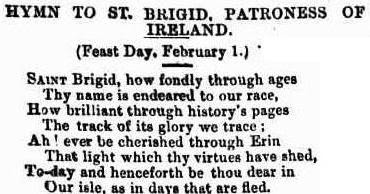
Continuing the octave of posts in honour of Saint Brigid with another hymn in her praise, a late nineteenth-century offering, published in The Freeman's Journal in Sydney, Australia in 1897.  It is unattributed and as these newspapers often syndicated articles from other sources, it may well have originated in the popular religious press in Ireland itself. Verse three alludes to Saint Brigid's traditional virtues of purity and charity and, appropriately for this blog, the final verse makes reference to her as one of our three patrons. There is even an air suggested to which this hymn could be sung. Initially I didn't recognize 'The valley lay smiling before me' but when I saw that it is also known as 'The pretty girl milking her cow' I realized I did know this melody and was able to try out the lyrics.


HYMN TO ST. BRIGID, PATRONESS OF IRELAND.

(Feast Day, February 1.)

Saint Brigid, how fondly through ages
Thy name is endeared to our race,
How brilliant through history's pages
The track of its glory we trace;
Ah! ever be cherished through Erin
That light which thy virtues have shed,
To-day and henceforth be thou dear in
Our isle, as in days that are fled. 
 
Saint Brigid, how deep the devotion
Long nurtured to thee, the green isle,
Till it 'swelled like the tide of the ocean.
Sunlit — 'neath thy virginal smile;
Oh ! sooner may cease the white surges
To break on her emerald shore,
Than cool the devotion that urges,
Sweet Patron, thine aid to implore. 
 
If, glorious Saint Brigid, the splendour
Of purity beams through our land,
Fair homage to thee should it render
Whose lily waves high in thy hand;
And well may the poor Irish maiden
Rejoice in thy fame and thy name,
White purity's robe thus arrayed in
While burning with charity's flame. 
 
With Columba and Patrick we've named thee
Chief Patron of old Innisfail,
And well have her Annals proclaimed thee
As true to the trust of the Gael;
Then potent protectress, may never
Thy love or thy prayer for us cease,
But our Mary of Erin be ever,
Till reach we the Kingdom of peace.

Air: — The valley lay smiling before me.


"HYMN TO ST. BRIGID, PATRONESS OF IRELAND." Freeman's Journal, 30 January 1897.

Content Copyright © Trias Thaumaturga 2012-2023. All rights reserved.
Thursday, 2 February 2023

Saint Columba's Hymn to Saint Brigid


We begin a series of posts to run until the octave of Saint Brigid's Day with a translation of the hymn Brigit bé bithmaith, one of the earliest Irish language hymns, possibly going back to the seventh century. The preface in the Irish Liber Hymnorum suggests a number of possible authors including Saints Ultan of Ardbreccan, Broccán Clóen and Columba. I have already posted two alternative translations at the blog, one by Whitley Stokes from an 1868 article on Broccán Clóen which you can read here and another here from 1908 where authorship is attributed to Saint Columba. The translation below appeared in the Boston Catholic newspaper The Pilot in 1848, it is much less literal than either of the others, but its rhyming style would have appealed to a nineteenth-century audience. The hymn is also attributed to Saint Columba here by author "J.C.M.":

ST. COLUMBA'S HYMN TO ST. BRIDGET.

FROM THE LIBER HYMNORUM*

Oh, Bridget, Virgin ever bright, 
Oh, golden torch of love and light, 
Rich lamp illumining earth's dark dome, 
Guide us to our eternal home! 
 
Defend us, Bridget, mighty Saint, 
From every evil touch and taint; 
Defend us from all wiles and woes. 
And from our fierce infernal foes. 
 
Create in us, anew, afresh, 
A spirit that shall hate the flesh: 
Oh! Blessed Virgin, Mother, give 
To all new power to love and live! 
 
Thou holiest saint of these our days, 
Worthy unutterable praise, 
Protect green Leinster from all harm 
And keep her sons from vain alarm! 
 
O! pillar of our kingdom, grandest! 
To Patrick next, that chief, thou standest! 
Thou blessed maid, thou Queen of Queens. 
On thee each soul devoutly leans! 
 
And after this vain life be past. 
Oh, let our lot with thine be cast! 
And save us in that last dread day 
When Heaven and Earth shall flee away!

J.C.M.

* “A work more than a thousand years old, if the copy in Colgan’s possession, now in St. Isidore’s, Rome, be the same as that in Trinity College library.

Boston Pilot, Volume XI, Number 40, 30 September 1848


Content Copyright © Trias Thaumaturga 2012-2023. All rights reserved.

Thursday, 9 February 2017

Saint Columba's Hymn to Saint Brigid

We conclude the series of posts on Saint Brigid on the octave day of her feast with a hymn attributed to her fellow-patron, Saint Colum Cille. He enjoyed a reputation as a prolific writer, as the compiler of the 'authoritative sources' tells us:


Saint Columba was passionately fond of books and learning in all its branches. He himself, we are told, copied out many hundreds of verses and also wrote poems himself, one of the latter being the following hymn on Saint Brigid, for whom he entertained a great affection: -

"Bridget the good and the virgin,
Bridget our torch and our sun,
Bridget, radiant and unseen,
May she lead us to the eternal kingdom,
May Bridget defend us,
Against all the troops of hell,
And all the adversaries of life,
May she beat them down before us,
All the ill-movements of the flesh.
This pure virgin whom we love,
Worthy of honour without end,
May she extinguish in us.
Yes, she shall always be our safeguard,
Dear Saint of Lagenia;
After Patrick she comes the first,
The pillar of the land,
When old age comes upon us,
May she be to us as the shirt of hair;
May she fill us with grace,
May Bridget protect us."


Saint Patrick and the Saints of Ireland from authoritative sources (London, John Ouseley Ltd, 1908-1909), 71-72.

Content Copyright © Trias Thaumaturga 2012-2017. All rights reserved.

Thursday, 9 June 2016

The Dove Ascends Beyond the Sky: A Hymn for the Feast of Saint Colum Cille

I was interested to see in an appendix to a biography of Saint Colum Cille by an eighteenth-century Scottish minister, the Rev. John Smith, Minister of Campbeltown, a translation of a hymn from the office for the feast. The 1620 date cited was a clue that this was most likely from the Office published by the seventeenth-century hagiologist Thomas Messingham and so indeed it proved to be. Although I was somewhat surprised to see a Scottish Presbyterian make use of the work of an Irish Catholic hagiologist who would have held a very different view of the saints, I can see that references to Saint Colum Cille entrusting his flock to the guidance of Christ by his gracious word would have been very congenial to our Campbeltown cleric. I would not though share his conviction that this is a hymn written soon after the death of the saint by his immediate successor(s). Its origins more likely lie in the texts composed for the 12th-century Translation of the Relics of the Three Patrons, also initially commemorated on June 9, on which you can read more here.

T. Messingham, Florilegium (1620)


From its connection with the subject, it may not be improper to add the following translation of a hymn used in the Office for the Festival of St. Columba, and published in Paris, in the year 1620, from an ancient MS. It was probably composed by Baithen, or some other of Columba's disciples, soon after his death. 

 TRANSLATION OF A HYMN USED IN THE OFFICE FOR THE FESTIVAL OF ST. COLUMBA, ON THE 9TH JUNE. 

 WITH snowy pinions soaring high, 
 The Dove* ascends beyond the sky; 
 He scorns the earth, he leaves its clay,
 And perches in the realms of day. 

There his refulgent colours shine, 
 Reflecting back the light divine. 
 But here his tender brood he left, 
 Of their dear parent now bereft. 

 Yet, ere he mounted to the skies, 
 With many prayers, tears and cries, 
 Their charge he gave to Christ his Lord, 
 To guide them by his gracious word, 
 And bring them to the same abode 
 In which their father lives with God. 

 O God ! who didst our father hear, 
 Be to his children ever near; 
 And grace vouchsafe to lead us on, 
 Until we meet him at thy throne.
* Alluding to his name, which means "a Dove."

Rev. J. Smith,  The Life of Saint Columba, The Apostle of the Highlands (Glasgow 1824), 178-179.

Content Copyright © Trias Thaumaturga 2012-2016. All rights reserved.

Tuesday, 9 September 2014

Alto et ineffabile: Saint Colum Cille in praise of Saint Ciarán of Clonmacnoise

September 9 is the feast of Saint Ciarán of Clonmacnoise.   Below is the text of a Latin hymn in his honour, attributed to Saint Colum Cille, and translated by Peter Davidson:

Latin Text

Hymnus S. Columbae in Laudem S. Ciarani.

Alto et ineffabile apostolorum coeti
celestis Hierusolimae sublimioris speculi
sedente tribunalibus solis modo micantibus
Quiaranus sanctus sacerdos insignis nuntius

Inaltatus est manibus angelorum celestibus
Consummatis felicibus sanctitatum generibus
quem tu Christe apostolum mundo misisti hominem
gloriosum in omnibus nouissimis temporibus

English Translation

Born of the soaring apostolic company
(glass of Jerusalem exalted ineffably)
raised on thrones as sunlight lustrous,
came Ciaran, priest and messenger glorious;

Borne to the sky by angel infantry
Fulfilling thus his folded family,
Christ’s herald, shining apostle of grace
Sent to Ireland in these last, sad days.


Peter Davidson, ‘The hymn of saint Columba in praise of saint Ciaran: an English translation’ in M.Richter and J-M. Picard, eds., Ogma – Essays in honour of Próinséas Ní Chatháin (Dublin, 2002), 320.

The hymn Alto et ineffabile is published as number 27 in the Irish Liber Hymnorum and the editors offer this introduction to it:

The Hymn Alto et ineffabili.

In the Life of St. Ciaran of Clonmacnoise (c. 26), as quoted by Colgan, we read: "Unus ex praecipuis Hiberniae est et merito numeratur Apostolis iuxta quod de ipso cecinit eius condiscipulus et coapostolus sanctissimus Columba in hymno quodam quem in eius composuit laudem dicens:

Quantum Christe O apostolum mundo misisti hominem
Lucerna huius insulae lucens lucerna mirabilis, etc."'

The first line of this couplet is almost identical with line 8 of the piece Alto et ineffabili, which suggests that this may be the hymn in question. It is mentioned again in the manuscript (wrongly) called the Book of Kilkenny in Marsh's Library at Dublin, where at fol. 148aa we read: " Et fecit sanctus Columba ympnum sancto Kiarano," a hymn which Ciaran's successor at Clonmacnoise called clarus et laudabilis. Columba, the story goes, asked in return for some earth from St. Ciaran's grave, with which he calmed the stormy water on his way back to Iona.'

This St. Ciaran, who is to be carefully distinguished from St. Ciaran of Saighir, was the founder of the great monastery of Clonmacnoise, and in its Annals the year of his death is given as 547. He is counted one of "the twelve Apostles of Ireland," and in the Martyrology of Donegal at Septr. 9) he is compared to the Apostle St. John. He was known in his life time as Ciaran mac an t-saor, or "Son of the Carpenter"; and was a friend of St. Kevin, as of St. Columba. His memory still survives in the place called " Temple Kieran," about four miles from Navan. In Cornwall the name of Ciaran (of Saighir) has become corrupted to Piran, to whom there were many churches dedicated.

J.H. Bernard and R Atkinson (eds.) The Irish Liber Hymnorum Vol 2, Translations and Notes (London, 1898), 218-220.

Content Copyright © Trias Thaumaturga 2012-2015. All rights reserved.

Sunday, 23 March 2014

Hymn to Saint Patrick

Last year I reproduced some hymns in honour of Saint Brigid taken from a compilation for children by the (in)famous 'Nun of Kenmare', Mary Frances Cusack. I turned back to this volume to see how Saint Patrick was featured and again found the same mixture of historic sources combined with contemporary compositions. Saint Patrick, however, is much less well-represented in this hymn book than either of our other two national patrons and I found this surprising. For our primary patron is allotted only two hymns, one ancient and the other modern, whereas Saint Brigid has six in her honour and Saint Colum Cille five. In her translation of Saint Sechnall's hymn, Cusack struggled to retain its alphabetical character, but as the text is already available at the blog here, I instead reproduce the contemporary composition. I won't pretend it has any special merit, as with many hymns of the Victorian era there is an emphasis on the Irish as a long-suffering people who cling to their faith in spite of persecution and poverty.  The first verse contains a reference to Ireland's 'martyred hosts' which I can only assume is a reference to those who suffered for the faith during the Reformation and Penal times, for the introduction of Christianity to Ireland was a bloodless affair. Verse three alludes directly to poverty but counsels patience and acceptance on the part of the poor. As with the Hymn to Saint Brigid, in 1868, twenty years after the 'year of revolutions' of 1848,  the then Archbishop of Westminster, Henry Edward Manning, granted an indulgence for the recitation of this Hymn to Saint Patrick. The Church was offering the spirit of the Beatitudes as its prescription for coping with poverty, reminding the reader that it is the meek who will receive their reward in heaven. Indeed, the final verse specifically exhorts the reader to pray for rich men as well as poor and for priests and nuns, sentiments in sharp contrast to those contained in the outlook of contemporary European radicals. Overall, my impression is that this hymn is not concerned with the Saint Patrick of the fifth century but rather with his patronage of Ireland as it was in the author's own day.

HYMN TO ST. PATRICK.

St. Patrick, for our country pray, 
Our ever faithful land, 
Whose martyred hosts so gloriously 
Before God's great throne stand; 
Look down upon thy children here,
Look down upon our race, 
And bless, dear Saint, this little isle 
And each one's native place. 

Chorus — From foes without, from fears within. 
From every evil, every sin, 
St. Patrick, set us free. 

Oh, hear us, Patrick, while we pray, 
Thou art our own dear Saint, 
Uphold the weak, protect the young. 
Strengthen the souls that faint; 
Thou know'st how we are tempted still — 
Thou know'st how we are tried — 
Thou know'st that we are faithful too, 
Whatever ills betide. 
Chorus. — From foes without, &c., &c. 

Oh, help our poor in patient love 
To bear their suffering life, 
To think of that great victory 
Which Cometh after strife; 
Keep from them all revengeful thoughts 
Whene'er they suffer wrong- 
The meek alone are crowned in heaven. 
And heaven will come ere long. 

Chorus, — From foes without, &c., &c.  

We are thy children, blessed Saint, 
The children of thy love, 
We know how mighty is thy prayer, 
How it was heard above; 
Pray for us now, for priest and nun. 
For rich men and for poor, 
That to the end, however tried, 
Our faith may still endure. 

 Chorus, — From foes without, &c., &c.* 

 Haily Mary. 


* " We hereby grant an Indulgence of Forty Days to all who shall devoutly recite the Hymn of St Patrick, with one Hail, Mary. 

" + HENRY EDWARD, 

 "Archbishop of Westminster,  February 20th, l868."


Sister Mary Francis Clare, Cloister Songs and Hymns for Children (London and Dublin, 1881), 154-155.

Content Copyright © Trias Thaumaturga 2012-2015. All rights reserved.

Monday, 17 March 2014

Exultent filii matris ecclesie - A medieval hymn for the Feast of Saint Patrick


Let the sons of mother church rejoice and let us,
their fellows sing a hymn today.
The glorious feast day of Patrick, a day of light and joy, has come.

While the world held him in the chains of the flesh
he abounded with many miracles.
He was a source of healing for the Irish people
through the nourishment of his holy teaching.

He spread abroad the seeds of the faith
He banished serpents from Ireland.
He gave the lame to walk, the blind to see, and to him the people sing.

The power of a new miracle is revealed.
The goat is recognised in the belly of the thief 
through the sound of its bleating.
People marvel at the virtue of the servant of God.

Honour and devotion to the unbegotten Father,
praise to only begotten Son of God;
equal praise to the Spirit Paraclete
for ages unending.

Amen.

Content Copyright © Trias Thaumaturga 2012-2015. All rights reserved.


Wednesday, 6 February 2013

Hymn to Saint Brigid


The series of hymns from the work of Sister Mary Francis Cusack concludes with a nineteenth-century composition. This one received the endorsement of the then Archbishop of Westminster, Henry Edward Manning, one of the famous Anglican converts to Catholicism in Victorian England.  Unlike modern hymns which depict concern for the protection of the environment as Saint Brigid's main priority, this one views her as a helper in the Christian struggle against sin and the devil and extols the idea of perseverance in the face of suffering. I note too that our male patron Saint Patrick is at her side:

HYMN TO ST. BRIGID.

Saint Brigid, Saint most holy,
Dear Patron of our Isle,
Oh, keep us meek and lowly
Whatever foes beguile!
Watch o'er our sea-girt island,
Thy mantle spread around,
As once thou didst extend it
On Curragh's holy ground.  

Ask that God's saints may bless us
With blessings not a few;
What can we fear of evil
With Patrick and with you?
Make the holy still more holy,
Make the pure ones still more pure-
With thy protection, Brigid,
Of blessings we are sure.

Pray for us, saintly maiden.
Pray for thy own dear isle.
And keep us from the tempter.
From sin and every guile.
Oh, make our faith still stronger.
Our patience yet more sure.
And teach us that the victor
Must to the end endure.

Pray for us, then, St. Brigid,
Thy children we would be.
And guide us up to heaven.
To Patrick and to thee.
We fight for crowns eternal,
We suffer but to win,
And he must fight who conquers
The tempter and the sin.*

Hail, Mary.

* “We hereby grant an Indulgence of Forty Days to all who shall devoutly recite the Hymn of St. Brigid, with one Hail Mary.

HENRY EDWARD,

"Archbishop of Westminster
February 20th, 1868."


Content Copyright © Trias Thaumaturga 2012-2015. All rights reserved.

Tuesday, 5 February 2013

From the Metrical Life of Saint Brigit


The fourth hymn pays tribute to Saint Brigid's single-minded Christian devotion: 

FROM THE METRICAL LIFE OF ST. BRIGIT-

"Brigit, Saint of highest fame,
For Christ the world despised;
Like bird on high she sat and sang,
And only virtue prized.

“Her only thought was heaven and God,
Her only thought was pure;
She sought bright mansions in the skies,
And life for aye secure.

“And in her waking and her sleep,
She pined for Christ, her love;
And for His Passion grieved alone,
With cry like captive dove.

"O Brigit! near to Christ my Lord,
Of earthly souls the best,
Pray still for me that I may come
To His eternal rest." *


*Metrical Lives of the Irish Saints, which run to very great length, may be found in Colgan's Trias Thaumaturgus where the originals of these Hymns may be seen. For full particulars of the Lives of St. Patrick, St. Brigit, and St. Columba, we must refer the reader to our large illustrated Lives of these Saints, published by Mr. Murdock, 41 Castle Street, Holborn, London; also, to our new and enlarged illustrated History of the Irish Nation, by the same publisher, which contains a full account, with facsimiles of all the early Celtic Manuscripts, both historical and religious.

Sister Mary Francis Clare, Cloister Songs and Hymns for Children (London and Dublin, 1881), 42.

Content Copyright © Trias Thaumaturga 2012-2015. All rights reserved.


Monday, 4 February 2013

Brigida Nomen Habet


The third hymn in the series alludes to the traditional interpretation of the root of Saint Brigid's name as 'bright':

HYMN IN HONOUR OF ST. BRIGIT.

BRIGIDA NOMEN HABET.

Resplendent is great Brigit's name
Like flash of diamond bright!
Resplendent is great Brigit's name,
Shining in heavenly light!

A virgin of the Lord is she —
A virgin crucified;
A virgin of the Lord is she,
To His Cross closely tied.

Sister Mary Francis Clare, Cloister Songs and Hymns for Children (London and Dublin, 1881), 41.

Content Copyright © Trias Thaumaturga 2012-2015. All rights reserved.


Sunday, 3 February 2013

Christus in Nostra Insula

We continue the series of hymns in honour of Saint Brigid with the famous Christus in Nostra Insula.


ALPHABETICAL HYMN.

CHRISTUS IN NOSTRA INSULA.

There is an alphabetical hymn in honour of St. Brigit, but only a part of this composition remains, unless, indeed as has been conjectured, the hymn consisted of only three verses. This hymn, or what remains of it, is both quoted and referred to in very ancient manuscripts at present extant in Continental libraries.

Christ in our isle was shown to men,
By Brigit's saintly life;
Excelling all who came before,
She conquered in the strife.

Like her no other saint was found,
But Jesu's mother blest;
Her virtues and her wondrous fame
Can never be expressed.

With holy fervour girdled round,
The victor's palm she gains
And like the glorious sun above.
In heaven refulgent reigns.

Then listen to this virgin's praise:
To Christ she gave her vow,
Faithful she kept it; her reward
Is reigning with Him now.

O queen, enthroned in heaven above
Look on thy children dear;
And help them to eternal life,
In God's most holy fear.

Christ Jesus, author of all good,
Have mercy upon me;
That with Thy angels up in heaven,
I may Thy mercy see.

Sister Mary Francis Clare, Cloister Songs and Hymns for Children (London and Dublin, 1881), 39-40.

Content Copyright © Trias Thaumaturga 2012-2015. All rights reserved.

Saturday, 2 February 2013

Pro Nobis Precetur Brigida

I would like to mark the Feast of Saint Brigid with an octave of posts in her honour. I will begin with a series of medieval hymns in honour of the saint as translated by the 19th-century writer, Mary Frances Cusack, 'The Nun of Kenmare'. She used this material in both her 1877 biography of Saint Brigid and in an 1881 volume Cloister Songs and Hymns for Children.  I was disappointed that there was no foreword to this latter volume as it is intriguing to see such relatively high-brow sources included in a collection aimed at a young audience and I would like to have had an insight into her thinking. We begin with a translation of the concluding verses of the first and metrical Life of Saint Brigid, for an overview of the various Lives see the summary here:


"LIFE OF ST. BRIGIT."

Pro Nobis Precetur Brigida.

The first and metrical life of the Saint is too long for insertion here, but we give a few of the concluding verses.

For us may holy Brigit pray,
And keep us safe from harm,
Until we see God's Spirit blest,
Where fears no more alarm.

Against the demons may she be
A fiery sword and strong,
Until her prayers shall bring us safe
To join the angel throng.

To praise God in His Holy Church,
Be still our constant task:
Like holy Brigit, let us not
For earthly pleasures ask.

With all Kildare's holy ones,
To Brigit I will pray,
That she may save from pain and loss
On the great judgment-day.

O holy Saint! who Currah's plains
Hast in thy lifetime trod;
There's none but Mary ever blessed
Has come so near to God.

In Brigit, then, oh let us trust,
She will protect us all;
For not in vain shall Erin's hosts
On holy Brigit call.

To praise Christ is a glorious work —
Then louder be our lays,
And special grace be given to all
Who thus St. Brigit praise.

And they who praise God and His Saints
From God and Brigit too,
In Heaven above shall have reward,
And honour as is due.

Two virgins are in heaven above,
Their client I would be;
Mary and Brigit I invoke,
Protection give to me.

With exaltation see she scorns
The world, and all its joys! 
With exaltation see she scorns
Earth's passing shows and toys! 

She dreaded earthly pomp and state.
Its riches she despised;
She dreaded earthly pomp and state,
For God alone she prized.

She looked for everlasting joys,
She sought a great reward;
She looked for everlasting joys
With Christ, her love and Lord.

She heard the echoing shouts of heaven,
The triumph of the blest!
She heard the echoing shouts of heaven-
Of those with Christ at rest!

Oh! pray for us; kind virgin, pray
That we may joy with thee.
Oh! pray for us; kind virgin, pray
That Christ we too may see. *

*The repetition of the first line is in the original.

Sister Mary Francis Clare, Cloister Songs and Hymns for Children (London and Dublin, 1881), 36-38.

Content Copyright © Trias Thaumaturga 2012-2015. All rights reserved.

Friday, 15 June 2012

Colmcille: The Columban Suite


This recording in honour of Saint Columba is something different, combining liturgical texts, poetry and newly-composed instrumental pieces for the harp. It is the work of Janet Harbinson and performed by the Belfast Harp Orchestra and St Killian's Choir from Mullagh, Co.Cavan. The recording was issued in 1997 to commemorate the 1400th anniverary of Saint Columba's repose. Some of the Antiphons from the Inchcolm Antiphoner feature, including this one:

Dei potens, Hic agonista
Pater Columba, Dei monem ex pugnabat milia.

This powerful champion of God, father Columba,
vanquished thousands of demons.

Full details of the recording and the artistes, plus sound samples, are available here.

Saturday, 9 June 2012

A Liturgy for Saint Columba


A second recording of material from the Inchcolm Antiphoner can be found on this CD. Seven Antiphons are appended to the Gregorian chants from the Roman Liturgy sung by the monks of Pluscarden Abbey in Scotland. The accompanying sleevnotes are useful and for a flavour, here are the notes for Track 20, the Magnificat Antiphon:

The text is a poem, with a strong rhythmic beat and persistent rhyme, in a style that appears often in the Bangor Antiphoner. This still surviving Irish liturgical book of the 7th century gives texts but, of course, no music. Could the music provided here have come down to mediaeval Inchcolm along with the words, through all those centuries? It is a lovely piece, in the first mode, having a wide range, and featuring the repetition of recurring motifs.

Salve splendor et patrone
iubarque iustitiae.
Orthodoxe doctor bone
pastor et vas gratiae.
O Columba columbine
felicis memoriae,
tuae fac nos sine fine
cohederes gloriae.
Magnificat... (Lk.1:46-55)

Hail Columba our glory and our patron;
sun beam of righteousness.
Orthodox doctor, good shepherd, and vessel of grace.
O Columba of happy memory,
truly dove-like:
make us also inherit your glory without end.
My soul magnifies the Lord....

The recording is available to order from the Abbey Shop. There are 22 tracks in all with a total playing time of 55 minutes.

Content Copyright © Trias Thaumaturga 2012-2015. All rights reserved.