
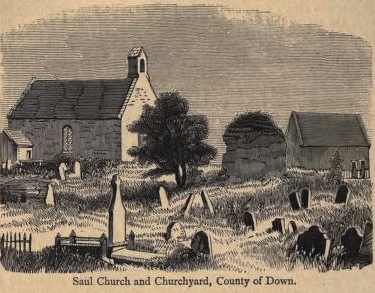
In this final paper ecclesiastical historian, Father Sylvester Malone, argues for Saul rather than Downpatrick as the burial place of Saint Patrick. Although he examines the same evidence as Bishop John, Father Malone takes a more sceptical approach and reaches different conclusions.
ST. PATRICK'S BURIAL-PLACE
THE burial-place of our national saint, like other incidents connected with him, has been a matter of doubt and discussion. The doubt arises from the contradictory notices in the Book of Armagh. These notices appear in one place to favour the claim of Downpatrick to the burial-place; in a second place, the claim of Saul quite convenient to it; and in a third place, the claim of Armagh. The value of each of these notices is not the same, but depends on the intrinsic evidence of the statement, as well as on the bias and intelligence of the writer, and on the age to which he belonged.
The claim of Armagh is very slender, and rests merely on the possession of some relics of St. Patrick of some kind, coupled with the supposition of only one Patrick having been in the early Irish Church; but the existence of two Patricks and their respective identities have been established in a former number of the I. E. RECORD. I am not in accord with those who deny the existence of bodily relics of St. Patrick in Armagh during the ninth century. It was natural and usual to desire the possession of some relic of a saint less renowned than St. Patrick ; and that Armagh procured some bodily relic of him is clearly evidenced in a passage in the Book of Armagh. This passage, which must have escaped the notice of the advocates for Armagh, taken by itself would seem to favour their pretensions. [" In ecclesia australi ubi requiescunt Corpora Sanctorum peregrinorum de longue cum Patricio trausmarinoruin caeterorum que Justorum.'' (Book of Armagh, fol. 21, a. 1.]
The biographers of our national saint have surrounded his death and burial with childish miracles. A comparison instituted by them between him and Moses, however edifying it may be, has led to error on several incidents in his life and the circumstances of his burial. The advocates for Downpatrick have so rested the story of his death and burial on a supernatural basis, as scarcely to leave a human fringe for historical criticism. Nevertheless, the proofs adduced by them appear to me quite questionable, while I judge those in favour of Saul to be highly probable.
I now give a description of St. Patrick's burial-place from the oldest, most impartial, and consistent account in the Book of Armagh. Tirechan, in a lengthened summary of the saint's life, taken from the oral and written account of Bishop Ultan, who lived in the middle of the seventh century, states that St. Patrick was like to Moses in four things, and the fourth thing was that " no person knew where are his bones." The writer then continues to state that two hosts contended for his body during twelve days without night ; and on the twelfth day, as the contending parties were going to give battle, each party saw with themselves the body on a bier, and in consequence refrained from fighting.
Then, as if to justify a departure, by the discovery of Columkille, from the likeness to Moses, the writer continues thus in reference to the burial and the prophetic gift of Columkille :
" Columkille under the influence of the Holy Ghost pointed out the burial-place of St. Patrick, makes out for certain where it is, that is in Sabul-Patrick, that is in the church, as a sprout from the waves, beside the sea, where is the bringing together of relics, that is of the bones of Columkille from Britain, and the bringing together of all the saints of Ireland on the day of judgment."
Now, nothing can be clearer than this valuable statement. The burial-place is stated to have been at the Sabul or Barn of Patrick : there was only one such place, and that within two miles of Down. The passage just quoted calls for a few remarks. First of all the absence of darkness during twelve days of waking is only a natural explanation of the effect of the lights over the corpse; and though there may have been a desire on the part of some people from Armagh to have the burial take place with themselves, we need not suppose there was a disposition to come to blows: a little exaggeration in the description is only very natural. The saint's wish was a command; and, as stated in the Book of Armagh that wish was carried out by his burial in Sabul or Saul. A holy rivalry for the possession of his body was a mark of religious zeal. Hence in another passage in the Book of Armagh, in reference to this subject, the writer states that without divine intervention, "it was impossible to have the peace kept about so illustrious and saintly a corpse." Friendly contention then about the body of our saint was only what decency required.
There is no good reason for doubting that some of the relics of St. Columkille may have been enshrined with those of St. Patrick, though the principal part of them were not located in Ireland till the end of the ninth century. St. Columkille in full health is said, in the Book of Cuana, to have come to St. Patrick's grave, and to have enshrined some of the relics buried with him ; and it is not unnatural to suppose that when dying he or his followers after his death wished to have some of his own relics rest with our national apostle.
The allusion to the gathering together of all the Irish saints at Saul is grounded on a petition found in his confession, to the effect that he should lose none of the Irish given him by God. In consequence of this, some Lives stated that God "left to him the judgment of the Irish on the day of doom." This tradition took another form, according to Tirechan : it was one of the three petitions which he made when dying; namely, ''that each of us repenting, even in the hour of death, would be saved on the day of judgment and escape hell." The church beside which our saint was buried - the sabul of Patrick stood, as a sprout from the wave, near the sea. The tidal waters flowing through the inlet of Strangford Lough flooded the low-lying grounds, even under the very shadow of Saul. Even down to the present century, the low ground was occupied by a standing lake, a mile in circumference, and is still called the salt marsh ;but, in early times, before a rampart was thrown up to dam the waters, the Sabul Church, peering above the wavelets, appeared to spring from the very waters. Now what is the reply usually given to this clear and natural statement, that he was buried in Saul ? This only that Saul meant Downpatrick! Such a reply scarcely deserves notice. We have another proof that St. Patrick was buried in Saul: it is found in the Fourth Life as given by Colgan. Saul is incidentally mentioned in connection with a plaything that accidentally fell into St. Patrick's grave there. The incident is alluded to as follows : -
"A boy playing about the church of Saul let his hoop drop into a chink in St. Patrick's grave; and having put down his hand to take it up could not withdraw the hand. Consequently, Bishop Loarn, of Bright, a place near at hand, was sent for ; and on his arrival addressed the saint thus: 'Why, O Elder, dost thou hold the hand of the child?'"
Here we have a statement incidentally made in reference to one of the incidents that filled up the life of our saint. It is made without a design of propping up a political or religious system. It was made at a time when Saul was comparatively insignificant, and when Downpatrick, owing to its situation, as a great emporium, had risen to importance, and was the seat of the chief of Ulidia.
Let us now examine what is said in reply to this proof. The reply is that St. Patrick did not hold the hand of the boy at all; that the phrase tenentem manum seems a translation of Irish in the Tripartite, gabail lama - expelling; that our saint only drove away the boy who gave annoyance; and that Bishop Loarn, who probably outlived our saint, was one of his religious family. The interpretation thus quoted is given on the authority of Dr. Stokes; but, with great respect for his accurate knowledge of Irish, he is not to be implicitly followed, as has been proved elsewhere. But before dealing with this, his opinion, I have to observe that though the Book of Armagh makes mention of a Loarn settled in Connaught, there is no warrant for stating that there was a Bishop Loarn in Downs, during the saint's lifetime; nor is there the least warrant for stating that he died before our saint. There is no valid reason then producible for denying the certain statement of the biographer -that St. Patrick was dead and in his grave when Bishop Loarn was sent for.
I now deal with the objection founded on the opinion of Dr. Stokes ; namely, that tenentem manum was a mistranslation of gabail lama, "expelling," and that consequently St. Patrick was not dead, nor his grave made on the occasion referred to, but "drove away" the playing boy perhaps with too much harshness : in confirmation of this latter view, the Tripartite is appealed to as an authority for stating that St. Patrick was not "always meek and patient;" and hence the rebuke of Bishop Loarn for probably too much harshness.
Well, an explanation that involves a censure on our national saint for harshness towards an unthinking boy at play is very suspicious. Besides, even if the boy were annoying the saint, as alleged, and if the saint exceeded the limits of moderation in correction, was it a case for having a bishop sent for, and have him rebuke his superior? Moreover, when the bishop came on the scene our saint's action was continued; and if tenentem manum meant expelling, the boy must have been persistently bold during the time the bishop was being sent for, and was coming to the church; and this fact should render impossible the charge of harshness for driving away the boy.
Again, if tenentem manum in the Latin Life be, as stated, a mistranslation of gabail lama in the Tripartite, and as Dr. Stokes has stated that the Irish Life was written in the eleventh century, while, the Latin was written in the ninth century, how could the latter be a mistranslation of the former?
In good truth, the writer of the Latin Life knew the meaning of tenentem manum ; and if he wished to express the idea of expulsion he had only to use the proper and natural Latin expello. On the other hand, if the writer of the Tripartite intended to express the same idea, he would have used, as on all other occasions he did use, the word indarb.
The Irish as well as the Latin phrase meant literally "seizing the hand," and figuratively "overpowering" or "thwarting." But I am told that other instances in the Tripartite countenance "expelling" as the meaning of the phrase. Well, all the instances which occur to me I will submit to a test. In looking into page 118 (Roll's Tripartite), I find the phrase gebthar do lam, "thy hand shall be seized." This was a reply from the angel to St. Patrick, who refused to budge till he obtained the privilege of rescuing as many souls from hell as hairs on his chasuble. The reply meant, "you shall be overpowered," and nothing more. The editor of the Tripartite inferred from the remark of St. Patrick about budging, that the reply had an antithetical meaning, but the inference was not correct.I alight on another instance. St. Patrick wished to establish a house in Assaroe, but was opposed by Coirbre " who sent two of his people to 'prevent him,'" gabail lama.
But a more crucial instance of the phrase occurs in page 156 of the Roll's Tripartite. Our saint wished to establish a house in Inishowen ; but Coelbad " prevented him in regard to it," gabail a laim ass, which the editor renders by "expelling thence." Now the addition of the word ass here, and not in the other instances, is translated by "thence." But surely we understand that when there is question of a person being in a place, and of his expulsion, the expulsion is from that place. The addition of the word ass then is unnecessary on the supposition that the phrase gabail lama in the other instances without it meant "expelling." I shall not dwell on another instance, in page 164, which has the same meaning ; and in these instances the word ass means not "thence" but "in regard to it."
That such is the meaning of ass, is very clearly brought out in page 163. It is there stated that our saint wished to take a place in Cell Glass, and (dlmotha do ass) "he was refused," according to Roll's editor, but properly and literally "it was refused to him in regard to it." The editor having no meaning for ass, but "thence," and seeing such a translation to be unmeaning, he did not translate it at all. The Irish word ass lends itself to various idiomatic phrases with which the learned editor is apparently not familiar. I hope now it may be admitted that the allusion to the detention of the boy's hand in St. Patrick's grave was not a mistranslation of the Irish, and that it establishes a belief in the writer of Vita Quarta as to the burial-place of St. Patrick in Saul.
Notwithstanding the political and social greatness to which Downpatrick had risen, and the comparative obscurity of Saul, there is evidence of its claim to St. Patrick's burialplace being recognised in succeeding ages. Thus, the Four Masters, under the year 1293, state that the relics of St. Bridget and Columkille were discovered with the remains of St. Patrick at Patrick's Saul. The discovery, witnessed by the Archbishop of Armagh, was accompanied by miraculous manifestations. The same statement is made in the Annals of Ulster. The fact remains, that at the end of the thirteenth century, we find solemn testimony, confirmatory of the statement made in the Book of Armagh, in the seventh century, in favour of Saul being the burial-place of St. Patrick.
Now, in reply to the several clear and natural statements made, without the aid of supernatural agency, in favour of Saul, what are we told ? This, that Saul meant Downpatrick, and that tenentem manum did not mean "holding the hand." And the proof in favour of the rival burialplace, of what is it composed? Merely of mystery, visions, and miracles ! That one angel was commissioned by another to send St. Patrick to him ; and the saint, having gone, was told by the angel from a flaming bush (a) that his death would be in Saul ; but, as a compensation to Armagh, that it should have primacy; (b) that there was to be no darkness for twelve days, or rather partial day for the rest of the year; that angels waked St. Patrick with vigil and psalmody during the first night, whilst all who came to the wake slept ; that oxen, yoked to the bier, were to be left to themselves to carry the corpse to the destined burial-place ; (c) that the rival provinces of Down and Armagh were kept from deadly fight by the swelling tide which became instinct with life ; that on the ebb of the tide the people of Armagh, fording the river, fancied they saw the bier carried on towards Armagh, till it disappeared at Cabcenne stream; that the corpse was to be buried, by angelic directions, seven feet deep in the earth ; that the relics should not be removed from the earth, but a church built over them; (d) and yet, that no person knew where was the burial-place : all this supplies material for the argument in favour of Downpatrick!
But I would offer a few hurried remarks (a) We are told in one place that St. Patrick went to the angel, but quite the contrary in the next page. (b) The primacy is said to have been given then to Armagh ; but it had been given, on as good authority, long before then to Armagh. (c) The angel directed a very practical direction that a church should be built where the oxen were to stop, over the corpse. What if they had not stirred from Saul, where there was a church, or moved to a place where there was already a church ? (d) It is strange that, as the Armagh people acknowledged the finger of God on the disappearance of the phantom bier, they paid no heed to the angel's directions, and were determined to give battle or have the corpse, (e) It is equally strange that a church directed by angels to be built, was undertaken only at the end of the seventh century. The narrator states that when a foundation for the church was being dug, quite recently ('novissimis temporibus'), flames issued from the grave. Does not this prove that the burial-place was known, notwithstanding the similarity to Moses ? Besides, the angel, in directing the building of a church, and directing that the delvers should sink the grave seven feet deep, must not have intended that the burial-place should be unknown. I may be told that a mistake in regard to Saul should rather be admitted than a whole cycle of miracles in defence of falsehood. Well, however unpleasant the fact, it must be admitted that unenlightened zeal or dishonest bias can sport with miracles for its own ends ; and the Book of Armagh affords ample proof of it in another passage.
The Book of the Angels tells its readers that an angel having tapped St. Patrick out of slumber, snatched from his long vigils, announced that God " gave him and to the diocese of Armagh all Ireland." The saint then is represented as deprecating such a large and unnecessary gift, because of receiving already a peculiar rent, given freely, though a debt ordained by God, from every free church, and as having no doubt that this debt would be decreed for the future bishops of Armagh by all cenobitical monasteries. What a caricature and profane libel this on the saint's disinterestedness! The writer ought to have remembered the Confession -
They have given me small voluntary gifts, and some of their ornaments upon the altar ; but I returned these to them, though they were displeased with me for so doing. But ... I wished to keep myself prudently in everything ... so that unbelievers may not, in my ministry, in the smallest point, have occasion to defame it."
But, perhaps, since I have baptized so many thousands, I may have accepted half a screapall. Tell it to me, and I will restore it. When the Lord ordained everywhere clergy, through my humble ministry, then if I asked the price of my shoe, tell it against me, and I will restore you more. I spent for you, that they may receive me."
In order to prop up the claims of Downpatrick, angels must commune with each other ; man had to abdicate the possession of his senses ; the brute beasts are brought to the scene to act their part ; and the waters became instinct with life " in digging deep valleys, while, at the same time, piercing the air" as a barrier against contending provinces. Heaven and earth are moved, with their inhabitants, in order to neutralize an historical and the earliest statement in favour of Saul. This simple and natural statement, in striking contrast to its contradictory, tells us that our saint, overtaken by the sickness of death at Saul, was there buried. Saul was his first love, the scene of his first missionary success, and the closing scene of his divinely-favoured apostolate. The alleged signs and wonders in connection with the burial resemble others on which, before the present, I had to observe that their extravagance appeared in proportion to the evidence of the falsehood in support of which they appeared to be manufactured. Downpatrick possessed nothing in fact, in association, in prophecy, not even a church, suggestive of a burial-place. Neither the glory of God, so far as it is allowed us to raise a corner of the mysterious veil, nor edification of man called for Divine interposition on the occasion. As to the dying wish of the saint, it certainly did not lean to Downpatrick, nor probably, notwithstanding the repeated and accentuated assurances to the contrary in the Book of Armagh, to Armagh; for his wish on such a matter would be an absolute command; and as to a chosen spot, "all Ireland was given to him as his diocese."
It was only natural, then, in the circumstances that the great high priest, the glorious national apostle, would lie where he fell; and, if it were not natural, it would be a matter of indifference to him who, in his extreme old age, had to say :
" I daily expect murder, or to be circumvented, or reduced to slavery, or to a mishap of some kind . . . And if ever I have imitated anything good on account of my God, Whom I love, I pray Him to grant me that, with those proselytes and captives, I may pour out my blood for His name's sake, even though I may be deprived of burial, and my corpse most miserably be torn limb from limb by dogs or wild beasts, or birds of the air should devour it."
In conclusion: the alleged angelic direction in regard to the burial of St. Patrick in Down, and to the church to be built over him, is still further proved to be false by the fact that law and custom forbade any person in the fifth century to be buried in a church, or a church to be built over him, unless he was a martyr.
SYLVESTER MALONE.

