Monday, 16 March 2015

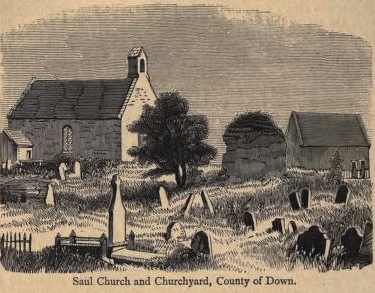
The Death of Saint Patrick


DEATH OF ST. PATRICK.

During his missionary life St. Patrick visited every part of Ireland, consecrating bishops, ordaining priests, and fostering the religion of Christ everywhere. Toward the close of his life, having the happiness of seeing the entire nation within the Christian fold, he confined his labors almost exclusively to his own Archdiocese of Armagh. Previous to his death he was forewarned that he should not die in Armagh, but in Saul, "a favorite retreat which he had built upon the land given him by his first convert, Dicho." Having repaired to the monastery of Saul, he awaited joyously the hour of his entrance into eternal bliss. Being admonished by his guardian angel as to the time of his death, says the chronicler, he fortified himself with the divine mysteries, from the hand of his disciple, the holy bishop Tassach, and lifting up his eyes, he beheld the heavens opened, and Jesus standing in the midst of a multitude of angels. Then raising his hands and blessing his people, and giving thanks, he passed out of this world, from the faith unto the reality, from his pilgrimage unto his country, from transitory pain unto eternal glory.

Short Instructive Sketches from the Lives of the Saints for the use of Parochial and Sunday Schools, Academies &etc. (New York, 1888), 40-41.

Content Copyright © Trias Thaumaturga 2012-2015. All rights reserved.

Sunday, 8 February 2015

European Offices and Devotion to St Brigid

We conclude the octave of posts in honour of Saint Brigid with a brief account of devotion to our national patroness in some other European countries:

The eminent charity, and the great number of miracles which God had wrought through her intercession, caused her to be placed, immediately after her death, amongst the most illustrious saints. Parents were emulous to give her name to their female children. The church erected altars, and dedicated temples to her, which honours were surpassed by those which she received from posterity. Ireland considered her as her patroness; and her reputation soon spread itself beyond the narrow limits of that island. All Europe participated in this devotion. Her name is invoked at Seville, Lisbon, Placentia, Tours, Besancon, at Namur, in the abbey of Fulda, in which are some of her relics; at Cologne, where one of the principal churches in the city is dedicated to her; and lastly, in London, where there is still a church that bears her name.

This devotion was strengthened by an office of nine lessons, in honour of this saint, which is to be met with in several Breviaries in Europe; in an ancient Roman one printed at Venice, in 1522, in that of Gien, (in Breviario Giennensi) in Italy; in that of the regular canons of Lateran; in an ancient Breviary of Quimper in Armorica: in a church bearing her name at Cologne, of which she is patroness; and finally in a chapel dedicated to her in the territory of Fosse, diocese of Maestricht. We find an office to St. Bridget in the Breviaries and Missals of Maestricht, Mayeuce, Treves, Wirtsburg, Constance, Strasburg, and other towns of Germany.
The History of Ireland Ancient and Modern taken from the most authentic records and dedicated to the Irish Brigade by the Abbé Mac Geoghegan (Dublin, 1844), 157.

As the Abbé has mentioned the offices to Saint Brigid to be found in continental Breviaries, it is perhaps appropriate to conclude with the prayer from the Roman Breviary, first posted here:

O GOD, Who year by year dost cause us to rejoice as upon this day, in the feast of Thy blessed hand-maiden Brigid, mercifully grant us help for her sake, the bright ensample of whose chastity doth still shed its light upon us. Through our Lord Jesus Christ Thy Son, Who liveth and reigneth with Thee, in the unity of the Holy Ghost, one God, world without end. Amen.

Content Copyright © Trias Thaumaturga 2012-2015. All rights reserved.
Saturday, 7 February 2015

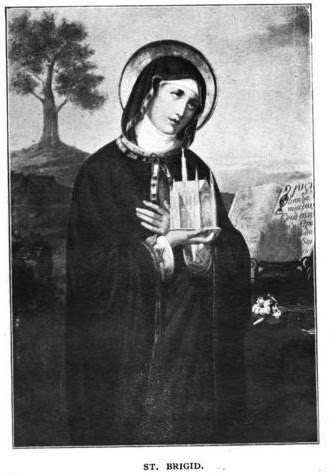
Saint Brigid's Feathered Servant

The dandelion was called Bearnain Bhrighide - "the serrated flower of Brigid" (it begins to flower on her day). The linnet is big-ean Bhrighide - "the little bird of Brigid" (it begins to sing on her day), and the oyster catcher is called giolla Bhrighide, "the servant of Brigid".

An Claidheamh Soluis, Jan. 25, 1908, quoted in 'St. Brigid in Tradition and Art', The Furrow Vol. 3, No. 2 (Feb., 1952), p. 4.

Content Copyright © Trias Thaumaturga 2012-2015. All rights reserved.

Friday, 6 February 2015

Saint Brigid and the Hard-Hearted Mistress


Vignettes from the Lives of the Irish Saints: Saint Brigid and the Hard-Hearted Mistress

Like St. Columba, she was always anxious to help those who were in bondage according to the custom of the times. She remained for some time at a place on the plain of Cliach, in the county Limerick, and while here a poor girl fled to her protection to escape the tyranny of a cruel mistress. The mistress came after her to reclaim her, and would not listen to the entreaties of the Saint. She seized the unhappy girl, and tried to drag her with violence from the protection of St. Brigit.

But the holy Abbess knew where to exercise severity, which in saintly hands is another form of mercy. She procured pardon for the maid, and the repentance of the mistress, by obtaining that the hand which held the girl should become withered. The woman, terrified at what had befallen her, and no longer able to hold the girl, gave her the freedom she desired, and immediately her hand was restored. But miracles of mercy were, indeed, worthy of her who had chosen mercy as her special virtue.

M. F. Cusack, The Lives of Saint Columba and Saint Brigit (Dublin and London, 1877), 223.

Content Copyright © Trias Thaumaturga 2012-2015. All rights reserved.

Thursday, 5 February 2015

Saint Brigid and the Uncharitable Woman


Vignettes from the Lives of the Irish Saints: Saint Brigid and the Uncharitable Woman

The Saint could not bear to see any want of charity in others. Once when a woman came to her with a present of apples, some lepers came at the same time asking for an alms. St. Brigit told the woman to divide the fruit amongst them, but she replied that she had brought the present for the nuns, and not for the lepers. The Saint was seriously displeased at her want of charity, and told her that her trees should  never bear fruit after this.

M. F. Cusack, The Lives of Saint Columba and Saint Brigit (Dublin and London, 1877), 217-8.

Content Copyright © Trias Thaumaturga 2012-2015. All rights reserved.


Wednesday, 4 February 2015

To Saint Brigid

Saint Brigid has been the subject of many poems over the centuries. I think it would be fair to say that this offering, published in 1926, would hardly be numbered among the greats, but it does at least see its subject as a Christian saint and opponent of paganism, a sentiment which is absent from so many contemporary offerings. I am also glad to see the writer give Saint Brigid her place as a patron of Ireland.

To St. Brigid

Dear Patron of our ancient race,
With Patrick and with Columcille,
The hand of Time can ne'er efface
The memory of thy zeal and grace -
It lingers with us still.

You saw the pagan darkness die
Within our country's shore,
And Faith's bright star illumined her sky,
For Erinn's golden age was nigh,
And Baal's reign was over.

Maurice R. Cussen

The Irish Monthly,Vol. 54, No. 639 (Sep., 1926), p. 483.

Content Copyright © Trias Thaumaturga 2012-2015. All rights reserved.

Tuesday, 3 February 2015

Saint Brigid and Somerset


I am always interested in the cult of Saint Brigid and our other native saints as found outside of Ireland. As I noted in an earlier post here, Saint Brigid was even more widely-known in medieval England than our national apostle, Saint Patrick. The English monastery of Glastonbury in particular led claim to relics of our patroness and below is a summary of this particular aspect of Brigid lore from a Somerset newspaper. Many of the themes it raises can be explored further in this post on Saint Brigid and Glastonbury.


St Brigid and Somerset

ST. BRIDGET'S-DAY.

The Churches of Chelvey and Brean are the only ones in Somerset dedicated to this saint. But the county is peculiarly interested in St. Bridget, for it is said she came to Glastonbury about A.D. 488, and that she passed some years in a certain island called Beckery, where there was earlier still a chapel dedicated to St. Mary Magdalene, and that on her return to Ireland, shortly before her death, she loft her wallet, her rosary, and her weaving tools at Beckery, which things, in consequence of the sweetness of her memory, were there preserved as reliques and reverenced. Moreover, the chapel was afterwards known by her name, in which chapel there was, in the southern part, a hole, through which all who passed would, according to common belief, receive forgiveness of their sins. Beckery lies nearly due west from Glastonbury— it consists of a ridge of no great elevation, stretching from near the site of the present railway station to the River Brue. St. Bridget is fabled to have nursed St. Patrick at Glastonbury in his last illness, and embroidered his shroud for him.

She is also said to have been buried at Glastonbury, although Kildare and Downpatrick in Ireland, and Abernethy, in Scotland, claim to have received her body. St. Bridget is pictorially represented as sitting with a bowl of milk in her lap, and a Glastonbury church tower bears a sculpture of what appears to be a dairymaid milking a cow. Mr. Bligh Bond attributes this as representing St. Bridget, who is reputed to have possessed many good characteristics. It is said that "wild ducks, swimming in the water, or flying in the air, obeyed her call, came to her hand, let her embrace them, and then she let them fly away again." In the Breviary of Sarum it is reported to be recorded that when she was sent a-milking to make butter, she gave away all the milk to the poor, that when the rest of the maids brought in their milk she prayed, and the butter multiplied; that the butter she gave away she divided into twelve parts, "as if it were the twelve Apostles," and one part she made bigger than any of the rest, which stood for Christ's portion, "though it is strange," says Bishop Patrick, "that she forgot to make another inequality by ordering one portion of the butter to be made bigger than the remaining ones in honour of St. Peter, the prince of the Apostles."


W. G. Willis Watson.

Calendar of Customs, Superstitions, Weather-lore, Popular Sayings and Important Events Connected with the County of Somerset. Reprinted from The Somerset County Herald (1920), 35-6.

Content Copyright © Trias Thaumaturga 2012-2015. All rights reserved.