Thursday, 5 February 2015

Saint Brigid and the Uncharitable Woman


Vignettes from the Lives of the Irish Saints: Saint Brigid and the Uncharitable Woman

The Saint could not bear to see any want of charity in others. Once when a woman came to her with a present of apples, some lepers came at the same time asking for an alms. St. Brigit told the woman to divide the fruit amongst them, but she replied that she had brought the present for the nuns, and not for the lepers. The Saint was seriously displeased at her want of charity, and told her that her trees should  never bear fruit after this.

M. F. Cusack, The Lives of Saint Columba and Saint Brigit (Dublin and London, 1877), 217-8.

Content Copyright © Trias Thaumaturga 2012-2015. All rights reserved.


Wednesday, 4 February 2015

To Saint Brigid

Saint Brigid has been the subject of many poems over the centuries. I think it would be fair to say that this offering, published in 1926, would hardly be numbered among the greats, but it does at least see its subject as a Christian saint and opponent of paganism, a sentiment which is absent from so many contemporary offerings. I am also glad to see the writer give Saint Brigid her place as a patron of Ireland.

To St. Brigid

Dear Patron of our ancient race,
With Patrick and with Columcille,
The hand of Time can ne'er efface
The memory of thy zeal and grace -
It lingers with us still.

You saw the pagan darkness die
Within our country's shore,
And Faith's bright star illumined her sky,
For Erinn's golden age was nigh,
And Baal's reign was over.

Maurice R. Cussen

The Irish Monthly,Vol. 54, No. 639 (Sep., 1926), p. 483.

Content Copyright © Trias Thaumaturga 2012-2015. All rights reserved.

Tuesday, 3 February 2015

Saint Brigid and Somerset


I am always interested in the cult of Saint Brigid and our other native saints as found outside of Ireland. As I noted in an earlier post here, Saint Brigid was even more widely-known in medieval England than our national apostle, Saint Patrick. The English monastery of Glastonbury in particular led claim to relics of our patroness and below is a summary of this particular aspect of Brigid lore from a Somerset newspaper. Many of the themes it raises can be explored further in this post on Saint Brigid and Glastonbury.


St Brigid and Somerset

ST. BRIDGET'S-DAY.

The Churches of Chelvey and Brean are the only ones in Somerset dedicated to this saint. But the county is peculiarly interested in St. Bridget, for it is said she came to Glastonbury about A.D. 488, and that she passed some years in a certain island called Beckery, where there was earlier still a chapel dedicated to St. Mary Magdalene, and that on her return to Ireland, shortly before her death, she loft her wallet, her rosary, and her weaving tools at Beckery, which things, in consequence of the sweetness of her memory, were there preserved as reliques and reverenced. Moreover, the chapel was afterwards known by her name, in which chapel there was, in the southern part, a hole, through which all who passed would, according to common belief, receive forgiveness of their sins. Beckery lies nearly due west from Glastonbury— it consists of a ridge of no great elevation, stretching from near the site of the present railway station to the River Brue. St. Bridget is fabled to have nursed St. Patrick at Glastonbury in his last illness, and embroidered his shroud for him.

She is also said to have been buried at Glastonbury, although Kildare and Downpatrick in Ireland, and Abernethy, in Scotland, claim to have received her body. St. Bridget is pictorially represented as sitting with a bowl of milk in her lap, and a Glastonbury church tower bears a sculpture of what appears to be a dairymaid milking a cow. Mr. Bligh Bond attributes this as representing St. Bridget, who is reputed to have possessed many good characteristics. It is said that "wild ducks, swimming in the water, or flying in the air, obeyed her call, came to her hand, let her embrace them, and then she let them fly away again." In the Breviary of Sarum it is reported to be recorded that when she was sent a-milking to make butter, she gave away all the milk to the poor, that when the rest of the maids brought in their milk she prayed, and the butter multiplied; that the butter she gave away she divided into twelve parts, "as if it were the twelve Apostles," and one part she made bigger than any of the rest, which stood for Christ's portion, "though it is strange," says Bishop Patrick, "that she forgot to make another inequality by ordering one portion of the butter to be made bigger than the remaining ones in honour of St. Peter, the prince of the Apostles."


W. G. Willis Watson.

Calendar of Customs, Superstitions, Weather-lore, Popular Sayings and Important Events Connected with the County of Somerset. Reprinted from The Somerset County Herald (1920), 35-6.

Content Copyright © Trias Thaumaturga 2012-2015. All rights reserved.

Monday, 2 February 2015

Brighid na gCoinneall - Brigid of the Candles


St Brigid is called the Mary of Ireland. Numbers of most beautiful legends cluster around her fame. She was the attendant woman of the Virgin and the foster-mother of Christ. She carried two candles before the Virgin at the Purification, hence she is called Brighid na gCoinneall - Brigid of the Candles - and her feast was Candlemas. Her crosses, indeed, are sometimes called Candlemas Crosses.

...On her day Winter is chased away, and life is breathed into the earth. At Candlemas a candle less is required, the days are so much longer.

An Claidheamh Soluis, Jan. 25, 1908, quoted in 'St. Brigid in Tradition and Art', The Furrow Vol. 3, No. 2 (Feb., 1952), p. 4.

Content Copyright © Trias Thaumaturga 2012-2015. All rights reserved.

Sunday, 1 February 2015

Saint Brigid's Day

To celebrate the feast of our beloved national patroness, below is a piece published over eighty years ago, in which the writer, Mrs Leonard Wheeler, dips into the hagiographical tradition to present a portrait of Saint Brigid. I have the impression that this was perhaps written for an American audience but I have no further information on the author. Her work is blessedly free of any allusions to Saint Brigid being a pagan deity thinly disguised, for example she acknowledges that the old writers speak of our saint having been born at sunrise, but Mrs Wheeler sees this, not as evidence of pagan sun-worship, but of Brigid's soul being akin to the sun in its clarity.


St. Brigid's Day

Many an Irish mother will be telling her children to-night the story of St. Brigid the Bright, the lover of the poor, and the friend of the weary and outcasts of the earth, whose birth is commemorated throughout the Emerald Isle on the 1st of February.

Brigid it was who cared for the birds and the animals and was called "The Mother of the Flocks" because of her kindness to her sheep, who fed a hungry hound with the food from her own table, and the story goes that there were still the same number of pieces of bacon remaining after she had given two to the dog. It was said that the touch of her fingers sent the cold mists from the rivers, that her gentle blessing calmed the wild birds till they fed from her hand. Brigid had a dairy with twelve cows; she divided her churning into twelve parts in honour of the Twelve Apostles, and the Irish mother tells her child there was yet a thirteenth part left - that was the biggest part of them all. That was in honour of the Christ Who was the Lord of the Twelve, and St. Brigid gave it away to the poor people who worked hard for a living and could not afford butter for their bread. Cows and dairies are her particular care, and she is the Saint of Dairymen. Where her pictures are seen. she wears a cross over her head, and there is a cow near by in the background.

Her birth, being in the sixth century, is veiled somewhat in the cloak of contradictory legends, as in most cases, but it is certain that she was born in Connacht, and her mother was a godly working woman, very devoted to the best traditions of the Celtic Faith. Her father was a rich man of Munster, with whom she was living between the period she was brought up by a bard, who taught her the beauty of song and poetry, and the time that she took the veil at Kildare, and founded the monastery which was the nucleus of many such beautiful retreats. Old writers say that she was born at sunrise - a poetic fancy, maybe, but an apt one. For her soul was akin to the sun, undarkened by any fear or misgiving. If she were aware of any strangeness in her powers, it did not alarm her calm spirit. Neither had she any sort go self-consciousness - like the sun that shone on her sweet face, she went on her simple way, singing about the daily tasks that she did in field or dairy, giving of her splendour and warmth to the cold and suffering as they came her way.

She must have had little time to think of herself, for a more industrious saint never trod the earth, She wove the first cloth in Ireland, and probably steeped it in her buttermilk, for modern ideas of manufacture were as far from her dreams as the modern conceptions of medical practice. She was a healer of sickness, and her patients included the birds, beasts, and fishes too. Not only the sicknesses of the body, but the diseases of the mind, were her care, and "Victorious Bright Brigid "loved not war. When she was asked to attend the warriors, she said: "Aye, but before going with the Angels to battle, let us run with the Angels to the Church, for the Lord is greater than any poem of Victory!"

Small wonder is it that the Irish love St. Brigid, the "Fiery Arrow", the Mary of the Gael. Small wonder that she is enshrined in their loyal hearts next to St. Patrick alone, and that her bones lie buried in the same grave with the Patron Saint himself, who baptised her mother, and in whose steps Brigid herself so bravely trod.

And as the twilight falls to-night on the humble homes of Ireland as well as in its old castle halls, the old legends will be repeated as the fires are covered in, and the beautiful prayer of the long centuries will be said:

"I save this fire as Christ saved everyone. Brigid beneath it, the Son of Mary within it, let the three Angels most high in heaven keep this house and its people sheltered till dawn of day."


MRS. LEONARD WHEELER.


The Irish Monthly, Vol. 60, No. 704 (Feb., 1932), pp. 91-92.

Content Copyright © Trias Thaumaturga 2012-2015. All rights reserved.

Saturday, 6 December 2014

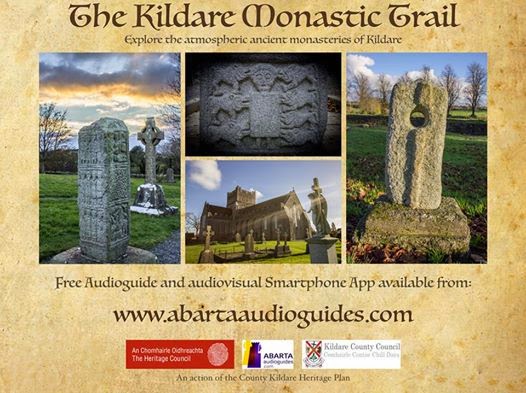
The Kildare Monastic Trail

Abarta Audioguides have made a copy of their Kildare Monastic Trail available to download free of charge:


We are absolutely delighted to announce the release of our latest audioguide: The Kildare Monastic Trail

This free to download audioguide helps you to explore the atmospheric ancient monasteries of County Kildare. The guide consists of 10 tracks and features sites like Castledermot, Old Kilcullen, Moone, Oughterard and more. Narrated by Kildare actor Liam Quinlivan, it tells of the history, archaeology, heritage and folklore of these fascinating sites and gives panel by panel descriptions of the spectacular high crosses at places like Moone and Castledermot.

The guide is free to download as a MP3 audioguide from our website:
http://abartaaudioguides.com/our-guides/Kildare-Monastic-Trail

Or download directly to your smartphone or tablet with our free app version (for Android and Apple). The app version is packed with images and comes with a map to help you navigate your way around the trail:
https://www.guidigo.com/Tour/Ireland/Kildare/Kildare-Monastic-Trail/b4ZmkCsGurI

This audioguide was produced by Abarta Audioguides in conjunction with Kildare County Council and with the kind support of The Heritage Council. We would like to thank Sharon Greene of Castledermot Local History Group, Noel Dunne National Roads Authority archaeologist, Mario Corrigan of Kildare Library Service and Kildare Heritage Officer Bridget Loughlin for all of their advice, support and information during the production of this guide.

This audioguide is an action of the County Kildare Heritage Plan.


Friday, 31 October 2014

Saint Faolán of Fosses and Devotion to Saint Brigid

October 31 is the feast of Saint Faolán, one of the many Irish missionary saints who laboured in Europe. He is also one of the Irish saints who helped to spread the cult of Ireland's patroness on the Continent. Roísín Ní Mheara has given a fascinating account of devotion to Saint Brigid of Kildare in the Meuse/Maas valley region in which Saint Faolán laboured. His monastery at Fosses was dedicated to Saint Brigid and today their names are still intertwined in this area:
In the cryptal chamber of Saint-Feuillen, old effigies of St Brigid and St Gertrud guard the place where Faolán's remains first reposed. And the particular devotion paid by the saint to his Irish patroness again bears evidence in a small church that tops a hill beside the town, to which the rue Saint-Brigette leads us. Said to have been erected by Faolán and his monks, it has a Celtic cross inserted in the outer wall of the sanctuary, believed to be the altar stone of the original seventh-century church, brought hither from Ireland! Be that as it may, Faolán is certainly responsible for implanting the very lively cult of St Brigid into this part of Belgium - a cult still practised at this ancient place. People gather here to celebrate her Feastday, bringing twigs bound together to form a cros Bríde, as in Ireland. After being blessed, these crosses are hung up in cow-sheds to protect the cattle for another year. Also reminiscent of the charitable aspect of the cult of St Brígid is the large hospital-cum-Old Folks Home beside the church on the hill, superseding, it is said, the original almshouse of the Irish missionaries. The nuns in charge of the hospital also have the keys to the church of Saint-Brigette.

Devotion to St Faolán, fanning out in all directions from Fosses, is marked with churches and chapels in his honour. Since rivers are often destined to be the carriers of man's history, it was the proximity of the river Meuse - Maas in Germanic tongues - that played a part in spreading Faolán's cult and reputation.

...The Meuse Valley's preoccupation with the cult of Faolán affected that of St Brígid. As a protectress of cattle her fame progressed through the land and across the river into the diocese of Cologne. An important Roman road linked Gallia Belgica with the Rhinelands via Maastricht, soon to be complemented by a Carolingian trade-route linking the North Sea port of Brugge with the seat of Charlemagne at Aachen (Aix) and continuing on to Cologne, the famed 'City of Holy Martyrs' - where St Brígid of Ireland, although no martyr, installed herself with a parish of her own in the city's core.

In the cathedral of Aachen, Brígid shares a stained glass window with Faolán, whose own adjacent church, that had served the community since the fifteenth century, has been rebuilt after destruction in World War Two. (The connection between Brígid and Faolán was carried as far as Spain, where their effigies adorn an early church in Navarre).

Roísín Ní Mheara, Early Irish Saints in Europe - Their Sites and their Stories (Seanchas Ard Mhacha, 2001), 70.

Content Copyright © Trias Thaumaturga 2012-2015. All rights reserved.