Wednesday, 1 February 2012

The Office of Saint Brigid from the Roman Breviary


OFFICES PECULIAR TO IRELAND

February 1

St Brigid (Bride,) Virgin.
Patroness of Ireland.

Double of the Second Class.

All from the Common Office for Virgins (p. 567,) except the following.

Prayer throughout the Office.

O GOD, Who year by year dost cause us to rejoice as upon this day, in the feast of Thy blessed hand-maiden Brigid, mercifully grant us help for her sake, the bright ensample of whose chastity doth still shed its light upon us. Through our Lord Jesus Christ Thy Son, Who liveth and reigneth with Thee, in the unity of the Holy Ghost, one God, world without end. Amen.

MATTINS.

FIRST NOCTURN.

Lessons from i Cor. vii. 25, as in the Common.

SECOND NOCTURN.

Fourth Lesson.

THE holy virgin Brigid was born of noble and Christian parents in the province of Leinster in Ireland, and she was the mother in Christ of many holy maidens. While she was yet a little child, her father saw men clad in white raiment pouring holy oil upon her head, which thing was a foreshadowing of the godliness and holiness of the virgin. As soon as she had attained to the first years of girlhood, she chose Christ her Saviour for her Bridegroom, and clung to Him with so profound a passion of her heart, that she gave away to the poor whatsoever she had. The matchless loveliness of her body brought about her a host of suitors, and lest they should prevail with her to break the intention of virginity, by which she had given herself over to God, she prayed God to make her unsightly. She was soon heard. One eye swelled, and her whole face became so changed, that she was allowed to send back the messenger of the suitors, and by a solemn vow to keep her virginity for Christ.

Fifth Lesson.

SHE took with her three maidens, and went to Bishop Mahew, the disciple of St Patrick. When he beheld a pillar of fire over her head, he clad her in a white tunic and a white mantle, read the sacred prayers, and admitted her to that canonical profession which blessed Patrick had brought into Ireland. At the moment that she bowed down her head to receive the hallowed veil, she chanced to touch the wooden step of the altar with her hand, and the dry wood at once became green, and her eye was healed, and her face became lovely as beforetime. After her example so great a multitude of maidens embraced the regular life, that in a little while all Ireland was filled with houses of nuns, whereof the chief was that one in which Brigid herself ruled, and from which the others hung, as from their head.

Sixth Lesson.

THE holiness of this virgin is witnessed by the miracles which she openly wrought, not only during her life, but also after her course in this world was ended. Very often did she cleanse lepers, and obtain health by her prayers for them that were sick of divers diseases. She opened the eyes of one that was born blind. A certain shameless woman had an unlawful child, whereof she protested that Bishop Broonus was the father, but Brigid made the sign of the cross upon the mouth of the new-born child, which forthwith told the name of its real father, and so delivered the Bishop from that false accusation. She had the spirit of prophecy, and foretold many things which were yet to come, as though they were present before her. She was bound in a holy friendship to St Patrick the Apostle of the Irish. She foretold when he would pass out of this life, and where would be the place of his sepulchre. She was there when he passed away, and gave the linen which she had made ready beforehand to swathe his body withal. At last she gave up her beautiful soul to her bridegroom Christ, and was laid in the same grave with blessed Patrick.

THIRD NOCTURN.

Lessons from Matth. xxv. i, with the Homily of St Gregory (p. 571.)

A Homily for Saint Brigid's Day


In previous years I have posted a homily for the feast of Saint Brigid, first from the Leabhar Breac and last year from a 19th-century Irish priest. We stay this year with another 19th-century Irish priest, none other than dear old Canon O’Hanlon himself. He was in homiletic mood at the conclusion to chapter XIII of his account of Saint Brigid’s life in Volume II of his Lives of the Irish Saints. Canon O’Hanlon draws together all of the virtues for which Saint Brigid was celebrated in hagiography and his tribute could not be more different in tone from the ethos of our own times. No fire goddesses or community activists here, just a romantic vision of Brigid the saint:

Like that peerless Mother of our Lord, to whom she has been compared, Brigid was beautiful with the beauty of Heaven and earth mingled together, with eyes sweet and dove-like, and with a countenance most soft and pure. She was both lovely to see, as well as perfect, in heart and in soul. Nor did the lapse of years steal away any single grace or charm, for her heart and feelings were ever freshened with religious inspiration. The biographers of this illustrious saint are unmeasured in terms, used to describe her virtues and merits; but, they do not exaggerate her praises, however they may dilate on various miracles, attributed to her powerful intercession. We are told, how this wondrous pearl of virginity neither deflected to the right or left, but always pursued a just and virtuous course. She never spoke without blushing, a sign of her great modesty. She never yielded to carnal illusions; for no person could be more chaste and continent. She considered her prestige and virtues to have been gifts coming from Divine Providence. She examined her acquirements and merits, according to those severe judgments, pronounced by a mind, filled with prudence and true faith; while, she took little heed of popular applause or flattery. She considered ill-regulated public opinion and mere human praise, as tending only to produce vanity and selfishness, or as savouring of a worldly spirit. Her whole desires consisted in not appearing to be holy, while she aspired to the most exalted degree of sanctity. And, as Brigid ever willed a most perfect conformity to the decrees of Heaven, so did Divine mercy bestow on her countless treasures of grace; for, according to Holy Scripture, to every one possessing them shall yet be given, and they shall abound, while to those wanting them, what they seem to possess shall be taken away. So excellent did Brigid appear in the sight of God, that He was pleased to manifest her sanctity by the performance of most renowned miracles. These are abundantly instanced, throughout her acts. Whenever liberality is hoped for, it will usually be fully tested; and, an opinion of unrestricted and active charity must inevitably draw together needy and afflicted, towards benevolently-disposed persons. Hence, it happened, that so many poor and infirm individuals flocked to St. Brigid, not only from her own locality, but from most distant places. Those were allured by a report of her virtues and charities, while, they hoped relief under privation from their various distresses. When our saint had satisfied the wants of one pauper, she was ready to perform a like charitable office for a petitioner succeeding; while the same generous disposition was manifested towards all, without personal favour or exception. However her bounty had been extended to the whole flock, notwithstanding her charity was still moderated, according to various necessities; she gave abundantly to those most in need, more restrictedly to those in middling circumstances, and a little was only distributed to those needing little. Yet, no gift of hers could be considered small, when her hands administered relief, and her warm heart became the prompter of her largesses. Again, she was very humble, and she attended or was accustomed to the herding of sheep, as an occupation, and to early rising as conducive to health. This her life proves, and Cuimin of Coindeire states, in his poem, referring to her great perfections. She spent indeed many years, diligently serving the Lord, performing signs and miracles, curing every disease and sickness. Her vigils were incessant, and she watched over those subjects committed to her charge, with extraordinary care and tenderness. Her numerous miracles are compared to the grass of the field, because it grows in such abundance, by one of her many eulogists. Those wonders, recorded in her various Acts, would seem to confirm such a statement. She is specially ranked among the friends and disciples of our great Irish Apostle, St. Patrick; and, among his numerous religious daughters, not one was more distinguished for great force of character, for high intellectual accomplishments, and for sublime spiritual gifts.

Content Copyright © Trias Thaumaturga 2012-2015. All rights reserved.

A Meditation for Saint Brigid's Day

I have previously published the text of the homily for the feast of Saint Brigid from the Leabhar Breac here and here. I found as an interesting contrast a meditation on the life of Saint Brigid by a nineteenth-century priest, written as one of a series of model homilies for the use of priests and seminarians. The view of Saint Brigid here is that of an exemplar of purity, charity and the religious life, this is Brigid the saint not Brigid the social worker. It is deliciously politically incorrect, the author considers that God's glory is revealed by the choice of a weak woman to be a tower of strength. Our patroness embodies the innocence of Eve before the Fall with the strength of Judith and the perfection of the Blessed Virgin Mary. I find it particularly interesting to see how the writer perceived Saint Brigid's role as a national patron, although the idea of Ireland being under the triple patronage of Ss. Patrick, Brigid and Columbcille had been established after the Norman conquest, here Patrick's primacy is re-asserted and Brigid assigned the role of female auxiliary. What he is to the entire Irish Church, she is to Irish women in particular. Inevitably though, as this is a priest writing for other priests, the author is most concerned with Saint Brigid as a nun and he concludes with a prayer asking her to act not only as a patroness to the people but as a special intercessor for the clergy.

ON ST. BRIGID, PATRONESS OF IRELAND.

" Tu gloria Jerusalem, tu laetitia Israel, tu honorificentia populi nostri."—Judith, Xv, 10.

ST. Brigid, one of the first of our saints, and the queen of our virgins, shed a lustre and a purity on the ancient Church of Ireland. Innocent like Eve in the garden before her fall, animated with strength and fortitude such as Judith had when God nerved her arm and made her the protection of Israel, endowed with the greatest perfections like the Blessed Virgin Mary, who is the refuge of all sinners and the mother of many virtues, St. Brigid was the light and glory of the infant Church, and contributed in no small degree to the spread of the faith, and to the observance of virtue among the people.

What St. Patrick was to the whole Church generally, St. Brigid was to those of her own sex in particular, instructing and infusing into them the spirit of true religion, and leaving them the example of perfect virtue. Though St. Patrick was the great founder and apostle of the Church in this country— though his labours were great and unceasing—though his missionaries went on all sides, and he himself " exultavit ut gigas ad currendam viam" still it was impossible for him to do everything required. The special need which the Church then had, the Almighty God supplied by raising up St. Brigid, who not only greatly contributed to the conversion of the people, and to the practice of piety amongst them, but also infused into many of the women of Ireland the love of the religious life, and the devotion to the virtues and perfections of the cloister, which have never since passed away. This was the flame which St. Brigid lighted up in faithful hearts, which was symbolised by that perpetual fire burning for many ages at her shrine, which has survived the change of manners and the lapse of time, and the spirit of which is to-day as rife among the people as when St. Brigid laboured at her noble mission with so much success, when God spoke through the wonders of her power, and through the works of her hands.

1. Her virtues and her miracles.

Consider and admire the inscrutable ways of that God who is " wonderful in his saints" and who chose a weak woman to be a tower of strength and a prodigy of virtue. No flesh should glory in his sight, for he has made the weak to confound the strong, he has selected a poor virgin, who was an outcast and a wanderer, not only to be an example of the greatest perfection by the subjugation of her passions, and to reflect in her life the virtues of the Gospel of Jesus Christ, but also to exercise a wonderful influence in leading souls to God, and in bringing them to the observance of the counsels of the Gospel, and to the highest practice of religious discipline.

St. Brigid not only excelled in the ordinary Christian virtues in an uncommon degree, but God gave her gifts and powers which are bestowed on few. St. Brigid had great humility; she had a heart full of kindness and compassion; she had the open and melting hand of charity. Her purity shone above all her other virtues, shunning and flying from every thing which could wound it in the slightest degree. In this she most resembled the Blessed Virgin Mary, and hence was she truly called " the Mary of Erin," because of her angelic purity, and of the perfection of her divine love.

This holy soul, so full of God's grace and such a vessel of election, God did not suffer to pass her tranquil years in the quiet and innocence of her cloister life, and in the strict observance of holy discipline. God had other designs, and for their accomplishment in his Church he gave to St. Brigid extraordinary gifts, and mysterious power. Accordingly, like her Divine Saviour she went about in signs and wonders. Wherever she went she left the evidence of her merciful compassion, and she spread around her the gifts and the blessings of God. She made the deaf to hear, the lame to walk, the blind to see, and the dead she restored to life, until all confessed that God spoke through the mouth of his servant, and that his power was in her hands.

As our Divine Saviour went through Palestine, visiting different places, so St. Brigid went about doing good in different parts of Ireland. She passed her early youth and made the vows of her religious life at Ussny, under the care of St. Maccaille. She visited the sainted prelate of Ardagh—St. Mel, who was rich in faith and in many virtues. St. Patrick, who was her great and sainted friend, she saw on his death bed, hearing his last prayer, and receiving his last sigh. Many years of her life she passed in the South, founding, wherever she went, houses of religion, and maintaining in them the observance of discipline and the practice of virtue, but it was on the vast plain of Kildare, by the Cell of the Oak, that she fixed her permanent home, and at the foot of that tower which even now exists, and which is the memorial of the ancient days and the mystery of our own, she lighted up the fire of true religion, and spread around far and near the faith and the love of Jesus Christ in the hearts of the people.

2. Her special mission.

Consider also the noble work and special mission which God called on her to fulfil. Even at that early period of the conversion of the island, the Christian religion took such hold, and made such progress in the hearts of many, that they not only observed the precepts of the Gospel, but they were also anxious to practise and to observe the evangelical counsels. Men and women with holy enthusiasm went to the altar, to give their lives to God as a perpetual sacrifice, and it was in the religious life, which regulates and sustains this divine ardour, that they found the fullest gratification of their hopes and wishes.

Inspired by God, St. Brigid continued, if she did not commence, the conventual institution in Ireland, and brought it, even in her own time, to a most happy issue, and made it produce the most wonderful results. Communities of holy virgins, overcoming the weakness of their sex, and the temptations of the world, sprung up under the hand of St. Brigid, and living under the rule which she prescribed, served God in holiness and fear, and made their lives the practice of the perfection and of the praise of God. This was the seed which St. Brigid sowed in Ireland, which even in the worst of times has produced the most happy fruits, and which, thanks be to the Almighty God, the Father of mercies and the giver of every good gift, is reviving to-day with a strength and power which are worthy of the best and most noble ages of the faith.

O holy St. Brigid, thou who art the light, the ornament, and the glory of the Church of Ireland, be the heavenly patron of its people, and be the especial friend and the protectress of the priests of the sanctuary. Let those who offer sacrifice to the name of God, be worthy of their exalted duties. Shew forth in their lives the form of all perfection and cover them with the robe of holiness. Let them love justice and hate iniquity. Let their prayer be like incense in the sight of heaven. Let their doctrine be saving and salutary to the people, and let the odour of their lives be the delight of the Church of God.

Homily from the Leabhar Breac - Conclusion


Brigit, and certain virgins with her, went to Bishop Mel, in Telcha Mide, to take the veil. Glad was he thereat. For humbleness Brigit staid, so that she might be the last to whom the veil should be given. A fiery pillar arose from her head to the ridgepole of the church. Bishop Mel asked: "What virgin is there ?" Answered MacCaille : "That is Brigit," saith he. "Come thou, O holy Brigit," saith Bishop Mel, " that the veil may be sained on thy head before the other virgins." It came to pass then, through the grace of the Holy Ghost, that the form of ordaining a bishop was read over Brigit. Mac Caille said that the order of a bishop should not be(conferred) on a woman." Dixit Bishop Mel: " No power have I in this matter, inasmuch as by God hath been given unto her this honour beyond every woman." Hence, it is that the men of Ireland give the honour of a bishop to Brigit's successor.

In the eighth (day) of the lunar month (?) was she born. On the eighteenth did she take the veil on her head. On the twenty-eighth did she go to heaven. Together with eight virgins was Brigit consecrated. According to the number of the eight beatitudes of the gospel did she fulfil (her course).

This was one of Brigit's miracles. When the solemnity of Easter drew nigh, Brigit set up, shortly before Maunday-Thursday, in a certain place near unto Bishop Mel. Brigit desired, through (her) charity, to brew ale for the many churches that were around her, and it was not usual to brew ale at that time. Brigit possessed only one measure of malt, and Brigit's family had no vessels save two troughs. They made a tub of one of the two vessels, and they filled the other vessel with the ale, and the virgins kept taking the ale from Brigit to the churches, and still the vessel before Brigit remained full. And thus the produce of one measure of malt, through Brigit's blessing, supplied (?) seven churches of Fir Telach for Maunday-Thursday and for the eight days of Easter.

When the solemnity of Easter was fulfilled, Brigit asked her maidens whether they had the leavings of the Easter ale. Replied the virgins: "God will give food," say they. Then two maidens came in with a tub full of water. " The Virgin's Son knoweth," says Brigit, "that there is good (ale) there." She thought that it was ale. Quicker than speech, as she said that, the water was turned into choice ale forthwith.

Brigit went to a certain church in the land of Teffia to celebrate Easter, when Brigit took to washing the feet of the old men and the feeble folk who were in the church. Four of the sick people there, were a maimed man, a madman, a blind man, and a leper. Brigit washed the feet of the four, and they were straightway healed from every disease that was on them.

Once Brigit was in a house as a guest, and all went out, save a stripling of fourteen years. He had never spoken, nor moved foot or hand, and Brigit knew not that he was thus. So then came guests into the house to Brigit. Said Brigit to the stripling : "Attend on the guests." "I will do so," saith the stripling. He got up at once and did service to the guests, and he was quite whole thenceforward.

Then there came to pass a meeting of the men of Ireland in Tailtin,in the place where Patrick abode, with a synod of Ireland's clerics around him. Now Brigit and Bishop Mel went to the meeting, and a certain woman (also) went thither with a babe on her arm, and she said that the babe was by Bishop Bron. The Bishop, however, denied that. Brigit asked the woman by whom the child had been conceived, and told her not to utter a lie. And the woman answered: It is by Bishop Bron. Then a swelling straightway filled her tongue, so that she was unable to speak. Brigit made the sign of the cross over the infant's mouth and asked it : "Who is thy father ?" The infant answered and said : "A wretched man who is in the outskirts of the assembly, that is my father," saith he. So in that wise Bishop Bron was saved through the grace of Brigit.

Brigit went to converse with Patrick in Mag Lemne while he was preaching the gospel. And Brigit fell asleep at the preaching. Dixit Patrick : "Wherefore hast thou slept ?" Brigit bent her knees thrice and said : "I saw a vision," quoth she. Dixit Patrick : "Tell us the vision." "I saw," quoth she, "four ploughs in the south-east, and they ploughed the whole island, and before the sowing was finished the harvest grew up, and clear wellsprings and shining streams came out of the furrows, and white garments were round the sowers and the ploughmen. I beheld four other ploughs in the north, and they ploughed the island athwart, and before the harvest came again, the oats which they had sown grew up at once and ripened, and black streams came out of the furrows, and black garments were on the sowers and on the ploughmen. And I am sorrowful thereat," quoth Brigit. Dixit Patrick : "Be not in sadness, for good is that which thou beheldest. The first four ploughs which thou beheldest, those are I and thou. We sow the four books of the gospel with seed of faith and confession. The harvest which appeared to thee, that is the perfect faith of those men-folk. The four other ploughs, those are the false teachers and the liars, and they will overturn the teachings that we sow, and those we shall not uplift. But we, I and thou, shall then be in the presence of the Creator."

Then Brigit went to Dunlaing to ask him to forfeit to her father the sword which he had given to him while he was in the door-way of the fortress. Then a slave of the slaves of the King came to speak with Brigit and said to her : "If thou wouldst save me from the servitude wherein I am, I would become a Christian, and I would serve thee thyself." Brigit said : "I will ask that of the King." So Brigit went into the fortress and asked her two boons of the King the forfeiture of the sword to Dubthach, and his freedom for the slave. Said Brigit to the King: "If thou desirest excellent children and a kingdom for thy sons and Heaven for thyself, give me the two boons that I ask." Said the King to Brigit : "The kingdom of Heaven, as I see it not, and as no one knows what thing it is, I seek not, and a kingdom for my sons I seek not, for I shall not myself be extant, and let each one serve his time. But give me length of life in my kingdom and victory always over the Hui Neill, for there is often warfare between us. And give me victory in the first battle, so that I may be trustful in the other fights." And this was fulfilled in the battle of Lochar, (which he fought) against the Hui Neill.

Once upon a time the King of Leinster came unto Brigit to listen to preaching and celebration at Easter-day. After the ending of the form of celebration, the King fared forth on his way and Brigit went to refection. Lomman, Brigit's leper, said he would eat nothing until the weapons of the King of Leinster were given to him both spears and sword and shield. A messenger went from Brigit after the King. From mid-day to evening a thousand paces until the weapons were given by him, and bestowed on the leper.

Once upon a time Bishop Ercc and Brigit were in the land of Leinster. She said to Bishop Ercc : "There is at present a battle between thy tribe and its neighbours." Dixit a student of Bishop Ercc's family : "We think not," saith he, "that that is true." Brigit sained the student's eyes. Said the student: "I see my brothers a-slaughtering now." Then the student repented greatly.

Once upon a time a certain leper came to Brigit to ask for a cow. Dixit Brigit to him : "Which wouldst thou prefer, to carry off a cow or to be healed of the leprosy ?" The leper said, that he would rather be healed of his leprosy than have the kingdom of all the world, for every sound man is a king, saith he. Then Brigit made prayer to God and the leper was healed and served Brigit afterwards.

Now, when Brigit's fame in miracles and marvels had travelled throughout all Ireland, there came unto Brigit for their healing two blind men from Britain, and a little leper boy with them, and they put trust in Bishop Mel to get them healed. Said Brigit : "Let them stay outside just now till mass is over." Said the Britons (for those people are impatient), " Thou healedst folk of thy own race yesterday, though thou healest not us to-day." Brigit made prayer and the three were healed at once.

Brigit went afterwards with her virgins to Ardachad of Bishop Mel. The king of Teffia was at a feast near them. There was a vessel covered with many gems in the king's hand. And a certain careless man took it out of his hand, and it fell and broke into pieces. That man was seized by the king. Bishop Mel went to ask for him, but nothing could be got from the king save his death. However, Bishop Mel asked that the broken vessel might be given to him by the king, and then he had it and took it with him to the house wherein was Brigit. And Brigit made prayer to the Lord, and the vessel was restored in a form that was better than before, and then it was taken to the king, and the captive was loosed. And Bishop Mel said : "Not for me hath God wrought this miracle, but for Brigit."

Once upon a time Brigit went to watch over a certain virgin, namely, Brigit, the daughter of Congaile, who used to work many miracles. And when Brigit and her virgins were at dinner, Brigit paused in the middle of the meal, and she said to a certain virgin : "Make thou Christ's cross over thy face and over thine eyes that thou mayest see what I see." So then the virgin beheld Satan beside the table with his head down and his feet up, his smoke and his flame out of his gullet and out of his nostrils. Said Brigit to the demon that he should answer her : "I cannot, O nun, be without conversing with thee, for thou keepest God's commandments and thou art .... to God's poor and to His family." "Tell us," saith Brigit, "why thou art hurtful in thy deeds to the human race ?"
Said the demon : "That the race may not attain unto Paradise." Said Brigit to the demon : "Wherefore hast thou come to us among our nuns ?"
"A certain pious virgin is here," saith the demon, " and in her company am I." Said Brigit to the virgin: "Put Christ's cross over thine eyes." And the virgin beheld at once the hideous monster there, and great fear seized the virgin when she beheld the demon." Wherefore shunnest thou," saith Brigit, "the fosterling whom thou hast been cherishing (?) for long seasons ?" Then the virgin repented, and she was healed of the devil of gluttony and lust that had dwelt in her company.

Once upon a time Brigit went over Teffia, and there were great hosts along with her. There were two lepers behind them, who quarrelled on the road. The hand of him that first raised his hand withers, and then the hand of the other leper withered. Thereafter they repented and Brigit cured them of their leprosy.

Once upon a time Brigit, with her virgins, was at Armagh, and two went by her bearing a tub of water. They came to Brigit to be blessed, and the tub fell behind them and went back over back from the door of the Rath as far as Loch Lapan. And it brake not, and not a drop fell thereout. It was well known to every one that Brigit's blessing had caused this, and Patrick said : "Deal ye the water throughout Armagh and Airthir." So it was dealt, and it cured every disease and every anguish that was in the land.

Brigit went into the province of Fir Ross to loosen a captive who was in manu with the King of Fir Ross. Said Brigit : "Wilt thou set that captive free for me ?" The King replied : "Though thou shouldst give me the realm of the men of Breg, I would not give him to thee. But go not with a refusal," saith the King. "For one night thou shalt have the right to guard his life for him" Then Brigit appeared at the close of day to the captive and said to him : "When the chain shall be opened for thee repeat this hymn, Nunc populus, and turn to thy right hand and flee." Thus it is done, and the captive flees at the word of Brigit.

Brigit one day came over Sliab Breg. There was a madman on the mountain who used to be destroying the companies. Great fear seized the virgins who were near Brigit, when they saw the madman. Said Brigit to the demoniac : "Since thou hast gone there, preach the word of God to us."
"I cannot," he saith, "be ungentle to thee, for thou art merciful to the Lord's family, to wit, to the poor and to the wretched." So then said the madman : "Reverence the LORD, O nun, and every one will reverence thee; love the LORD, and every one will love thee ; fear the LORD, and every one will fear thee!" Then the madman went from them and did no hurt to them.

Brigit was once journeying in Mag Laigen, and she saw running past her a student, namely, Ninnid the scholar. "What art thou doing, O Sage! " saith Brigit, "and whither art thou wending (so) quickly?" "To heaven," saith the scholar. "The Son of the Virgin knoweth," saith Brigit, "that I would fain fare with thee !" Dixit the scholar : "O nun," saith he, "hinder me not from my road ; or, if thou hinderest, beseech the Lord with me that the journey to heaven may be happy, and I will beseech God with thee that it may be easy for thee, and that thou mayst bring many thousands with thee to heaven."

Brigit repeated a Paternoster with him, and he was pious thenceforward ; and Brigit said that neither gallows nor punishment would be for him ; and he it is that afterwards administered communion and sacrifice to Brigit.

Brigit went to Bishop Ibair that he might mark out her city for her. So they came thereafter to the place where Kildare is to-day. That was the season and the time that Ailill son of Dunlaing, with a hundred horse-loads of peeled rods, chanced to be going through the ground of Kildare. Two girls came from Brigit to ask for some of the rods, and they got a refusal. Forthwith all the horses were struck down under their loads against the ground. Stakes and wattles were taken from them, and they arose not until Ailill son of Dunlaing had offered unto Brigit those hundred horse-loads ; and thereout was built Brigit's house in Kildare. Then said Brigit -

“........................................ my house
.............................................................
Let the kingship of Leinster for ever be
From Ailill son of Dunlaing.

On a time came two lepers unto Brigit to ask an alms. Nought else was in the kitchen save a single cow. So Brigit gave the single cow to the lepers. One of the two lepers gave thanks unto God for the cow. But the other leper was displeased, for he was haughty. "I alone," saith he, "have been set at nought with a cow ! Till to-day," saith he, "O ye nuns, I have never been counted among Culdees and amongst the poor and feeble, and I am not to be slighted with a single cow." Said Brigit to
the lowly leper : "Stay thou here to see whether God will put anything into the kitchen, and let that haughty leper fare forth with his cow." Then came a certain heathen having a cow for Brigit. So Brigit gave that cow to the lowly leper. And when the haughty leper went on his way he was unable to drive his cow alone, so he came back again to Brigit and to his comrade, and was reviling and blaming Brigit. "Not for God's sake," saith he, "bestowedst thou thine offering, but for mischief and oppressiveness thou gavest to me."

Thereafter the two lepers come to the Barrow. The river riseth against them. Through Brigit's blessing the lowly leper escapes with his cow. But the haughty leper and his cow fell into the stream, and went to the bottom, and were drowned.

Once upon a time the Queen of Cremthan, son of Ennae Cennselach, came and brought a chain of silver to Brigit as an offering. The semblance of a human shape was at one of its ends, and an apple of silver on the other end. Brigit gave it to her virgins ; they stored it up without her knowledge, for greatly used Brigit to take her wealth and give it to the poor. Nevertheless, a leper came to Brigit, and without her virgins knowledge, she went to the chain and gave it unto him. When the virgins knew this, they said, with much angry bitterness and wrath, "Little good have we from thy compassion to every one," say they, "and we ourselves in need of food and raiment." "Ye are sinning," saith Brigit : "Go ye into the church : the place wherein I make prayer, there will ye find your chain." They went at Brigit's word. But, though it had been given to the poor man, the virgins found their chain therein.

Once upon a time Brigit beheld a man with salt on his back."What is that on thy back ?" saith Brigit: "Stones," saith the man. "Let them be stones then," saith Brigit, and of the salt stones were made. The same man again cometh to (or past) Brigit. "What is that on thy back ?" saith Brigit: "Salt," saith the man. "It shall be salt then," saith Brigit. Salt was made again thereof through Brigit's word.

On a time came two lepers unto Brigit to be healed. Said Brigit to one of the two lepers : "Wash thou the other."Thus was it done, and he was quite sound forthwith. Said Brigit to the sound leper: "Bathe and wash thy comrade even as he did service unto thee." "Besides the time that we have [already] come together," says he, "we will never come together, for it is not fair for thee, O nun, (to expect) me, a sound man with fresh limbs and fresh clean raiment, to wash that loathsome leper there, with his livid limbs falling out of him." However, Brigit herself washed the poor, lowly leper. The haughty leper who had been washen first, then spake, "Meseems," saith he, "that sparks of fire are breaking through my skin." Swifter than speech he was straightway smitten with leprosy from the crown of his head to his soles, because of his disobedience to Brigit.

Another time as Brigit was going to confess to the bishop there was shewn to her a he-goat's head in the mass-chalice. Brigit refused the chalice. "Why," saith the ecclesiastic, "dost thou refuse it ?" "Not hard to say," saith Brigit, "this is why I refuse : the head of a he-goat is shewn unto me in the chalice." The bishop called the gillie who brought the imaltoir (credence-table?) " Make thy confessions, O gillie," saith the bishop. "This very morning," saith the gillie, "I went to the goat-house, and took thereout a fat he-goat, and his flesh I ate." The gillie did penance and repented. Brigit thereafter went to confession, and saw not the semblance.

Once upon a time came seven bishops to Brigit, and she had nought to give them after milking the cows thrice. So the cows were milked again the third time, and it was greater than any milking.

Once upon a time a certain nun of Brigit's family took a longing for salt. Brigit made prayer, and the stone before her she turned into salt, and then the nun was cured.

Once upon a time a bondsman of Brigid's family was cutting firewood. It came to pass that he killed a pet fox of the King of Leinster's. The bondsman was seized by the King. Brigit ordered a wild fox to come out of the wood. So he came and was playing and sporting for the hosts and the King at Brigit's order. But when the fox had finished his feats he went safe back through the wood, with the hosts of Leinster behind him, both foot and horse and hound.

(This) was (one) of Brigit's miracles. She had a great band of reapers a-reaping. A rain-storm poured on the plain of Liffey, but, through Brigit's prayer, not a drop fell on her field.

(This) was (one) of Brigit's miracles. She blessed the table-faced man, so that his two eyes were whole.

(This) was (one) of Brigit's miracles. Robbers stole her oxen. The river Liffey rose against them. The oxen came home on the morrow with the robbers clothes on their horns.

(This) was (one) of Brigit's miracles. When she came to the widow Lassair on Mag Coel, and Lassair killed her cow's calf for Brigit and burnt the beam of her loom thereunder, God so wrought for Brigit that the beam was whole on the morrow and the calf was along with its mother.

Once upon a time Brenainn came from the west of Ireland to Brigit, to the plain of Liffey. For he wondered at the fame that Brigit had in miracles and marvels. Brigit came from her sheep to welcome Brenainn. As Brigit entered the house she put her wet cloak on the rays of the sun, and they supported it like pot-hooks. Brenainn told his gillie to put his cloak on the same rays, and the gillie put it on them, but it fell from them twice. Brenainn himself put it, the third time, with anger and wrath, and the cloak staid upon them.

Each of them confessed to the other. Said Brenainn: - Not usual is it for me to go over seven ridges without (giving) my mind to God." Said Brigit: "Since I first gave my mind to God. I never took it from Him at all."

While Brigit was herding sheep, there came a thief unto her and stole seven wethers from her, after having first besought her (for them). Nevertheless, when the flock was counted the wethers were found again (therein) through Brigit's prayer.

A certain man of Brigit's family once made (some) mead for the King of Leinster. When the King came to consume it, not a drop thereof was found, for Brigit had given all the mead to the poor. Brigit at once rose up to protect the host, and blessed the vessels, and they were at once full of choice mead. For everything which Brigit used to ask of the Lord used to be given to her at once. For this was her desire : to feed the poor, to repel every hardship, to be gentle to every misery.

Many miracles and marvels in that wise the Lord wrought for Saint Brigit. Such is their number that no one could relate them unless her own spirit, or an angel of God, should come from heaven to relate them.

Now there never hath been any one more bashful or more modest than that holy virgin. She never washed her hands, or her feet, or her head, amongst men. She never looked into a male person's face. She never spoke without blushing. She was abstinent, innocent, liberal, patient. She was joyous in God's commandments, steadfast, lowly, forgiving, charitable. She was a consecrated vessel for keeping Christ's Body. She was a temple of God. Her heart and her mind were a throne of rest for the Holy Ghost. Towards God she was simple : towards the wretched she was compassionate: in miracles she was splendid. Therefore her type among created things is the Dove among birds, the Vine among trees, the Sun above stars.

This is the father of this holy virgin the Heavenly Father. This is her son Jesus Christ. This is her fosterer the Holy Ghost: and thence it is that this holy virgin wrought these great innumerable marvels.

She it is that helpeth every one who is in straits and in danger. She it is that abateth the pestilences. She it is that quelleth the wave-voice and the wrath of the great sea. This is the prophesied woman of Christ. She is the Queen of the South. She is the Mary of the Gael.

Now when Brigit came to the ending-days, after founding churches and church buildings in plenty, after miracles and wondrous deeds in number (like) sand of sea or stars of heaven, after charity and mercy, she received communion and sacrifice from Ninnid the Pure-handed, when he had returned from Rome of Latium, and sent her spirit thereafter to heaven. But her remains and her relics are on earth with great honour and with primacy and pre-eminence, with miracles and marvels. Her soul is like the sun in the heavenly City among quires of angels and archangels, in union with cherubim and seraphim, in union with Mary's Son, to wit, in the union with all the Holy Trinity, Father and Son and Holy Ghost.

I beseech the Lord's mercy, through Saint Brigit's intercession. May we all attain that union in scecula sceculorum. Amen.

On the Life of Saint Brigid - a Homily from the Leabhar Breac


Hi sunt, etc. These are the folk that follow the unpolluted Lamb, whatsoever way He may wend.

John, son of Zebedee, Jesus bosom-fosterling, heir of theVirgin, he it is that wrote these words, and that left them in the Church Christian in memory of the reward and guerdon which God hath given to the third grade of the Church, namely, to the Virgins, that is, the following of the unpolluted Lamb.

Inde Johannes, etc. Now this is the parallel part of the declaration by John, as far as where he previously said in his Gospel (sic) Nemo potest, etc. There cometh not to any one on earth to make unto the Lord meet praise or fitting quire-song, save only of a surety one of the all-fullness of either Church, who hath been brought up in chastity and in virginity, and hath been redeemed with the price of Christ s blood.

Virgines enim sunt. For those are the virgins assuredly. So on the track of these words John saith Hi sunt, etc. Nihil enim prodest, etc. It profiteth not any one to have the flesh a virgin if he be corrupt in mind. Virginitas enim, etc.

Hoc est enim in Evangelio, etc. For this is in the Gospel, that these are the virgins that have not oil in their vessels, namely,the virgins that do not keep (to themselves) the approbation of the Lord, but (make) boasting before every one.

Haec est falsa castitas, etc.

Now Patriarchs fulfilled the testament of virginity in prefiguration of Christ. And apostles and disciples of Jesus Christ son of the living God, fulfilled it also, the martyrs and anchorites of the Lord, the saints and holy virgins of the world besides, even as the holy, venerable virgin fulfilled it, she that hath a festival and a commemoration on the occasion of this season and this time, to wit, sancta virgo Dei Brigida, for then it is that the Christians celebrate the feast and festal day of this holy Brigit, to wit, the Kalends of February as to the day of the solar month.

Here then is related in the churches of the Christians some what of her miracles and marvels, and of her birth according to flesh.

Brigit (was the) daughter of Dubthach, son of Demre (or Dreimne), son of Bresal, son of Den, son of Conla, son of Artair (?) son of Art Corb. son of Cairpre the Champion, son of Cormac, son of Oengus the Dumb, son of Eochaid Find Fuathnart, son of Fedlimid the Lawgiver, etc.

Now that Dubthach son of Demre bought a bondmaid, named Broicsech, daughter of Dallbronach of Dal Conchobair in the south of Bregia. Dubthach united himself in wedlock to her, and she became pregnant by him. Thereafter Dubthach's consort grew jealous of the bondmaid (Brechtnat Blaithbec was the name of Dubthach's wife), and the queen said "unless thou sellest this bondmaid in far-off lands, I will demand my dowry of thee, and I will go from thee." Dubthach did not at all desire to sell the bondmaid.

Dubthach went, and his bondmaid along with him, in a chariot past the house of a certain wizard. When the wizard heard the noise of the chariot, this he said : "See, O gillie, who is in the chariot, for this is the noise of a chariot under a king. Said the gillie, “Dubthach is therein." Then the wizard went to meet the chariot, and he asked whose (was) the woman who was biding in the chariot. Said Dubthach, That is a bondmaid of mine," quoth he, Maithgen was the wizard s name, and from him Ross Maithgen is named. The wizard asked by whom the bondmaid was pregnant. "By Dubthach." says the bondmaid. Said the wizard, “Marvellous will be the offspring, the like of her will not be in (all) the land.

Said Dubthach, " My consort did not allow me not to sell this bondmaid."
Said the wizard through his gift of prophecy, "Thy wife's seed shall serve this bondmaid's seed, for the bondmaid will bring forth a daughter, noble, revered, before the men of the earth. As sun shineth among stars, (so) will shine the maiden's deeds and merits."

Dubthach and the bondmaid rejoiced thereat, (and) Dubthach said, "Since I have (already) sons, I should like to have a daughter." Then Dubthach went (back) to his house and his bondmaid with him. The wife however was still jealous of the bondmaid.

Great was the honour in which God held this girl. For two bishops of the Britons came to her from Alba to prophesy of her and to sanctify her, to wit, Bishop Mel and Melchu nomina eorum. So Dubthach gave them a welcome and the bondmaid served them and tended them. Now Dubthach's consort was mournful thereat, and Bishop Mel asked her the cause of her sadness. Said the wife, "Because Dubthach hath distinguished his bondmaid from me."Said Bishop Mel, " Thus shall it be as thou sayest, for thy seed shall serve the seed of the bondmaid, but her seed shall be profitable unto thy seed." She was angry with him. So the bishop asked her," How many sons hast thou ?" Said the wife,"Six sons." Dixit Bishop Mel, " Thou shalt bear the seventh son, and he will be the worst of them, and the other sons will be bad unless the bondmaid's seed ennobles them, and thou thyself shalt be accursed, because of the cruelty which thou shewest to the bondmaid."

After these words there came to Dubthach's house, out of the border of Hui-Maiccuais, another wizard who had been gathering treasures. Now when the wizard knew that the bondmaid was the cause of the anger of Dubthach's wife, he said, "Wilt thou sell the bondmaid?" "I will sell," saith Dubthach. Quoth the bishops,"Sell the bondmaid, but sell not the child that is in her womb." Thus did Dubthach.

The wizard went forth and the bondmaid with him. The wizard with his bondmaid arrived at his house.

A certain poet came out of the province of Conaille to the house of the wizard aforesaid in order to buy a slave or a bondmaid. The wizard sold him the bondmaid, but sold him not the offspring. Then it came to pass that the wizard made a great feast, and bade the king of Conaille to the feast, and it was then the time for the king's wife to bear a child. There was a prophet along with the king, and a friend of the king's asked him what hour would be lucky for the queen to bring forth the royal offspring. Dixit propheta," The child that shall be brought forth to-morrow at sunrise shall overtop every birth in Ireland." Now the queen's travail came on before that hour, and she brought forth a dead son. Then the poet asked the prophet what hour would be lucky for the bondmaid to bring forth? Said the poet, "The child that shall be brought forth to-morrow at sunrise, and neither within the house nor without, shall surpass every child in Ireland."

Now on the morrow, at sunrise, when the bondmaid was going with a vessel full of milk in her hand, and when she put one foot over the threshold of the house inside and the other foot outside, then did she bring forth the girl, to wit, Brigit.

The maid-servants washed the girl with the milk that was in her mother's hand. Now that was in accord with the merits of Saint Brigit, to wit, with the brightness and sheen of her chastity. On a Wednesday and in the eighth moon was Brigit born in Fothart Murthemni. Still, to the south-east of the church is the flagstone whereon Brigit was born, and the girl was taken straightway after her birth to the queen's dead son, and when Brigit's breath came to him he swiftly arose out of death.

Then the wizard and the bondmaid with her daughter went into the province of Connaught: her mother (was) of Connaught, her father out of Munster, her abode with the Connaughtmen.

On a certain day the bondmaid went to her island, and covered up her daughter in her house. Certain neighbours saw the house wherein was the girl all ablaze, so that a flame of fire was made of it from earth to heaven. But when they went to rescue the house, the fire appeared not, and this they said, that the girl was full of the Holy Spirit.

One day the wizard went with his bondmaid to visit the cattle. The cow-dung (?) that lay before the girl was seen ablaze. But when the wizard and the bondmaid stretched down their hands to it, the fire appeared not.

Once upon a time when the wizard was sleeping, he saw three clerics in white garments, to wit, three angels of heaven, and they poured oil on St. Brigit s head, and they, completed the order of baptism. And the third cleric said to the wizard " This shall be the name of this holy maiden : Sancta Brigita". The wizard arose, and told what he had beheld.

Now this holy virgin, namely, Brigit, was nourished with food and like to her compeers (?) besides, and she rejected the guidance of the, wizard and used to give it (the food) away. The wizard meditated on the girl, and it seemed to him that it was because of the impurity and the corruption of his food. Then he enjoined a white red-eared cow to give milk to Brigit, and he enjoined a faithful woman to milk the cow. The virgin took her fill of that.

That holy virgin was reared till she was a handmaiden, and everything to which her hand was set used to increase and reverence God. Every store of food which she saw and served used to grow. She bettered the sheep: she tended the blind: she fed the poor.

Brigit was minded to go and watch over her fatherland. And the wizard sent messengers to Dubthach, that he might come for his daughter. The messengers declared unto Dubthach the maiden's miracles and many wonders. Then Dubthach came, and the wizard bade him welcome, and gave him his daughter free.

Then they went to their country, Dubthach and his daughter Brigit, in the province of Offaly and there did Brigit work a wondrous miracle, to wit, her fostermother was in weakness of disease, and the fostermother sent the holy Brigit and another maiden with her to the house of a certain man named Boethchu, to ask him for a draught of ale. He refused Brigit. Then Brigit filled a vessel out of a certain well, and blessed it, and (the water) was turned into the taste of ale, and she gave it to her fostermother, who straightway became whole thereby. Now when they went to drink the banquet not a drop thereof was found.

This (was another) of Brigit's miracles : while she was herding Dubthach's swine, there came two robbers and carried off two boars of the flock. They fared over the plain, and Dubthach met them and bound on them the erc (mulct) of his swine. Said Dubthach to Brigit, "Is the herding of the swine good, my girl?" saith he. Dixit Brigit to Dubthach, "Count thou the swine." Dubthach counted the swine, and not one of them was wanting.

Guests, then, came to Dubthach. Dubthach sundered a gammon of bacon into five pieces, and left them with Brigit to be boiled. And a miserable, greedy hound came into the house to Brigit. Brigit out of pity gave him the fifth piece. When the hound had eaten that piece Brigit gave another piece to him. Then Dubthach came and said to Brigit : "Hast thou boiled the bacon, and do all the portions remain?" "Count them," saith Brigit. Dubthach counted them, and none of them was wanting.

The guests declared unto Dubthach what Brigit had done."Abundant," saith Dubthach, " are the miracles of that maiden." Now the guests ate not the food, for they were unworthy (thereof), but it was dealt out to the poor and to the needy of the LORD.

Once upon a time a certain faithful woman asked Dubthach that Brigit might go with her into the plain of the Liffey, for a congregation of the synod of Leinster was held there. And it was revealed in a vision to a certain holy man who was in the assembly, that Mary the Virgin was coming thereto, and it was told him that she would not be (accompanied) by a man in the assembly. On the morrow came the woman to the assembly, and Brigit along with her. And he that had seen the vision said "This is the Mary that I beheld" saith he to Brigit. The holy Brigit blessed all the hosts under the name and honour of Mary. Wherefore Brigit was (called) the Mary of the Gael thenceforward.

On a time it came into Brigit's mind, through the grace of the Holy Ghost, to go and see her mother who was in bondage. So she asked her father's leave, and he gave it not. Nevertheless, she went without permission from Dubthach. Glad was her mother when she arrived. Toil-worn and sickly was the mother and she (Brigit) for her mother, and took to bettering the dairy. The first churning that Brigit had she divided the fruit thereof into twelve shares in honour of the twelve apostles of the Creator, and she set the thirteenth portion so that it was greater than every (other) portion in honour of Jesus Christ, and she gave them all then to the poor of the Lord. Now the wizard's herdsman marvelled at the ordering that Brigit gave the butter. Then said Brigit:"Christ with his twelve apostles preached to the men of the world. In His name it is that I feed the poor, for Christ is in the person of every faithful poor man."

The charioteer (that is the herdsman) went to the wizard's house, and the wizard and his wife asked him "hath the virgin well cared for the dairy?" And the charioteer (i.e., the herdsman) said "I am thankful anyhow, and the calves are fat" for he durst not carp at Brigit in her absence. The charioteer took with him a firkin(?), eight fists in height. Said the charioteer to Brigit :"The wizard will come with his wife to fill this firkin with the butter of the dairy." "They are welcome," saith Brigit. The wizard and his consort came to the dairy, and beheld the calves fat. And Brigit made them welcome and brought them food. Then said the wizard's wife to Brigit : "We have come to know whether that which hath been entrusted to thee hath profited. Of butter what hast thou?" She had none in readiness, except the making of one churning and a half making, and she first brought the half. The wizard s wife mocked thereat and said : "This quantity of butter," says she, "is good to fill the big firkin that I have" "Fill your firkin" saith Brigit, "and God will put butter into it."

So she kept going still into her kitchen and carrying out of it a half making at every journey, for God did not wish to deprive her of honour, so in that wise the firkin was filled. And this is what she repeated on going into her kitchen -

O God, O my Prince
Who canst do all these things,
Bless, O God (a cry unforbidden),
With thy right hand this kitchen !
May Mary's Son, my Friend, come
To bless my kitchen !
The Prince of the world to the border,
May we have abundance with Him !

The wizard and his consort venerated the Lord because of the miracle which they beheld; wherefore then said the wizard to Brigit: "The butter and the kine that thou hast milked, I offer them to thee. Thou shalt not abide in bondage to me, but serve thou the Lord”. Brigit answered him and said: "Take thou the kine and give me my mother's freedom." Said the wizard: "Not only shall thy mother be freed,(but) the kine shall be given to thee, and whatsoever thou shalt say (that) will I do." Then Brigit dealt out the kine unto the poor and the needy of God. The wizard was baptized and was faithful, and accompanied Brigit from that time forth.

Then came Brigit, and her mother with her, to her father's house. Thereafter Dubthach and his consort were minded to sell the holy Brigit into bondage ; for Dubthach liked not his cattle and his wealth to be dealt out to the poor, and that is what Brigit used to do. So Dubthach fared in his chariot, and Brigit along with him. Said Dubthach to Brigit :"Not for honour or reverence to thee art thou carried in a chariot, but to take thee to sell thee, and to grind the quern for Dunlang MacEnda, King of Leinster.” When they came to the King s fortress, Dubthach went in to the King and Brigit remained in her chariot at the fortress door. Dubthach had left his sword in the chariot near Brigit. A leper came to Brigit to ask an alms. She gave him Dubthach's sword. Dixit Dubthach to the King: "Wilt thou buy a bondmaid, namely, my daughter?" says he. Dixit Dunlang: "Why sellest thou thine own daughter ?" Dixit Dubthach : " She stayeth not from selling my wealth and giving it to the poor." Dixit the King : "Let the maiden come into the fortress." Dubthach went for Brigit and was enraged against her, because she had given his sword to the poor man. When Brigit came into the King's presence, the King said to her : "Since it is thy father's wealth that thou takest, much more, if I buy thee, wilt thou take my wealth and my cattle and give them to the poor ?" Dixit Brigit: "The Son of the Virgin knoweth if I had thy might with (all) Leinster, and with all thy wealth I would give (them) to the Lord of the Elements." Said the King to Dubthach : "Thou art not fit on either hand to bargain about this maiden, for her merit is higher before God than before men." And the King gave Dubthach for her an ivory-hilled sword, et sic liberata est sancta virgo Brigita captivitate.

Shortly after that came a certain nobleman unto Dubthach to ask for his daughter (in marriage). Dubthach and his sons were willing, but Brigit refused. Said a brother of her brethren named Beccan unto her : "Idle is the fair eye that is in thy head not to be on a pillow near a husband."

"The Son of the Virgin knoweth," says Brigit, "it is not lively for us if it brings harm upon us." Then Brigit put her finger under her eye, and drew it out of her head till it was on her cheek ; and she said : "Lo, here for thee is thy delightful eye, O Beccan !" Then his eye burst forthwith. When Dubthach and her brethren beheld that, they promised that she should never be told to go unto a husband. Then she put her palm to her eye and it was quite whole at once. But Beecan's eye was not whole till his death.

Said Dubthach to Brigit : "O daughter, says he, "put a veil on thy head. If thou hast dedicated thy virginity to God, I will not snatch it from Him." Deo gratias, says Brigit.

Content Copyright © Trias Thaumaturga 2012-2015. All rights reserved.

Adest Dies Leticie - This is the Day of Rejoicing


This is a hymn for the feast of Saint Brigid from a 15th-century manuscript of her festal Sarum Office, preserved at Trinity College, Dublin. The hymn celebrates the incident of the wood made to spring back to life at the touch of Saint Brigid, which the Martyrology of Ado and the Roman Martyrology record.

Adest dies leticie
quo sancta virgo Brigida
de tenebris miserie
transit ad regna lucida.
A statu puericie
Deo servire studuit
dono pollens mundicie
sponso superno placuit.
In signum pudicicie
altaris quod exaruit
manus tactu virginee
lignum repente viruit
Hec est laurus Hibernie
cuius viror non marcuit
plena misericordiae
nulli petenti defuit.
Per secla sine terminis
soli Deo sit gloria;
qui prece tante virginis
nos ducat ad celestia.
Amen.

The day of rejoicing is come,
In which the holy virgin Brigid
From the shadows of misery
passes to the realms of light.
From a modest station
She strove to serve God,
Mighty in the gift of purity
She was pleasing unto the Bridegroom on high.
As a sign of her virtue
The wood of the altar which had dried out
By a touch of the hand of the virgin
Was at once made green again.
This is Ireland's laurel
Whose green verdure never fades,
Filled with loving kindness
She fails none who entreat her aid.
For ages without end
To God alone be glory,
Who by the prayers of such a virgin
Leads us to the Kingdom of Heaven.

Content Copyright © Trias Thaumaturga 2012-2015. All rights reserved.

Lauds for the Feast of Saint Brigid


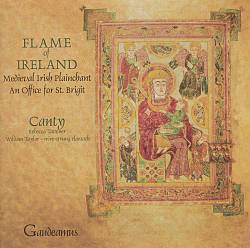
Below is the text and translation of another hymn taken from the recording of a 15th-century Sarum Rite Office for the Feast of Saint Brigid by the Scottish ensemble, Canty.

Hymn: Christo canamus gloriam

Christo canamus gloriam,
qui per beatam Brigidam
decoravit Hyberniam,
vitam dans eius lucidam.

Hec speculum mundicie
quae mundo late claruit;
hec rosa temperancie
cuius virtus non languit.

Manco manum restituit;
leprosos mundans maculis;
gressum claudis exhibuit;
sanans privatos oculis.

Cenam fecit mirabilem
multis de uno modio;
totum prebens durabilem
toto paschali gaudio.

Per secla sine terminis
soli Deo sit gloria;
qui prece tante virginis
nos ducat ad celestia.

Amen.

Christ's glory let us sing
Who through the blessed Brigid
Adorned Ireland,
Granting it her light-giving life.

She is the mirror of purity
That lit up the wide world,
She is the rose of temperance
Whose strength never failed.

She restored the hand that was withered
Cleansed lepers from their ills,
She showed the lame how to walk,
Healed those who had lost their sight.

She made a marvellous banquet
For many from a single peck of corn,
Granting all the peck to last
For the whole joy of Eastertide.

Throughout the endless ages
To God alone be glory.
That through the prayers of such a virgin
He may lead us up to heaven.

Content Copyright © Trias Thaumaturga 2012-2015. All rights reserved.