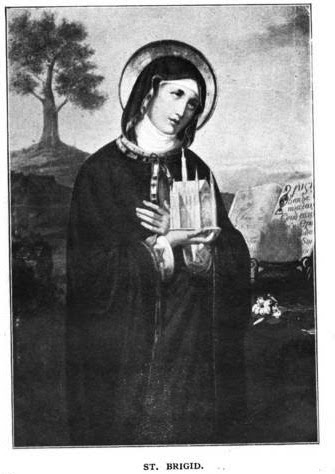
Showing posts with label Devotion Outside Ireland. Show all posts

Thursday, 3 February 2022

Where Brigid is Honoured


We stay with the theme of devotion to Saint Brigid in Europe with a 1929 piece from Irish Benedictine writer Dom Patrick Nolan. He is perhaps best known for his 1908 book The Irish Dames of Ypres which looked at the history of the Irish Royal Abbey of Ypres founded by seventeenth-century Catholic exiles. Here, however, he provides us with a gazetteer of places outside Ireland which cherished Saint Brigid and describes some of the history and traditions associated with them. As the immediate inspiration for Dom Patrick's reflections seems to have been the return of a portion of the relics of Saint Brigid to Killester in 1929, he concludes with a brief sketch of the history of her relics:

WHERE BRIGID IS  HONOURED.

Europe's Devotion to Irish Saint.


BY DOM PATRICK NOLAN, O.S.B.

A recent interesting article in the 'Irish Independent' on St. Brigid and the celebrations in her honour at Killester, prompts me to remind Irish people that devotion to this great saint is not confined to Ireland, and that her 'cultus' is as far flung as are the numerous lands evangelised by Irish missionaries.

Devotion to St. Brigid has been a constant European tradition, and her fame has extended far beyond our Continent. It may, indeed, be said to be greater in some Continental countries than in her own native land.

St. Brigid and Britain.

On Sunday January 27, I announced to the congregation, mostly English Catholics, of a small Oxford village that Friday, February 1, would be kept as the feast of St. Brigid of Ireland throughout the diocese of Birmingham, and rightly so.

The ancient Saxon kingdom of Mercia, which comprised the territory of the present Archdiocese of Birmingham, was evangelised by the children of St. Brigid many long centuries go, and the erection of the present nourishing diocese was a direct result of the extensive immigration of St. Brigid's children in the 'forties and 'fifties of last century.

In Scotland.

Our Scottish kinsfolk do not yield to their Irish forebears in their veneration for our great Irish saint. To the Scottish Gael, as Fiona Macleod reminds us, she is the 'Fair Lady of February,' 'St. Bride of the Kindly Fire,' and 'St. Bride of the Shores.' February is her own month, the month of 'Bride Min,' gentle Brigid; or 'Brighid boidheach Muime Chriosd,' Bride the Beautiful, Christ's Foster Mother.

In the Gaelic Highlands and storm-swept Isles of the West her emblems are the dandelion, the lamb and the sea-bird known to the common folk as the 'oyster-opener.'

The humble dandelion, the harbinger of Spring and of St. Brigid, the dealan Dhe, 'the little flame of God,' or bhearnan Brighde, 'St. Bride's forerunner,' has from remotest times been associated with St. Brigid by the Scottish Gael.

St. Bride's Flocks.

'To this day shepherds on Ah Fhiell Brighde,' St. 'Brigid's feast, 'are wont to hear among the mists the crying of in numerable young lambs, and this without the bleating of ewes, and so by that token know that Holy St. Bride has passed by, coming earthward with her flocks of countless lambs. . . .'

'In these desolate far isles where life is so hard ... a rejoicing sound is that in truth when the Gille-Bhride is heard calling along the shores.' And well may this welcome visitor to the bleak Scottish coasts be called the 'Servant of Bride,' for does not its incessant, cheery cry 'gilly-breed, gilly-breed, ' come to Gaelic ears like an invocation to the Mary of the Gael?

Alsace.

It is a far cry from Scotland to Alsace, but there too the traditional devotion to our Irish saint still flourishes.

The Canons of Old St. Peter's at Strassburg used to distribute 'St. Brigid 's Bread,' their best wine was known as 'St. Brigid's Wine.' Alsatian farmers had such devotion to her that they placed their fields and field work under her special protection, and 'Buren-bridel' was a generic title for Alsatian farmers' daughters, many of whom bore the name of Brigid, a name still not uncommon in Southern Germany.

The festival of St. Brigid was solemnly kept almost universally throughout the mediaeval German Empire, and by all the religious Orders. Churches and chapels were dedicated to her at Cologne, Mainz,
and elsewhere, from an early date.

At Fosses, in Belgium, an ancient chapel of St. Brigid still tops the hill so conspicuous from the railway station. At Piacenza, in North Italy, there is a church of St. Brigid, said to have been founded in 868 by the Irish saint, Donatus, Bishop of Fiesole. Annexed to it was a hospice for Irish pilgrims on their way to Bobbio or Rome.

Story of St. Brigid's Relics.

Much more could be said about the 'cultus' of St. Brigid on the Continent, but I must conclude with a few remarks as to her relics.

Cogitosus tells us that St. Brigid's relics were kept in a richly-decorated shrine in Kildare. It is not known when they were 'translated' and placed with St. Columba's and St. Patrick's at Downpatrick, but Columba's relics were still at Iona in the beginning of the ninth century.

During native political broils, devotion to the saint nagged and all knowledge of the whereabouts of her relics was lost. But they were miraculously re-discovered through the prayers of a holy Bishop, Malachy, in the year that Earl, later King John, came to Ireland (1185), as related in a special office for the day, printed in Paris in 1620. 

The Shrine Desecrated.

They were solemnly authenticated, or translated, on June 9 (St. Colum's day) in the presence of a Cardinal Legate, specially sent from Rome, and 15 Bishops; but the shrine was desecrated by Lord Leonard Gray, Viceroy of Henry VIII.

The head of St. Brigid is said to have been previously transferred to Newstadt in Austria, where it was venerated in the chapel of the imperial citadel. Later on the Emperor Rudolph II. gave it to John Borgia, son of St. Francis Borgia, and Ambassador of Philip II., who took it to Spain in 1587, and gave it to the Lisbon Jesuits, who kept it in the chapel of their house of studies at St. Roch, the solemn translation, one of the most magnificent ever seen, taking place in 1588.

St. Roch or Lumiar.

But Cardosus says that the head of St. Brigid is preserved with very great veneration in the church at Lumiar, formerly known as. St. John the Baptist's, but now as St. Brigid's. Three Irish knights are said to have taken it into Portugal to King Dionysius, or Denis (d. 1225).

Don Philip O'Sullivan Beare supports the Lumiar tradition, so that we may suppose the relic at St. Roch's, Lisbon, to be that of another St. Brigid, for there have been more than one saintly imitator of the great Irish original. We presume the great St. Brigid of Sweden had the Irish saint for her patron and model, and we know that Scandinavian pilgrims frequented the hospice of St. Brigid at Piacenza.

"WHERE BRIGID IS HONOURED." The Catholic Press, 28 March 1929
Content Copyright © Trias Thaumaturga 2012-2022. All rights reserved.

Wednesday, 2 February 2022

Saint Brigid in the Empire of the Gael


When I first established this blog it was my custom to make an octave of posts in honour of Saint Brigid and it is a tradition which I am pleased to revive. Over the ten years that this blog has been running I have written a number of times on the devotion to Saint Brigid outside her native land. Earlier posts can be found tagged here. Today we have a brief reminder of the honour paid to our patroness on the continent of Europe as found in an Australian newspaper of 1929, the centenary year of Catholic Emancipation. The reputation of Saint Brigid that was carried to continental Europe by Irish missionaries was that she was 'the Mary of the Gael'.  The German reference in the article is to the (in)famous complaint of an anonymous poet that in Erfurt, the Irish when they were drunk claimed that 'Brigit is God's Mum'. Obviously the Irish traditions about Saint Brigid as 'another Mary, mother of the great Lord', suffered somewhat in translation!

SAINT BRIGID
In the Empire of the Gael

THERE are few countries that can boast of as great an empire as Ireland can — an empire not won by oppression and slaughter, but by the Gospel of Christ, as preached by the early Irish monks and priests. It has in truth been called the Spiritual Empire of the Gael. A cursory glance at the ecclesiastical map of Europe reveals the number of religious foundations which were the work of Irish monks of the seventh and eighth centuries.

Irish Missionaries and Saints

A remarkable feature of their work was the preaching of devotion to their national saints, St. Patrick and St. Brigid. Everywhere they preached they told the story of their home saints, and caused to spring up a devotion to them which has; lasted when all memory of the preachers and their foundations has faded out of popular memory and traditions.

Indeed, so great was the propaganda spread, consequently their popularity, that it raised the ire of a German writer of the 12th century. He poked fun at the exaggerations the Irish foreigners, as he styled them, were led into by their unlimited admiration for the saints of their race.

Doubtless the exaggeration he referred to was the custom of referring to St. Brigid as 'the Mary of the Gael.' Even in the poetic 12th century the Gaelic imagination was too much for the realistic mentality of the German.

St. Brigid Abroad.

The saint of Kildare, says Dom Gougaud, enjoyed a remarkable popularity through all Europe. She seems to have captured the imagination of the people, and was honored above all the women of her time. 

As far back as the seventh century her festival was kept in Germany. The peasantry of Wallon knew of her kindness to animals in the eighth and ninth centuries, and they invoked her aid for their cattle and crops in the chapel dedicated to her honor in the town of Fosse — a town which owes its origin to an Irish saint, and which is linked once more with Ireland through the White Canons. The return of her relic from Portugal has told us of the veneration she enjoyed at Lumier. Cologne, Strasbourge, Liental, Genoa, Liege, are a few of the many places that know and honor the 'Pearl of Ireland.' In order to follow her cult, says Gougaud, it is only necessary to let the eye' roam over the map of Irish establishments on the Continent. Where an Irish monastery was, there Brigid was honored.

Brittany is a land full of odd memories, full of old churches, and full, too, of old pilgrimages and Pardons. Amongst all these old memories of saints and pilgrimages the memory of St. Brigid of Kildare is still found.

There is no saint — after their own national saint— enjoys such a popularity as the saint of Kildare. The tenacity of the Breton in clinging to old beliefs and devotions have often expressed itself on her behalf.

The celebration of a saint's festival is called a 'Pardon' in Brittany. Saint Brigid's festival, February 1, is celebrated by a Pardon at La Turbaille in Brittany, and all the neighborhood gather for this day of prayer and festival in honor of the Brigid of Kildare. On February 1, on the banks of the Loire, the sweet clear voices of Breton boys and girls rise in chant in honor of our dear saint from the Church of the Oaks.

 This year calls up the glories of the past — the glory of those who suffered for the faith of Patrick and Brigid at home and abroad.


JOHN O'DRISCOLL,
In 'Irish Catholic.'

SAINT BRIGID (1929, June 20). Freeman's Journal (Sydney, NSW: 1850 - 1932), p. 34. 
Retrieved December 18, 2017, from http://nla.gov.au/nla.news-article118097731
 
Content Copyright © Trias Thaumaturga 2012-2022. All rights reserved.

Sunday, 20 March 2016

Saint Patrick: An Acceptable Saint in 12th-century England

As we have just witnessed the annual and ever-growing phenomenon of Saint Patrick's Day being celebrated all over the world (and not just by people of the Irish diaspora), I found it interesting to reflect that his cult had already spread beyond these shores in medieval times. Jocelin of Furness was one of three English writers who wrote a Life of Patrick in the twelfth century. I have already made a post on the conclusions of Professor Robert Bartlett on this subject here. The conclusion of another recent scholar is also worth considering in trying to put Jocelin's work into context:
In the 12th century the British Isles were free from hagiographical barriers: cults of Irish saints, notably Patrick and Brigid, were perfectly acceptable in England. No reader of the twelfth-century Life of Patrick by Jocelin of Furness, which was dedicated to the Ulster conquistador John de Courcy, as well as to northern Irish bishops, could avoid the message that Patrick the Briton's career belonged to Britain and Europe as well as to Ireland.
R. Frame, 'Exporting state and nation: being English in medieval Ireland' in L. Scales and O. Zimmer, eds., Power and the Nation in European History (Cambridge Univ. Press, 2005), 155.


Content Copyright © Trias Thaumaturga 2012-2016. All rights reserved.

Sunday, 8 February 2015

European Offices and Devotion to St Brigid

We conclude the octave of posts in honour of Saint Brigid with a brief account of devotion to our national patroness in some other European countries:

The eminent charity, and the great number of miracles which God had wrought through her intercession, caused her to be placed, immediately after her death, amongst the most illustrious saints. Parents were emulous to give her name to their female children. The church erected altars, and dedicated temples to her, which honours were surpassed by those which she received from posterity. Ireland considered her as her patroness; and her reputation soon spread itself beyond the narrow limits of that island. All Europe participated in this devotion. Her name is invoked at Seville, Lisbon, Placentia, Tours, Besancon, at Namur, in the abbey of Fulda, in which are some of her relics; at Cologne, where one of the principal churches in the city is dedicated to her; and lastly, in London, where there is still a church that bears her name.

This devotion was strengthened by an office of nine lessons, in honour of this saint, which is to be met with in several Breviaries in Europe; in an ancient Roman one printed at Venice, in 1522, in that of Gien, (in Breviario Giennensi) in Italy; in that of the regular canons of Lateran; in an ancient Breviary of Quimper in Armorica: in a church bearing her name at Cologne, of which she is patroness; and finally in a chapel dedicated to her in the territory of Fosse, diocese of Maestricht. We find an office to St. Bridget in the Breviaries and Missals of Maestricht, Mayeuce, Treves, Wirtsburg, Constance, Strasburg, and other towns of Germany.
The History of Ireland Ancient and Modern taken from the most authentic records and dedicated to the Irish Brigade by the Abbé Mac Geoghegan (Dublin, 1844), 157.

As the Abbé has mentioned the offices to Saint Brigid to be found in continental Breviaries, it is perhaps appropriate to conclude with the prayer from the Roman Breviary, first posted here:

O GOD, Who year by year dost cause us to rejoice as upon this day, in the feast of Thy blessed hand-maiden Brigid, mercifully grant us help for her sake, the bright ensample of whose chastity doth still shed its light upon us. Through our Lord Jesus Christ Thy Son, Who liveth and reigneth with Thee, in the unity of the Holy Ghost, one God, world without end. Amen.

Content Copyright © Trias Thaumaturga 2012-2015. All rights reserved.

Tuesday, 3 February 2015

Saint Brigid and Somerset


I am always interested in the cult of Saint Brigid and our other native saints as found outside of Ireland. As I noted in an earlier post here, Saint Brigid was even more widely-known in medieval England than our national apostle, Saint Patrick. The English monastery of Glastonbury in particular led claim to relics of our patroness and below is a summary of this particular aspect of Brigid lore from a Somerset newspaper. Many of the themes it raises can be explored further in this post on Saint Brigid and Glastonbury.


St Brigid and Somerset

ST. BRIDGET'S-DAY.

The Churches of Chelvey and Brean are the only ones in Somerset dedicated to this saint. But the county is peculiarly interested in St. Bridget, for it is said she came to Glastonbury about A.D. 488, and that she passed some years in a certain island called Beckery, where there was earlier still a chapel dedicated to St. Mary Magdalene, and that on her return to Ireland, shortly before her death, she loft her wallet, her rosary, and her weaving tools at Beckery, which things, in consequence of the sweetness of her memory, were there preserved as reliques and reverenced. Moreover, the chapel was afterwards known by her name, in which chapel there was, in the southern part, a hole, through which all who passed would, according to common belief, receive forgiveness of their sins. Beckery lies nearly due west from Glastonbury— it consists of a ridge of no great elevation, stretching from near the site of the present railway station to the River Brue. St. Bridget is fabled to have nursed St. Patrick at Glastonbury in his last illness, and embroidered his shroud for him.

She is also said to have been buried at Glastonbury, although Kildare and Downpatrick in Ireland, and Abernethy, in Scotland, claim to have received her body. St. Bridget is pictorially represented as sitting with a bowl of milk in her lap, and a Glastonbury church tower bears a sculpture of what appears to be a dairymaid milking a cow. Mr. Bligh Bond attributes this as representing St. Bridget, who is reputed to have possessed many good characteristics. It is said that "wild ducks, swimming in the water, or flying in the air, obeyed her call, came to her hand, let her embrace them, and then she let them fly away again." In the Breviary of Sarum it is reported to be recorded that when she was sent a-milking to make butter, she gave away all the milk to the poor, that when the rest of the maids brought in their milk she prayed, and the butter multiplied; that the butter she gave away she divided into twelve parts, "as if it were the twelve Apostles," and one part she made bigger than any of the rest, which stood for Christ's portion, "though it is strange," says Bishop Patrick, "that she forgot to make another inequality by ordering one portion of the butter to be made bigger than the remaining ones in honour of St. Peter, the prince of the Apostles."


W. G. Willis Watson.

Calendar of Customs, Superstitions, Weather-lore, Popular Sayings and Important Events Connected with the County of Somerset. Reprinted from The Somerset County Herald (1920), 35-6.

Content Copyright © Trias Thaumaturga 2012-2015. All rights reserved.

Friday, 31 October 2014

Saint Faolán of Fosses and Devotion to Saint Brigid

October 31 is the feast of Saint Faolán, one of the many Irish missionary saints who laboured in Europe. He is also one of the Irish saints who helped to spread the cult of Ireland's patroness on the Continent. Roísín Ní Mheara has given a fascinating account of devotion to Saint Brigid of Kildare in the Meuse/Maas valley region in which Saint Faolán laboured. His monastery at Fosses was dedicated to Saint Brigid and today their names are still intertwined in this area:
In the cryptal chamber of Saint-Feuillen, old effigies of St Brigid and St Gertrud guard the place where Faolán's remains first reposed. And the particular devotion paid by the saint to his Irish patroness again bears evidence in a small church that tops a hill beside the town, to which the rue Saint-Brigette leads us. Said to have been erected by Faolán and his monks, it has a Celtic cross inserted in the outer wall of the sanctuary, believed to be the altar stone of the original seventh-century church, brought hither from Ireland! Be that as it may, Faolán is certainly responsible for implanting the very lively cult of St Brigid into this part of Belgium - a cult still practised at this ancient place. People gather here to celebrate her Feastday, bringing twigs bound together to form a cros Bríde, as in Ireland. After being blessed, these crosses are hung up in cow-sheds to protect the cattle for another year. Also reminiscent of the charitable aspect of the cult of St Brígid is the large hospital-cum-Old Folks Home beside the church on the hill, superseding, it is said, the original almshouse of the Irish missionaries. The nuns in charge of the hospital also have the keys to the church of Saint-Brigette.

Devotion to St Faolán, fanning out in all directions from Fosses, is marked with churches and chapels in his honour. Since rivers are often destined to be the carriers of man's history, it was the proximity of the river Meuse - Maas in Germanic tongues - that played a part in spreading Faolán's cult and reputation.

...The Meuse Valley's preoccupation with the cult of Faolán affected that of St Brígid. As a protectress of cattle her fame progressed through the land and across the river into the diocese of Cologne. An important Roman road linked Gallia Belgica with the Rhinelands via Maastricht, soon to be complemented by a Carolingian trade-route linking the North Sea port of Brugge with the seat of Charlemagne at Aachen (Aix) and continuing on to Cologne, the famed 'City of Holy Martyrs' - where St Brígid of Ireland, although no martyr, installed herself with a parish of her own in the city's core.

In the cathedral of Aachen, Brígid shares a stained glass window with Faolán, whose own adjacent church, that had served the community since the fifteenth century, has been rebuilt after destruction in World War Two. (The connection between Brígid and Faolán was carried as far as Spain, where their effigies adorn an early church in Navarre).

Roísín Ní Mheara, Early Irish Saints in Europe - Their Sites and their Stories (Seanchas Ard Mhacha, 2001), 70.

Content Copyright © Trias Thaumaturga 2012-2015. All rights reserved.

Wednesday, 22 October 2014

Bringing Brigid to Italy: Saint Donatus of Fiesole

October 22 is the feast of Saint Donatus of Fiesole, an Irishman who became a bishop in Italy and who promoted the cult of Saint Brigid in his adopted homeland. An account of his life can be found at my other site here. Donatus was among the hagiographers of Ireland's patroness and a translation of the prologue to his Life of Saint Brigid can be found here with a commentary here. You will notice that in the prologue the saint refers to Ireland as Scotia, but this was commonplace in the early Middle Ages and it was only later that the term was applied exclusively to the land we now call Scotland. The prologue extols the virtues of Ireland and its people, but more so the virtues of its patroness, which are as innumerable as the grains of sand on the shore. I find Saint Donatus a most engaging figure and his story deserves to be remembered in his own country.  As an old Life of the saint puts it: 'let Hibernia rejoice, which sent forth such a teacher; let Fiesole and the whole province of Tuscany be glad'.

Content Copyright © Trias Thaumaturga 2012-2015. All rights reserved.


Saturday, 1 February 2014

Saint Brigid and Saint Derlugdacha

Although February 1 is Saint Brigid's Day, it is worth noting that it is a feast day she shares with the woman said to have been her immediate successor - Saint Derlugdacha. I have posted Canon O'Hanlon's account of this saint at my other site here. The hagiographers present the sharing of the same feast day by the pair as an example of the devotion Derlughdacha felt for the woman who was both her foster-mother and her mother in religion. For Derlughdacha begged to be allowed to die on the same day as Saint Brigid and this wish was granted, but only after she had served one year herself as Abbess of Kildare. Sadly, the close relationship between the two has today been taken out of the spiritual realm by some and they are held up as an example of 'gay saint' role-models for the marginalized 'LGBT community'. Indeed, a Catholic monastic artist has even painted a grotesque 'icon' of the pair which gives me the creeps. As I pointed out on my other site, Saints Brigid and Derlugdacha are not the only saints who share a feast day in this way for Saint Colum Cille shares his day on June 9 with his immediate successor, Saint Baithin, who also begged to be allow to share the earthly departure of his master but who also had to wait one year. I have yet to see anything suggesting that the relationship between the Iona monastics went beyond the spiritual, but then an understanding of hagiographical motifs cannot compete with an underground stream of secret knowledge about gay saints which 'they' are trying to keep from us.  No, of much more interest to me is the spread of the cult of Saint Derlugdacha beyond these shores. Canon O'Hanlon described a devotion to her found in Bavaria, which the infamous Scottish hagiologist, Thomas Dempster, tried to  explain by making our saint one of a family of 'Scots' who travelled to Germany and who were martyred there. This claim cannot be substantiated, although it would indeed be interesting to know by what means the cult of Saint Derlugdacha did arrive there. The other external centre for her cult is in Abernethy in Scotland, where both she and Saint Brigid feature in the founding story. This site quotes the following:
St Darlugdach
Saint’s Day 1st February
Also known as Darlaugdach, Dardulacha, Derlugdach and Darulagdach 
Darlugdach was supposedly the successor of ST BRIGID as abbess of Kildare in Ireland. According to one of the foundation legends of Abernethy, she came to Scotland in the time of Nechtan and: 
“In the third year of his reign, Darlugdach, abbess of Kildare, in Ireland, was an exile for Christ’s sake in Britain. In the second year of her sojourn, Nectonius dedicated Abernethy to God and St Brigid, in the presence of Darlugdach, who sang alleluia over such an offering.”
Obviously there is more to unpack here and I would like to undertake some further research into the Abernethy connection. For now, however, we will close with an account of Saint Derlugdacha from another Scottish source:
FEBRUARY 1 St. Darlugdach, Virgin, A.D, 524.  
THIS saint was an Irish virgin who was educated to the monastic life by the great St. Bridget, the glory of Ireland. She is said to have visited Scotland during the reign of King Nectan and to have presided over a community of religious women attached to a church which that King had built at Abernethy and dedicated to the Blessed Virgin. By some writers St. Bridget herself is said to have led the monastic colony to Scotland, but this is by no means clear. It is true that great devotion was shown towards her, and many Scottish churches and wells bear her name, but this may be accounted for by the close connection with Ireland which subsisted in those early times. Her relics, too, were venerated at Abernethy. St. Darlugdach did not remain in Scotland, as she succeeded her friend and patroness St. Bridget as Abbess of Kildare, where she died.

Dom Michael Barrett, O.S.B., A Calendar of Scottish Saints, 2nd edition, (Fort Augustus, 1919), 16-17. 

Content Copyright © Trias Thaumaturga 2012-2015. All rights reserved.

Friday, 9 March 2012

St. Patrice de Rouen


The current generation of scholars are still debating the claims of his hagiographers that Saint Patrick spent some time in Gaul, coming into contact with such luminaries of the Church as Martin of Tours, Hilary of Arles and Germanus of Auxerre. The French connection was a thesis advanced with much enthusiasm by earlier writers, you can find a good example of it in F.R. Montgomery Hitchcock's 1915 work, Saint Patrick and his Gallic Friends. Below is an 1889 paper on a church dedicated to Saint Patrick in Rouen which describes some of the scenes from Patrician hagiography that are featured in the church's rare painted-glass windows. I only regret that the paper was not illustrated and that the author was unable to say when the church was built or who was responsible for its dedication to Ireland's patron:

ST. PATRICE DE ROUEN.

By J. CASIMIR O'MEAGHER.

[Read November 11, 1889.]

The Parish Church of St. Patrice is situated in an elevated and northern part of the city of Rouen, in the centre of a quiet and pleasant quarter, and near the Square de Solferino, an open space in front of the new Picture Gallery. When it was built and by whom there is no record, nor is there any tradition that the Irish Apostle visited Rouen. We know that on his return from captivity he travelled from Brotgalum to Trajectus, which is found on an ancient map of Gaul on the River Dordogne, about 60 miles to the east of Burdigala, the modern Bordeaux.

In 1228, on the feast of St. Lawrence, the Church of St. Patrice was burned. In 1374 the Archbishop Phillipe d'Alenqon founded in St. Patrice the Confraternity of the Passion. On every Holy Thursday the Confraternity, recruited from the ranks of the most respectable citizens, assembled in the church and formed a solemn procession, which was preceded by a band of children carrying the implements of the Passion, and followed by twelve poor men clothed at the expense of the Confraternity. After service and sermon, three of the principal members of the Confraternity washed the feet of the poor men, and subsequently entertained them — whilst each child that took part in the procession received five sous, a small loaf, and a herring.

In 1442 the Confraternity performed a Passion Play in the Cimitière des Jacobins and in 1498 a Passion Play was acted in the church.

In 1535 the church was rebuilt on the original site, but on a larger scale. A Literary Society was founded in St. Patrice in 1543, with the object of encouraging the composition of verses and sonnets in  commemoration of the death of Christ. Again, in 1592, the church was in the hands of the reconstructor, and in 1683 it was greatly damaged by a terrific storm.

The church is a very interesting edifice to visit, although it offers but a poor idea of late decorated Gothic architecture; considering it in its entirety, it is a very regular building, but of mediocre proportions.

It has neither choir nor transepts. The tower is romanesqne, surmounted by a carillon. There are but two entrances to it— one in Rue St. Patrice now blocked up, and the other in Rue Neuve St. Patrice. Over this entrance are two spirited groups, carved in Caen stone; the upper group represents Logaire mac Noill's druid attempting to poison the Apostle, and the lower, the baptism of Oengus mac Natfraich. The Apostle is represented in cope and jewelled mitre, the soldiers in Norman armour, and the laity in the costume of that period. The vaulted roof is supported by two rows of pillars, which divide the church into nave and aisles. The high altar, which is covered by a valdacchino, stands in a shallow apex at the eastern end of the nave, on either side of which are two altars — one dedicated to the B.V.M. and the other to St. Joseph. The beautiful sculptured woodwork which embellishes these altars came from the suppressed Church of St. Eloi. A peculiarity in St. Patrice is, that it has no Communion-rail, and that a portion of the nave has been railed off and fitted with sedilia. The pulpit, which is erected on the Gospel side of the altar, is not devoid of artistic merit; it was brought from the ruined Church of St. Lo; and the organ, which passed in the sixteenth century as one of the first in France, is encased in richly-carved oak.

Upon entering St. Patrice the visitor's attention is at once drawn to the rare painted-glass windows, dating from the sixteenth century, the period at which painting on glass was in full perfection.

The window dedicated to St. Patrick is immediately behind the pulpit. The upper panels illustrate three of his miracles, thus described in the Tripartite Life, edited by Whitley Stokes:

“Now, when the holy Patrick was born, he was taken to the blind, flat-faced son to be baptised. Gornias was the priest's name, and there was no water by him wherewith he could perform the baptism: so with the infant's hand he made the sign of the Cross over the earth, and a well of water broke thereout. Gornias washed his face (with that water) and his eyes were opened, and he read the (order of) Baptism: he who had never learned letters." — Page 9.

And

"At another time, as Patrick was playing among his foster-brothers in the season of winter and cold especially, he gathered his lapful of icicles, and carried them home to his foster-mother. Then said his foster-mother to him: ‘To bring a faggot of firewood, that we might warm ourselves thereat, were better for us than what thou hast brought.' Then he said to his foster-mother: 'Believe that it is competent to God that even icicles should flame like firewood;' and, quicker than speech, when the icicles were set on fire, and when he breathed under it, they flamed forthwith like firewood, and God's name and Patrick's were magnified by that miracle." — Page 11.

Underneath is an incomplete inscription in black letter : —

"... baptesme sort une fontaine veux des glaçons ur…"

At the top of the window the saint is represented as a young lad carried off into slavery, and underneath the panel is an inscription:

"Ceulx d'Ibernie font un effort contre la Bretagne ou S Patrix est pris prison."

To the right and beneath the above is a panel illustrating:

“When Patrick was biding in the wilderness, he heard the voice of the angel saying to him: 'Ready is the ship whereon thou mayest fare to Italy to learn the Scriptures.' Said Patrick: 'I have not the price (of my ransom) in gold for my lord, and without that he will not allow me (to leave him).' The angel said to him: 'Mind thou the herd to-day, and thou wilt see a boar uprooting the earth, and he will bring a mass of gold thereout, and give thou (that gold) to thy lord for thy head, and fare forth from this land to loam wisdom and, godliness.' Patrick watched the boar, and found the mass of gold, and gave it for his head to his lord, who consented to let him go, for he was glad of the gold." — The Lebar Brecc, Homily on St. Patrick, W.S., p. 443.

And underneath is an inscription, of which the following words alone remain: —

“…garder les pourceaulx fange.

…trésor fouillé par iceulx."

Beneath this panel is a representation of St. Patrick's visit to Sescnen, the father of Benignus:

“(He sailed) along the sea to Magh Breg (and stopped at Inver Colptha), and he found there great welcome in that place from a certain Franklin who both believed in him with all his household and was baptized, wherefore with him he (Patrick) left his boat. A little boy that was biding in the house gave love to Patrick, and took hold of his leg as he was going into the chariot, and his family surrendered him to Patrick, and Patrick takes him with him, and this is Benen, Patrick's gillie." — The Lebar Brecc, Homily on St. Patrick, W.S., 455.

Underneath is the inscription: —

“Retournant de … son hoste le fils duquel convertit."

The pedigree of Benignus is thus given among the saints' pedigrees in the Book of Lecan:

“Benen, son of Sescnen, psalmist to St. Patrick, of the Cianachta of Glenn Gemhin, of the race of Tadhg, son of Cian, son of Oilill Ollum."

Lower down in the centre is a representation of the attempt of the Druid Lucat-Moel to poison the saint:  

“Patrick is then called to the king's couch that he might eat food. Howbeit Patrick refused not that. The wizard Lucat-Moel put a drop of poison into Patrick's cruse, and gave it into Patrick's hand. But Patrick blessed the cruse and inverted the vessel and the poison fell thereout, and not even a little of the ale fell, and Patrick afterwards drank the ale." — The Lehar Brecc, Homily on St. Patrick, W.S., p. 450.

Then follows an illustration of another miracle : —

“Then three of the Ui Meith Mendait Tire stole (and ate) one of the two goats that used to carry water for Patrick, and came to swear a lie. It bleated from the bellies of the three. ‘My God's doom,' said Patrick, ‘the goat himself hides not the stead wherein he is.'" — The Lehar Brecc Homily on St. Patrick, W.S., p. 467.

The inscription beneath is : —

" Le venim ne luy peult nuire et fait qu'un laron
Beele ainsi que la brevis qu'el avoit dérobée."

To the left of the preceding is depicted Locgair’s druid, Lucat-mael, challenging the saint to work miracles:

“Thereafter the hosts fared forth out of Tara. Then said the wizard: 'Let us work miracles together that we may know which of us is the stronger.' 'So be it done’ said Patrick. Then the wizard brought snow over the plain till it reached men's shoulders. Dixit Patricius to him: 'Put it away if thou canst.' Dixit
magnus: ' I cannot till the same time to-morrow.' 'By my debroth (that is, by my God of judgment),' saith Patrick, ‘it is in evil thy power lieth, and nowise in good.' Patrick blessed the plain, and the snow melted at once.

“The wizard invoked demons, and over the plain he brought darkness that could be felt, and trembling and terror seized everyone. Dixit Patricius: ‘Take away the darkness if thou canst.' The wizard replied: 'I cannot till the same time to-morrow.' Patrick blessed the plain, and the darkness at once departed, and the sun shone forth. . . . All who were there gave thanks to God and to Patrick." — Lebar Brecc, Homily on St. Patrick, W.S., p. 461.

The inscription beneath is:

“Le temps nebuleux et la terre couverte de Nèges et en un instant descouverte et la terre fertille."

To the right of the above is given the baptism of King Oengus mac Natfraich:

“Patrick passed afterwards by Belach Gabrain into the province of Munster, and preached to the territories and to the churches, so that they believed and were baptised and he blessed them, and with them he left priests instructing (them) and practising godliness. When he reached Maghfemin, he was received by Oengus, son of Natfraich, King of Munster. Oengus made him great welcome, and brought him to his house to Cashel. Patrick preached to him. The hinder end of his crozier went through his foot and wounded it greatly. Patrick said: 'Why didst thou not protect thyself?' 'Methought,' saith Oengus, 'that it was a rite of religion.' Said Patrick: ' Blood shall not be shed in this place from to-day to doom; and of all those that shall succeed thee but one king shall be slain.' " — Lebar Brecc, Homily on St. Patrick, W.S., p. 470.

The inscription beneath is: —

" Mict son baston pastoral pour pra . . . er
. . . et le pied d'un capitaine et le . . . rist."

In the centre of the window St. Patrick's figure is of larger proportions than in any other panel. He is depicted in cope and mitre, and wearing on his shoulders the pallium, received, according to the Bollandists, from Leo the Great in 444, and carrying in his right hand an Archbishop's crozier. In front of the prelate are a number of venomous reptiles which he is driving before him, and from above the Almighty is represented blessing his mission. Below is an incomplete inscription:

" II chassa (d'Ib)ernie les
. . . bestes."

I failed to find any confirmation of St. Patrick having been invested with the pallium. The Annals of Ulster under the year 441 merely record: “Leo being ordained the 41st bishop of the Roman Church, the faith of Patrick the bishop was approved." Lastly, to the left is portrayed the saint's fast, and his descent from Croagh Patrick:

“Thereafter Patrick gat him into the wilderness, that is, to Cruachan Aigli, after the mayner of Moses, and Ellas, and Christ. And for forty days and forty nights he fasted in that place, having four stones about him and a stone under him, even as Moses fasted on Mount Sinai when the Law was delivered unto him.
For they, Moses and Patrick, were alike in many ways. One hundred and twenty years was the age of them both. Each was a leader of people. Forty nights on mountains they fasted, and the burial places of them both are uncertain." — Lebar Brecc, Homily on St. Patrick, W.S., p. 475.

And his descent from Croagh Patrick, when he is met by a crowd, and in order to emphasise his preachings by a miracle, he struck the ground with his pastoral staff, and thereupon a deep chasm was formed, which is represented on the window as filled with flames. The inscription is:

“Luy priant la terre s'ouvre que l’on
Appelle le purgatoire Sainct Patrice.

There are other fine windows in this church, depicting — The Torments of Job; Three Episodes in the Life of Abraham; The Salutation; The Visitation; The Annunciation; The Adoration; The Virgin and Child; The Infant Saviour bearing in His hand the Terrestrial Globe; St. John; St. James; The Woman Accused of Adultery. Three windows contain the insignia of the Passion; another portrays Mater Dolorosa; and the three windows over the high altar represent the Passion, Death, and Resurrection. The Golden Legend of St. Eustach, and the Life of St. Louis are also depicted; and a window presented in the year 1540 by the Confraternity of St. Fiacre is still intact. These windows suffered more or less from the storm which burst over Rouen in 1683. They were repaired in 1683, 1726, 1727, and 1765 by the Le Viel family, one of whom wrote l’Art ds la Peinture sur verre.

In 1839 the Government, Louis Philippe being then on the throne, at the request of the Prefect Baron Dupont-Delporte, erected a handsome stained-glass window in this church, illustrating the four principal events in the life of St. John the Baptist.

St Patrice is also adorned by several fine pictures. — The Apostles Leaving the Temple; a St. Justine, respectively attributed to Poussin and Mignard; a Crucifixion, by Bassano; and a St. Michael, by Hyacinth Langlois.

I am indebted to Canon Cayez, the venerable Curé of St. Patrice for his deciphering the black-letter inscriptions on the window dedicated to our National Saint, and for photographs of the interior and exterior of his church.

Proceedings of the Royal Irish Academy, 3rd series, Vol. I (1891), 326-332.

Content Copyright © Trias Thaumaturga 2012-2015. All rights reserved.

Thursday, 8 March 2012

Devotion to Saint Patrick in Europe


We are used in our own times to Saint Patrick's Day being a world-wide phenomenon, but devotion to Ireland's patron had been spread outside these islands many centuries ago, as Dom Louis Gougaud recounts in his classic work on the Irish saints in Europe:

St. Patrick had travelled through Gaul, but it was only in Ireland that he carried out his apostleship. His cult was, however, introduced to continental countries by the very first missionaries from beyond the seas. His natalis, on the 17th March, a birthday which has remained, above all save one, sacred to every son of Erin, was celebrated as early as the seventh century at Luxeuil, at Peronne, and at Fosses in Belgium; at Echternach, Corbie, Nivelles and Reichenau probably from the very foundation of those abbeys. The celebration of the 17th March can be proved at Treves and at Landévennec in Britanny in the tenth and eleventh centuries.

When we realise the antiquity and wide spreading of this liturgical devotion, we are the less surprised that popular piety should in its turn have seized upon this foreign saint in order to make of him one of its most beloved heroes. Many churches and monasteries boasted that they possessed some of his relics: Saint-Pierre of Rheims, Lisieux, Issoudun, Pfaffers in Switzerland, Lumiar near Lisbon. The village of Neubronn, half a league from Hohenstadt, near Aalen (Wurtemberg), possesses a statue of the saint which is greatly venerated throughout the district. In Upper Styria, Patrick is invoked as protector of cattle; elsewhere prayer is said to him to obtain the cure of the deaf and dumb. According to a Breton saying, whoever kills an earwig with his finger gets the saint's blessing. This, no doubt, is attributable to the undying belief which insists that the apostle of Ireland drove out of that island snakes and all poisonous creatures.

Wednesday, 7 March 2012

The Cult of Saints Brigid and Patrick in 12th-Century England


I have recently been reading a paper on the cult of Irish saints in medieval England. The evidence points to Saint Brigid being perhaps the best-known. She was, for example, the only Irish saint found in the Litany of the Saints in the late-12th century English Psalter Gough liturgica 2, which contains the names of 113 saints. She also appears in virtually all the English monastic kalendars of the Middle Ages. In the early 1130s Laurence of Durham composed a Life of Brigit that he dedicated to Aelred, the latter abbot of Rievaulx, on the basis of a Life given to him by Aelred's father, Eilaf, who had ended his days as a monk of Durham. I was especially interested to learn that in the 12th and 13th centuries, a number of English cathedrals and abbeys claimed relics of Saint Brigid, namely Abingdon, Durham, Exeter, Glastonbury, Leominster, Reading, Waltham and York. I will try to follow up on the references given as I would be keen to know if there is a description of these relics and whether any of them survived.

By contrast, Saint Patrick took second place to Saint Brigid in English cult, having fewer ancient dedications (7 for Patrick compared to 15 for Brigid), fewer relics in English churches (with the exception of Glastonbury which claimed his entire body!) and fewer commemorations in monastic kalendars. There were, however, three Latin Lives of Saint Patrick composed in 12th-century England, the first an anonymous Life preserved in the Legendary in Gloucester Cathedral MS 1, copied around 1200, the second a Life by William of Malmesbury written for the monks of Glastonbury but now lost and finally, the Life by Jocelin of Furness. Jocelin was a monk from the Cistercian monastery of Furness in Cumbria who wrote a number of saints' lives in the period 1175-1215. His Life of Patrick was written at the request of Tomaltach, Archbishop of Armagh, Echmilid, the bishop of Down and John de Courcy, the Anglo-Norman ruler of Ulster. This Life was thus written in England for export to Ireland as part of de Courcy's attempt to secure the blessing of the three native Irish patrons, whose relics he had translated to Downpatrick in the 1180s.

Source: Robert Bartlett, 'Cults of Irish, Scottish and Welsh Saints in 12th-century England' in B.Smith (ed.), Britain and Ireland, 900-1300: Insular Responses to Medieval European Change (C.U.P., 1999), 67-86.

Content Copyright © Trias Thaumaturga 2012-2015. All rights reserved.

Monday, 27 February 2012

The Life of Brigit of Kildare in the Castilian Leyenda de los Santos


Whilst I have found the study of the lives of those Irish saints like Saint Columbanus who laboured in Europe particularly rewarding, I have also been fascinated by the European dimension to the cult of some Irish saints who were not numbered among the peregrini pro Christo. The following abstract of a recently-published article deals with the Lives of Saint Brigid known in the medieval Iberian peninsula, I only wish I were able to access the full text:

Abstract

Across the twelve Castilian collections of saints' lives, or santorales, derived in the fourteenth and fifteenth centuries from Jacobus de Voragine's Legenda aurea, there are witnesses of saints, some of them local, whose lives do not appear in the Latin compilation. These saints, purposely taken from other sources and added to the compilations, merit the attention of scholars of medieval Castilian hagiography. One of these saints is Brigit of Kildare (c. 451–525), who follows an active vocation and performs miracles in her role as abbess of a monastery, and whose life (alongside that of Bárbara) garnered sufficient popularity for it to be added to later versions of the Legenda aurea. This contribution discusses the Castilian witnesses of the saint's life (one in Esc MS k–II–12 and one in Esc MS m–II–6), the ways in which they compare and the differences between them, and the extent to which they correspond to the earliest Latin versions, in order to shed light on the ideological representation of Saint Brigit in the medieval Iberian Peninsula. It also includes transcriptions of the Título de santa Brígida and the Vida de señora santa Brígida la qual fue fija de Diptoto e de Broca su madre, both previously unedited accounts of Brigit's life.

Sunday, 26 February 2012

A Commentary on the Life of Saint Brigid by Donatus of Fiesole


In a presentation to an International Congress in Florence in 2001 Irish scholar, Professor Máire Herbert, has provided a most useful commentary on the Life of Saint Brigid by Bishop Donatus of Fiesole. Before looking at this however, it is worth noting that the devotion of Saint Donatus to Saint Brigid is known from sources other than the metrical life. There is a charter dated 850 in which Donatus, Bishop of Fiesole, grants a church at Piacenza to the Monastery of Bobbio on condition that it should act as a hostel for Irish pilgrims passing through the area. This church was dedicated to Saint Brigid, and Michael Richter in his book 'Bobbio in the Early Middle Ages' comments that this is apparently the earliest-known dedication to Saint Brigid outside of Ireland. So clearly in the life of the ninth-century Irish Bishop of Fiesole, the cult of Saint Brigid of Kildare played a very important part. Professor Herbert sets this into context:
Irish hagiographers from the eighth century attributed contacts with Rome to their saints in order to stress their participation in the unity of Christendom. In the eighth-century text of a Life of Brigit the saint is granted a vision of Masses being celebrated in Rome at the tombs of Peter and Paul, and she asks that the order of this Mass and of ‘the universal rule’ be brought to her. Then, after a time, she declares that she has discerned that certain things had been changed in the mass in Rome since her messengers returned, so she sent them back for the newer version. In hagiographical terms, what Brigit’s monastic followers in Ireland were affirming was the fact of their own contemporary contact with Rome, and with its most recent liturgical usage.

We may suggest, then, that the establishment of Brigit’s cult in Italy was a process which proceeded in parallel with the various types of Irish peregrinatio during the period between the seventh and the tenth centuries. The connection which I have already suggested between the mission of Columbanus and the introduction of Brigit’s cult finds support in the fact that around St Gallen Brigit is commemorated in association with the local patron who came to the area in the company of Columbanus. Thereafter Brigit’s monastic followers in seventh and eighth-century Ireland stressed their own communication with Rome, and these traditions persisted. In fact, we find a foundation-legend for Brigit’s church at Piacenza in an eleventh-century Irish hymn-preface. This relates that three members of the saint’s household, en route for Rome, reached ‘Blasantia’, where they were saved from an attempt to poison them by recitation of a eulogy of Brigit, who miraculously appeared in their midst. The saint’s reappearance converted the potential murderer, who granted his own dwelling, or the whole of the city of ‘Blasantia’, to Brigit. The legend supports an association between the Roman contacts of Brigit’s community in Ireland in the seventh and eighth centuries and the establishment of Brigidine sites on the route to Rome. In the ninth century, then, the third kind of Irish traveller, the scholar, bishop Donatus of Fiesole, made his particular contribution to the promotion of the cult of Brigit, as he affirmed her role as patroness of visiting pilgrims in Piacenza, and produced a new verse Life of Brigit.

Brigit had been commemorated in Ireland by Latin prose vitae from the seventh century onward, but the texts which survive are known only through the fact that numerous manuscript copies were made in continental Europe. Indeed, the Life of Brigit is probably the most-copied of all the vitae of early medieval women saints in Europe, yet no copy of the early vitae survived in Ireland. It is to the peregrini that we owe our knowledge of these most important records of Irish hagiography. While we have no very early Italian manuscript copy of a seventh-century vita of Brigit, we do have evidence that these vitae were in circulation among the Irish in Italy. A poem by an Irishman called Colman, said to have been composed in Rome, recalls one of the best-known of Brigit’s miracles, the incident of the cloak on the sunbeam , a story interesting also for the fact that it seems to be modelled on an apocryphal story about the infant Christ playing on a sunbeam as if it were a solid wooden beam. Colman ends his verses on Brigit by stating that he leaves to others the narration of the saint’s many other uirtutes.

Bishop Donatus of Fiesole [876], the fellow-countryman of Colman, seems to have taken up the challenge.

The metrical Life of Brigit ascribed to Donatus survives in four main copies, all apparently of Tuscan provenance. The text shows close but not direct relationship with the so-called Vita Prima of Brigit, itself identified as an eighth-century amalgamation of three seventh-century vitae. We may suppose that both works drew independently on the same material. Why did Donatus produce yet another vita of Brigit when vitae from Ireland were evidently in circulation? The work of Donatus shows that he is focusing in particular on a continental readership rather on the Irish emigrees familiar with the saint. Donatus substitutes a hagiographical form which came into vogue in Carolingian circles, that of a Latin hexameter epic, for the existing Hibernicized Latin prose narratives which were influenced by vernacular Irish storytelling. Clearly, in proclaiming Brigit’s deeds to Tuscan ecclesiastics, Donatus sought that the medium of his work should invite reception and that form should not distract from content.

We learn more of the writer’s outlook from his prologues. Two hymns on Christ and the saints set Donatus’s account of Brigit in context. In the first hymn we find praise of Christ through brief recall of his deeds for mankind, especially his death and resurrection, and at the end is the poet’s own request for mercy and eternal salvation. The adoption of this poetic mode suggests that Donatus viewed his work in a manner similar to that which we noted earlier in the verse of Columbanus and of Blathmac, and thus within a framework of reciprocal relations between poet and patron. Donatus the bishop is also concerned with proper protocol, as he accords Christ pride of place as his primary patron, then he proceeds to extol the saints from the martyrs onward, and follows with praise of Brigit in particular. Before recounting Brigit’s deeds, moreover, Donatus includes verses in praise of Ireland, native land of the saint and his own native land. We may view this as Donatus the exile looking back on his homeland as a kind of Biblical paradise. Yet the placement of these verses in his hagiographical text suggests that somewhat more was in question, that Donatus wished to link Brigit’s Irishness with her sanctity. Proclaiming to a Tuscan audience that Brigit’s deeds merited recognition in the universal canon of sanctity, at the same time he proclaims that this great saint was his compatriot.

Once he had asserted the fact of Brigit’s Irishness, Donatus dispenses with the detail, abbreviating biographical data in his source-texts. He is more concerned with establishing the saint’s favour with God than with setting out a chronological career. Brigit is called ‘ uirgo Dei’ or ‘ sancta Dei’, and it is emphasized that divine power was manifested in the deeds which she was enabled to do. Miracles of assistance predominate. The sick and disabled are cured, lepers are healed, food is miraculously multiplied, water is changed into beer or milk, lost or broken objects are restored. Brigit is a saint who protects and provides, who restores health, guides the lost, and gives abundantly. Furthermore, Brigit is shown as being eminently approachable. She is not cloistered, and she travels through the countryside, encountering and assisting people from every echelon in society. Her deeds proclaim the virtues of humility and charity, and the few instances of punishment through her power arise through sins against these virtues. Donatus, in his pastoral role, presents Brigit as a saint who interacted with kings and bishops, but who had especial care for the poor and afflicted. She is a patron worthy of the regard of the whole community.

The epitaph of Donatus emphasizes the prominent role which he played in public life in northern Italy as a scholar and as an ecclesiastical magnate who interacted with secular powers.

Yet his devotion to Brigit implies concern with the weak in society as well as with the strong. Brigit was a role-model in helping and protecting all who sought her assistance, especially the most needy in the community. Historical sources testify that in his episcopal role Donatus attended royal courts and church councils, and acted as feudal lord in the city. Was there a contradiction, then, between his public role and his position as a follower of Brigit, saint of humility and charity? Beyond the city is the rural hermitage of Santa Brigida, very probably dedicated by Donatus to his patron saint. The hermitage under Brigit’s patronage may well have constituted for Donatus a place of ascetic retreat, known in Irish as di/sert, literally ‘desert’, away from the obligations of episcopacy and power, where he might pray and contemplate. Following the example of Martin of Tours, one of the saints most venerated in the early Irish church, Donatus may have sought to balance the episcopal and monastic roles, the pastoral and the ascetic. City and hermitage thus may be seen as contrasting yet complementary dwellings, the one serving public obligation and interaction with the powerful, the other, offering private meditation and interaction with the poor and needy of the countryside.

In parallel, Donatus’s own commemoration of Brigit linked Irish tradition with Carolingian scholarship, as the narration of the saint’s deeds in epic hexameters performed the service of poetic praise for patron in expectation of a spiritual reward. Donatus’s composition implies the view that while Brigit belonged to Ireland she belonged also to the wider world and to Tuscany itself. The fact that Tuscany preserved manuscripts of Brigit’s Vita and the name of Santa Brigida must surely be attributed to the actions of Donatus, and ultimately to his conviction that the deeds of Brigit were not merely matters of history or clerical concerns, but served as a universal inspiration for all time.

Moreover, our earliest documentary reference to Brigit, in a vernacular Irish text dated about 600 AD says of her “She will be another Mary, mother of the great Lord ”. Devotion to Brigit was, therefore, associated with Marian devotion. A vernacular text on the Life of Brigit dated c. 900 AD depicts a prophecy of Brigit’s coming to her Irish site of Kildare thus: “ This site is open to heaven ...; and today a girl for whom it has been prepared by God will come to us like Mary”. The close geographical association between Santa Brigida and Marian sites in Tuscany such as Santuario Madonna delle Grazie al Sasso thus mirrors a connection between Brigit and Mary which extends back to the beginnings of Christianity in Ireland.

The continuing veneration of Santa Brigida, moreover, indicates that the site served as a place of retreat and meditation even after the time of Donatus. That it was particularly linked with female devotion is suggested by an episode in the thirteenth-century Life of St Andrew, identified as a disciple of Donatus in Ireland, and subsequently his Archdeacon in Fiesole.

It is related that God took pity on Andrew as he lay in his final illness far from his homeland, and angels were sent to bring his sister, Brigit, from Ireland to comfort him at his life’s end. After Andrew’s death, the Life recounts that his sister remained in the area, living a life of prayer in the hermitage now known as Santa Brigida. The hagiographical episode may be based on an episode in the Life of Donatus himself, which recounts how the saint was consoled and healed by a vision of his patron saint, Brigit. The thirteenth-century story in the Life of Andrew seems to be an adaptation which makes the sixth-century Irish saint into a more accessible and immediate figure, who was physically as well as spiritually present in the Tuscan countryside. The significance of the story is that it witnesses in an important way to contemporary devotion, and to the fact that the secluded site of Santa Brigida was known as the retreat of a female saint. Thus, the legacy of Brigit, patron and guide of the first Irish pilgrims to Italy, took root and survived, in various forms, and through the centuries. The saint’s legacy in Tuscany associates female sanctity and intercession with a holy place which continues to inspire the practices of prayer and contemplation.

The City and the Book Congress, Florence 2001, IN IRELAND: THE LEGACY OF THE IRISH PEREGRINI IN TUSCANY, PROFESSOR MAIRE HERBERT, UNIVERSITY OF CORK, IRELAND.

Content Copyright © Trias Thaumaturga 2012-2015. All rights reserved.

Saturday, 25 February 2012

Prologue to The Life of Saint Brigid by Donatus of Fiesole


Below is the translation by Margaret Stokes of the Prologue to the Life of Saint Brigid attributed to Saint Donatus of Fiesole. In it he describes his homeland, Ireland, or Scotia as it was often called at this time, as an almost magical place blessed with all manner of riches and resources (except in the fierce beasts department). It is into this rich and wonderful land that the holy virgin Brigid is born. She, of course, outdoes her homeland when it comes to the enumerating of her virtues. Saint Donatus also refers to some of the other biographers of Saint Brigid -Ultan, Aileran and Animosus - and to her father, Dubtach.

Three fragments of the writings of Donatus have been preserved. The first is a prologue to the life of St. Brigid of Kildare, in an ancient MS. preserved in the Laurentian Library, Florence. (Bibl. Mugellane xix, p.78)

"Far in the west they tell of a matchless land,
Which goes in ancient books by the name of Scotia;
Rich in resources this land having silver,
Precious stones, vesture and gold;
Well suited to earth-born creatures as regards
Its climate, its sun and its arable soil,
That Scotia with lovely fields
Hath skill with husbandry and raiments, and arms and arts and fruits
There are no fierce bears there, nor ever
Has the land of Scotia brought forth savage
Broods of lions. No poisons hurt no serpent
Creeps through the grass, nor does the babbling frog
Croak and complain by the lake. In this land
The Scottish race are worthy to dwell, a renowned race of men
In war, in peace, in fidelity. Here was born in former days
The most holy virgin,
Brigid, glory of the Scots; her name, her honour,
A tower reaching to the highest points of the flame-bearing heaven.
An inexhaustible light, a noble crown of God,
A blessed fountain rejoicing, reforming the hearts of the Scots;
While recreating them, she takes care of herself, she feeds, she grows;
A ladder prepared for men, excellent for youths and girls.
For mothers and for saints, she reaches to the stars of heaven.
Her father was called by name Dubtacus;
A man renowned for his good deeds, of famous ancestry;
Noble and humble, gentle and full of piety ;
Nobler because of his wife and pious offspring.
Many have written of the virtues of this virgin soul.
The learned Ultan and Eleran honouring her ;
One called Animosus has written many books
Concerning the life and studies of this virgin and her good deeds.
I shall begin from the least, nor shall greater things follow,
But so shall I gather fitting blossoms in a garden full of flowers.
If, beholding the glittering stars of heaven, we seek to know
their order and high-aspiring course,
If we could number the minutest grains of sand which the troubled
waves of the sea have scattered on our shores,
Then might we number the virtues of this virgin
Whose body was the temple of the Most High God."


Margaret Stokes, Six months in the Apennines; or, A pilgrimage in search of vestiges of the Irish saints in Italy (London, 1892), p237-8.

Content Copyright © Trias Thaumaturga 2012-2015. All rights reserved.

Thursday, 16 February 2012

Devotion to Saint Brigid in Wales


Saint Brigid of Kildare is also venerated in Wales, where she is known as Saint Ffraid. Let's begin with a useful summary:
FRAID (LEIAN,) is the Welsh name of St. Bridget or St. Bride, whose memory has been held in the highest respect in the principality. According to the ancient records quoted in Bonedd y Saint, she was the daughter of Cadwrthai or Cadwthlach Wyddel, otherwise Dwyppws ab Cevyth. The Irish accounts state that she was born at Fochard, in the county of Louth, about A. D. 453, and that she was the illegitimate daughter of Dubtach or Dubtachus, a man of considerable rank in his country. When she grew up no importunities could prevail upon her to enter the married state, so she took the veil from the hands of St. Mel, a disciple and nephew of St. Patrick, who received her profession of perpetual virginity. She formed a religious community of her companions, who had been veiled with her, which increased so much, that she was obliged to erect several nunneries in many different parts of Ireland. Her fame spread through the British isles, and besides the numerous churches dedicated to her in Wales, there are several in England and Scotland, also in the Isle of Man, and especially in the Hebrides, where in one island, near to Isla, a celebrated monastery was built in her honour, called Bridgidiani. Iorwerth Vynglwyd, a Welsh poet of the fifteenth century, has put her legend in verse, with the miracles attributed to her, which is printed in Williams's History of Aberconwy. (8vo. Denbigh, 1835.) It is also to be found in English verse in a rare book entitled "A Triad of Irish Saints;" (Patrick, Columba, and Brigit,) published at Louvain, in 1647. Among other wonders, it is said that she sailed over from the Irish coast on a green turf, and landing near Holyhead, at the spot now known as Towyn y Capel; the sod became a green hillock, on which she caused a chapel to be built, which was called after her name. (See an interesting account of Towyn y Capel in the Journal of the Archaeological Institute, ill. 223, by the Hon. W. Owen Stanley.) That she visited Wales at some period, seems corroborated by the great veneration paid to her, for there are no less than eighteen churches and chapels dedicated to her in the Principality, viz. Diserth, in Flintshire; Llansantffraid Glan Conwy, and Llansantffraid Glyn Ceiriog, in Denbighshire; Llansantffraid in Mechain, Montgomeryshire ; Llansantffraid Glyn Dwrdu, in Merionethshire; St. Bride's, in Pembrokeshire; Llansantffraid, in Cardiganshire; Llansantffraid Cwmmwd Deuddwr, and Llansantfrraid in Elvael, Radnorshire; Llansantffraid, in Breconshire; St. Bride's Major, St. Bride's Minor, and St. Bride's super Elai, in Glamorganshire; St. Bride's or Llansaintffraid, Skenffreth, St. Bride's, in Netherwent, and St. Bride's Wentloog, in Monmouthshire; besides Capel Santffraid, now in ruins near Holyhead. St. Brigit died A. D. 525, on the first of February, on which day her memory is celebrated. There was another St. Brigid of Sweden, who is often confounded with her, but she lived many ages afterwards. [1]

I wouldn't share the author's conviction that Saint Brigid must have visited his country in person, it seems more likely that her cult was introduced by Irish monks. Yet I am very interested to see the distinctive Welsh genealogy for our saint which the sources preserve. When I read this translation of the 15th-century poet Iorwerth Fynglwyd's life of Saint Brigid though, I saw that he acknowledged her Irish birth and alluded to some of the most famous episodes from her various Irish lives, - food miracles, removal of her eye to avoid marriage - while also presenting the specifically Welsh dimension - floating across on a turf, the miracle of the fish:
The Welsh poet, Iorwerth Fynglwyd (Edward Greybeard, 1480-1527) described the life of Saint Bridget originally in verse, in the course of which he also recalled some of the many miracles that have been attributed to her:

“She was a beautiful nun, the daughter of Dubtach, an Irish nobleman. She procured honey from stone for the poor and gave her distaff to a ploughman to do duty for his broken mould-board. She converted butter that had been turned into ashes into butter again and gave to a certain district all the cheese in the steward's store, but not so much as one was ever missed by him. She knew the fifteen prayers. Whenever it rained heavily she would throw her white winnowing sheet on the sunbeams. On one occasion when her father desired her to marry someone she did not like, one of her eyes fell out of its socket, which she afterwards put back and it was as well as ever. She floated from Ireland to Wales on a turf and landed in the Dovey. She made of rushes (brwyn) the beautiful fish - without a single bone - called brwyniaid (smelts or sparlina), which she scattered among the watercress. She visited St. Peter's in Rome and a festival on Candlemas Eve (February 1st) was established in her honour.” [2]

The reference to Saint Brigid's knowledge of 'the fifteen prayers' would appear to indicate a confusion in the poet's mind between the holy lady of Kildare and the 14th-century saint Bridget of Sweden, to whom a medieval devotion known as the 'Fifteen Oes' is attributed. The Swedish Bridget died in 1373 so perhaps it is understandable that her cult was more topical in the poet's lifetime. Indeed, in researching devotion to Saint Brigid of Kildare in Europe I have come across cases where churches originally dedicated to the Irish virgin were rebuilt in later times and dedicated to the Swedish widow, in a case of mistaken identity.

I found it interesting too that in the Welsh miracle of the fishes, there is a link to rushes, which in the Irish context are most famously associated with Saint Brigid's crosses:
Another legend tells of a severe fish famine at Conwy. Saint Bride (Ffraid) was one day walking along the banks of the River Conwy and she was throwing rushes into the water. She prayed that there would be an end to the famine, and in a few days the rushes were transformed into fish. Soon the river was teeming with the miraculous fish, which ever since have been known as brwyniaid (‘sparlings’), meaning ‘rush-like’. It is a small, tasty fish (Osmerus eperlanus), belonging to the same family as the trout and is comparatively rare in Britain. [3]

Yet it is clear that the poet Iorwerth Fynglwyd was familiar with the stories of Saint Brigid to be found in the Irish sources, one of the most famous being the manner in which she avoided marriage by plucking out her eye:
A cywydd by Iorwerth Fynglwyd (fl. 1485-1527) to San Ffraid:

Y dydd, y ceisiodd dy dad
wra yt, a'i roi atad,
un o'th lygaid a neidiawdd
o'th ben, hyn a'th boenai'n hawdd;
a thrannoeth aeth yr wyneb
oll yn iach, ni bu well neb.

[The day your father attempted to find you a husband, and give him to you, one of your eyes jumped out of your head, and this inevitably hurt you; but the next day, all your face healed, no one had ever felt better.] [4]

Saint Brigid has continued as a source of interest and inspiration to Welsh poets, the contemporary poet Ruth Bidgood was commissioned by the BBC in 1979 to write a radio poem and produced a Hymn to Saint Ffraid for three voices. This has now been published in full in a 2006 collection entitled 'Symbols of Plenty'. Another one for my must-read list.

Finally, more evidence of continuing devotion to Saint Brigid can be seen in the Millennium project at Trearddur Bay, Anglesey. This is the place where she was said to have come ashore after crossing the Irish Sea on a grass sod. A splendid Celtic cross, carved from native stone, was erected in 2000. It has the following inscription:
Y SANTES FFRAID GWEDDIA DROSOM NI
SAINT BRIDE PRAY FOR US
SANCTA BRIGIDA ORA PRO NOBIS
A BRIHD BHEANNAITHE GUIDH ORAINN

On the column is St. Ffraid's hand holding the eternal flame of Kildare, together with the inscription:

TO THE GLORY OF GOD
A.D. 2000 [5]

I find this continuity of Welsh devotion to Ireland's patroness a wonderful tribute to how she was able to touch not only the people of her own country, but those of other lands over the centuries.


References

[1] Rev. Robert Williams, Enwogion Cymru – A Biographical Dictionary of Eminent Welshmen from the earliest times to the present, and including every name connected with the Ancient History of Wales. (Llandovery, 1862), 156-157.

[2] Noel Walley, Saints of North Wales -Saint Ffraid, Saint Mary’s Prayers, and Bardsey Island. Accessed online: http://www.greatorme.org.uk/bryncroes.html

[3] Robin Gwyndaf, Welsh Folk Tales, (National Museum of Wales, 2nd edition, 1995), 13.

[4] Feminine Sanctity - The Female Saints of Wales. Accessed online: http://cymraeg.lamp.ac.uk/Department/English/current/sanctity.php

[5] For further details of the cross and of excavations at the site go to http://www.holyhead.com/tbaycelticcross/index.html

Content Copyright © Trias Thaumaturga 2012-2015. All rights reserved.